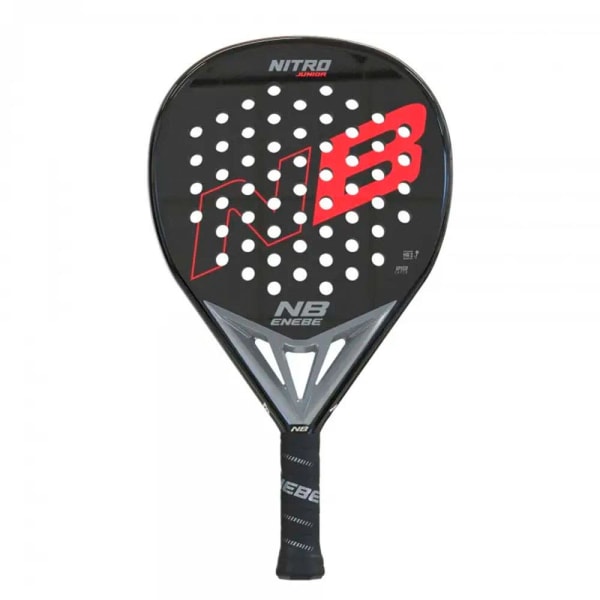
Enebe Nitro Red Junior 2024
✓Cross-checked with official data from Enebehow we score
PADELTESTLAB SCORE
0-100 scale
79/100
Description
Who this racket is for
Pros
- ✓That 320-340 g range with even balance lets a junior whip the racket through fast volleys and wall exits without leaning on the shoulder to compensate — which is exactly where discomfort tends to build up at that age The round shape and its wide sweet spot forgive off-centre contact: balls caught near the throat or close to the frame still come off with usable direction The Black EVA HR2 soft-density core practically returns the ball for you on defensive lobs and bandejas, which matters when a young player's arm still can't generate its own racket speed Fibreglass on both face and frame soaks up vibration on mishits and gives a soft, predictable feel when cutting under a bandeja The 38 mm frame plus Speed Layer tech keeps the racket stable when blocking volleys, without adding weight or stiffening the response
Cons
- ✗The power ceiling is low: once a player starts snapping the wrist for a remate por 3 or a vibora, this racket runs out of road and needs replacing The smooth face and fibreglass surface offer little bite on the ball, so cut or lift barely shows up in the ball's trajectory The low overall stiffness means the racket flexes on fast balls to the body, costing a bit of directional precision It's a short-lived racket in the bigger picture: great for the learning phase, but it won't keep pace once a player pushes past that first real progression
PADELTESTLAB SCORE
0-100 scale
79/100
Out of stock right now
None of the shops we track has it in stock right now. We last saw it on August 2 at €41.80.
See similar rackets in stockEnebe Nitro Red Junior 2024 review: a 320-340 g padel racket built to save young arms
The Enebe Nitro Red Junior 2024 weighs in at 320-340 grams, pairs a fibreglass face and frame with a Black EVA HR2 core, and rounds it all off with a 38 mm round profile. None of that is accidental — it's the most sensible technical package for a young player who's still building technique and shouldn't be lugging an adult-sized racket weight around the court.
The black finish with red accents places it in the Nitro range, but the interesting stuff is under the paint.
Why weight matters more than any other spec on a junior padel racket
A kid playing with an adult racket doesn't play worse because of poor technique — they play worse because they simply can't get there in time. The Enebe Nitro Red Junior sits at 320-340 g specifically so the player can complete the full swing, get the racket up in time for a volley, and come off the wall cleanly instead of dragging dead weight.
That has a direct payoff for arm health. Less mass means less accumulated fatigue over the course of a match and less strain on the elbow and shoulder — exactly where problems show up when a junior plays with oversized gear.
The even balance rounds out the package. With no extra mass pushed toward the head, the racket whips through the air quickly at net and doesn't force the player to compensate with the torso on reaction volleys.
Fibreglass and Black EVA HR2: what it actually feels like on contact
Pair a fibreglass face with a soft-density Black EVA HR2 core and you get a heavily cushioned feel. The ball sinks into the face, dwells for a beat, and comes off with a generous ball exit that does most of the work for the player.
That's exactly what someone who can't yet generate their own arm speed needs. On a defensive lob from the back of the court, the racket sends the ball deep without demanding a perfect strike. On a bandeja, the soft touch lets you guide the ball rather than having to muscle it.
The 38 mm frame and Speed Layer technology supply the stability that fibreglass alone wouldn't provide. Blocking volleys, the face doesn't buckle under fast incoming balls, and the racket holds its line without leaning on stiffer materials that would harden the feel.
| Spec | Value |
|---|---|
| Shape | Round |
| Weight | 320-340 g |
| Balance | Even |
| Face | Fibreglass |
| Core | Black EVA HR2 (EVA Soft) |
| Frame | 38 mm |
| Surface | Smooth |
| Technology | Speed Layer |
| Level | Beginner |
| Playstyle | Control |
The sweet spot: the spec that decides whether a kid keeps playing
The round shape puts the sweet spot dead centre on the face and makes it unusually wide. In practice, a shot struck two or three centimetres off-centre still comes off with usable pace and direction.
That matters more than it sounds. A beginner mishits the majority of their shots, and a racket with a narrow sweet spot turns every off-centre strike into a dead ball. Not here — the response stays reasonably consistent across almost the whole face, which keeps confidence intact during the learning curve.
It's the same reason it performs well on wall exits, where a junior player often arrives late and makes contact with the racket poorly positioned.
Where does this padel racket fall short?
Let's be upfront about the ceiling. This Enebe model is a control racket with contained power, and that becomes obvious the moment a player starts wanting more.
- **Smash**: the soft core absorbs energy instead of returning it. A remate por 3 or a vibora looking for pace won't get the crisp response those shots demand.
- **Spin**: the smooth surface and fibreglass face grip the ball poorly. Cut on the bandeja or lift on the lob barely translates into real trajectory change.
- **Fast balls to the body**: the racket's low stiffness lets the face flex, costing a bit of directional precision.
None of these are manufacturing flaws — they're the logical trade-off of a design built to prioritise lightness, forgiveness and joint protection over outright performance.
Player profile: who should buy it, and who shouldn't
This model is aimed at junior players in their early steps, with limited technical range and not yet able to generate their own power. For that profile, the 320-340 g weight and the round shape's forgiveness are strong selling points.
I wouldn't recommend it for a junior already competing at some level, closing out points with a smash and looking for spin. That player has outgrown the racket and needs a denser core and a face with more bite.
As for doubles pairings, it works well alongside another beginner: neither player is going to win points on raw pace, so the game gets built from the back with lobs and wall exits — precisely the terrain where this racket shines.
Verdict: it does its job, and doesn't pretend to do more
The Enebe Nitro Red Junior 2024 does the one thing it needs to do well: let a kid play a full match with balance, stability, and without punishing the arm. The soft feel of the Black EVA HR2, the wide sweet spot and the 38 mm frame add up to a coherent package for that stage.
In exchange, you have to accept it's short-lived gear. The day a player starts hitting the ball for real, they'll have outgrown this racket — and that's a sign of progress, not a flaw in the product.
In the brand's lineup
Within Enebe's lineup, the Nitro Red Junior positions itself as a distinctive alternative. At 79/100, it serves its purpose, though there are stronger alternatives on the market.
Frequently asked questions
Who is the Enebe Nitro Red Junior 2024 for?
The Enebe Nitro Red Junior 2024 is built for beginner level: easy to handle and forgiving. Not the ideal pick if you already have consolidated technique.
How much does the Enebe Nitro Red Junior 2024 weigh?
The Enebe Nitro Red Junior 2024 weighs 320-340g according to the manufacturer's stated specs.
What's the Enebe Nitro Red Junior 2024's PadelTestLab score?
The Enebe Nitro Red Junior 2024 scores 79/100 in our review, based on power, hardness, control, maneuverability, ball exit, sweet spot and surface roughness.
Similar alternatives
Other rackets with a similar profile and price range: