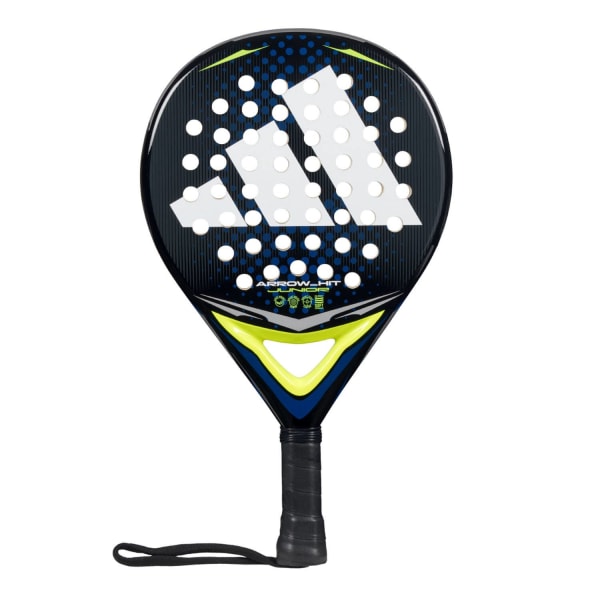
Adidas Arrow Hit White/Blue Junior 2026
✓Cross-checked with official data from Adidashow we score
PADELTESTLAB SCORE
0-100 scale
79/100
Price range
Description
Who this racket is for
Pros
- ✓The Soft Performance EVA core practically returns the ball on its own from dead wall exits, the shot that trips up most players in development who haven't yet built arm speed At 310-330 grams with a medium balance, you can repeat the bandeja all match long without the shoulder dropping or the swing shortening from fatigue The round shape concentrates the sweet spot at the geometric center and forgives off-center hits, which make up most contacts while bounce reading is still a work in progress The Exoskeleton, with reinforcements built into both frame and core, keeps the structure solid despite the low weight: the racket doesn't twist when blocking a volley off a passed ball The fiberglass face filters vibration on off-center impacts, which matters for wrists and elbows that are still growing
Cons
- ✗On a flat smash it lacks mass behind the shot: the ball comes out with little pace and tends to stay in court after the bounce, rarely clearing the back fence A smooth finish with holes as the only spin aid: the cut vibora and kick serve lose bite compared to rough-textured faces, and the bounce doesn't kick up as much The 36mm frame with a soft core cushions so much that it's hard to feel a crisp impact; players who already hit hard will find the racket short and soft at mid-court The 310 to 330 gram range is wide for a junior line: a lighter kid may find the top end of that range heavy when repeating the bandeja
PADELTESTLAB SCORE
0-100 scale
79/100
It is at its lowest price since we started tracking it: €59.95, down from €75.00. We began recording on March 20.
Prices collected on 98 days between March 20 and October 15
The Adidas Arrow Hit White/Blue Junior 2026 is a round-shaped padel racket weighing 310 to 330 grams, with a fiberglass face, 36mm frame, Soft Performance EVA core and Exoskeleton reinforcement. Everything on its spec sheet points to one goal: getting the ball out.
There isn't a single design decision aimed at punishing power. Medium balance, smooth surface, soft rubber and a contained profile add up to a padel racket built to support learning, not to reward someone who already hits hard.
What does this racket solve that an adult racket doesn't?
It cuts weight to 310-330g and spreads the mass into a medium balance, so a developing arm can complete the swing without compensating with the shoulder. The round shape shifts the sweet spot toward the geometric center and forgives off-center hits, which are the majority while bounce reading is still developing.
| Spec | Value |
|---|---|
| Shape | Round |
| Weight | 310-330 g |
| Balance | Medium |
| Face | Fiberglass |
| Core | Soft Performance EVA |
| Frame | 36 mm |
| Surface | Smooth |
| Level | Beginner |
| Playstyle | Control |
| Technologies | Exoskeleton, Structural Reinforcement, Smart Holes Curve |
Exoskeleton and Soft Performance EVA: stiffness without the grams
The classic problem with a light racket is that it twists. When the frame flexes on impact, some of the energy gets lost in the deformation and the ball comes off the strings misdirected, especially on block volleys against a passed ball.
The Exoskeleton tackles that directly: it builds structural reinforcements into both frame and core to raise overall stiffness without piling on weight. The Structural Reinforcement rounds out the idea by bracing the zones that take the most stress when the shot lands off-center.
The Soft Performance EVA is the counterweight. It's a soft rubber with wide deformation and slow rebound, one that compresses at low arm speed and sends the ball back without demanding a perfect strike. That plush feel is exactly what makes this model playable for a beginner.
The fiberglass face rounds out the package: it flexes more than a rigid weave, filters vibration on off-center hits, and avoids the sharp rebound that punishes wrists and elbows that are still growing.
Shot by shot: where it delivers and where it falls short
Wall exit. This is its best shot. The ball arrives dead, the soft rubber compresses and gives energy back, and all it takes is following through to pull it out of the corner. No need to accelerate.
Volley. The low weight and medium balance let you reach crosscourt balls a heavier racket wouldn't get to. The firm frame keeps the face from twisting on the block.
Bandeja. You can repeat it all match without the swing shortening. The smooth finish calls for a clean cut: open the hitting plane too much and the ball runs long because the spin doesn't hold it back.
Smash and vibora. This is where it falls short. There's not enough mass behind the impact to generate pace, and the kick never clears the back fence. The flat smash stays in court after the bounce and hands the point back to the opponent.
Lob and defense. Easy to lift and handle even late, which is exactly when a developing player tends to get there.
Smart Holes Curve: teaching spin
The Smart Holes Curve arranges the hole pattern to favor spin generation across shot types. It's a geometric trick, not a surface one.
Worth understanding the difference. With a smooth face, spin comes from the angle of attack and how air behaves through the perforations, not from surface friction. The result is moderate spin, enough for a kid to feel the difference between hitting flat and hitting with cut, but nowhere near what a rough-textured surface produces.
As a teaching tool, it works: it rewards the correct technique without requiring power to make the spin show up.
Who is this Adidas racket for?
It suits junior players who already sustain rallies and are still grooving their baseline technique, as well as complete beginners who need a racket that won't punish every off-center mishit.
- Developing players whose arm is still building strength.
- Baseline rallying, patience and the lob before finishing power.
- Frequent off-center contact that needs cushioning.
- Clean technique prioritized over ball speed.
It's not a fit for a player who's already smashing with intent to put the ball away. That player will feel the soft frame and lack of mass within a month.
Verdict
The Arrow Hit White/Blue Junior 2026 delivers exactly what it promises: forgiveness, handling and ball exit in a 310-330 gram package that a young arm can control. The Exoskeleton keeps the light weight from turning into a structurally soft racket, and the soft core compensates for the arm speed a beginner doesn't have yet.
The trade-off comes at the ceiling. Once a player starts hunting the vibora with real intent and smashing to close out points, this racket will hold them back: it lacks bite on the surface and mass on impact. This is a stage-of-development padel racket, and it's worth buying it with that in mind.
In the brand's lineup
Within Adidas's lineup, the Arrow Hit White/Blue Junior is one of the most accessible options starting at €59.95, perfect for getting started without a heavy outlay. At 79/100, it serves its purpose, though there are stronger alternatives on the market.
Frequently asked questions
Who is the Adidas Arrow Hit White/Blue Junior 2026 for?
The Adidas Arrow Hit White/Blue Junior 2026 is built for beginner level: easy to handle and forgiving. Not the ideal pick if you already have consolidated technique.
How much does the Adidas Arrow Hit White/Blue Junior 2026 weigh?
The Adidas Arrow Hit White/Blue Junior 2026 weighs 310-330g according to the manufacturer's stated specs.
What's the Adidas Arrow Hit White/Blue Junior 2026's PadelTestLab score?
The Adidas Arrow Hit White/Blue Junior 2026 scores 79/100 in our review, based on power, hardness, control, maneuverability, ball exit, sweet spot and surface roughness.
How much does the Adidas Arrow Hit White/Blue Junior 2026 cost?
Current price of the Adidas Arrow Hit White/Blue Junior 2026 is 59.95€, comparing 2 shops in our finder.
Similar alternatives
Other rackets with a similar profile and price range: