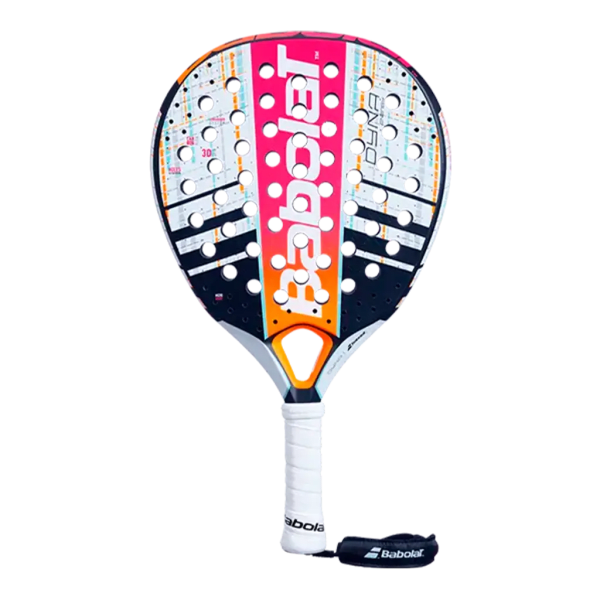
Babolat Dyna Energy
✓Cross-checked with official data from Babolathow we score
PADELTESTLAB SCORE
0-100 scale
82/100
Price range
Description
Who this racket is for
Pros
- ✓That 36 mm frame and sub-320 g starting weight let you punch a low volley on the wrong foot and string two net touches together without your arm ever getting left behind The 3D SPIN surface with its microperforations really bites into the ball: sliced bandejas and backspin dejadas grab the bounce without needing extra arm speed Carbon Flex, by pairing carbon with fibreglass, gives back a genuinely generous ball exit: a defensive lob from the back of the court reaches the opposite baseline without straining the shoulder The teardrop shape with medium balance puts the sweet spot right in the upper-centre of the face, so a flat smash doesn't demand surgeon-level precision to keep its pace
Cons
- ✗At 320-340 g with a medium-to-high density EVA core, a clean baseline smash needs your own arm behind it — this padel racket won't supply the mass a genuinely heavy racket would The 36 mm frame trims lateral stiffness, and on balls arriving tight off the back wall right near the edge, the response goes soft and imprecise This teardrop with medium balance isn't a pure blocking racket: if your game is grinding from the back and waiting for the error, you'll feel it's short on wall compared to a true round shape The pronounced texture of 3D SPIN chews through balls fast: play with balls that already have some miles on them and the spin you gain on court you'll pay for in material durability
PADELTESTLAB SCORE
0-100 scale
82/100
It is at its lowest price since we started tracking it: €144.50, down from €172.95. We began recording on May 20.
Prices collected on 91 days between May 20 and October 15
Babolat Dyna Energy Review: A 36 mm Frame Built for Speed at 320 g
The Babolat Dyna Energy sits among the lightest rackets the French brand has ever built: 320-340 g, a frame of just 36 mm, a teardrop shape with medium balance, and a Carbon Flex face blending carbon with fibreglass. The core is a moderate-density EVA, and the surface carries the textured 3D SPIN pattern with microperforations. Every design call points the same direction: cut weight without losing ball feel.
Who is the Dyna Energy actually built for?
Babolat pitches this at fast, dynamic players who close out points at the net, and the spec sheet backs that up. At 320 g in its lightest build and a 36 mm frame — against a market standard closer to 38 mm — this padel racket moves before you've even finished deciding.
That matters for one shot in particular: the blocked volley in a fast exchange, when your opponent fires at your feet and you need to get the face up and reset in under a second. The Dyna Energy never makes you slow your swing down for that.
The skill level here is beginner-to-intermediate. It won't punish an off-centre hit, but it's not chasing the title of a category-three basher's weapon either.
Carbon Flex: why fibreglass isn't a quality cutback
| Spec | Value |
|---|---|
| Shape | Teardrop |
| Weight | 320-340 g |
| Balance | Medium |
| Face | Carbon + fibreglass (Carbon Flex) |
| Core | EVA |
| Frame | 36 mm |
| Surface | Textured with 3D relief |
| Technologies | Carbon Flex, MICROPERF, 3D SPIN, SMART BUTTCAP |
There's a lazy read floating around that says carbon equals quality and fibreglass equals corner-cutting. On the Dyna Energy, the blend is deliberate.
Carbon supplies the stiffness that keeps the face from caving on impact; fibreglass adds elasticity, and that elasticity is what gives the ball back on shots where you haven't put in the energy yourself. A blocked return off a deep serve and an emergency lob from the corner are the two moments where it shows: the ball travels further than what your arm actually put into it.
MICROPERF pulls in the same direction through the air. The perforations cut swing resistance, and paired with the narrow frame, they're a big part of why this Babolat racket sets up so quickly on the bandeja.
How 3D SPIN changes what you can do with the bandeja
The textured surface with its three-dimensional relief isn't just for show. At the point of contact, the extra grip holds the ball against the face for a few extra milliseconds, and that's where the amount of spin you generate gets decided.
In practice, that translates into three shots that come out better than the racket's weight would suggest:
- **Sliced bandeja:** backspin comes from the wrist, not from muscle, and the ball dies short after the bounce.
- **Vibora:** the side-spin cut finds bite even when contact isn't perfectly centred.
- **Dejada:** the grip lets you kill the ball's pace against the glass without it running long.
What you gain in traction, you pay for in ball wear. A surface with this much texture chews through felt fast; play three straight hours with the same ball and you'll notice it.
Where does the Babolat Dyna Energy fall short?
Straight answer: it's short on mass for the flat smash. Topping out at 340 g, the racket doesn't bring its own inertia to a flat smash down the line or a kick serve hunting glass exit. If closing out points means hitting hard from the back, this isn't your tool — the shot lands fine, but it's rarely a finisher.
There's a second honest trade-off. The 36 mm frame is narrow, and that narrowness costs structural stiffness on impacts near the edge. When a ball comes off the side wall tight and you catch it on the top rim of the face, the response turns mushy and direction goes with it.
And a third. The medium-balance teardrop chases a compromise between handling and ball exit, but it's no defensive wall. Deep in the court, against an opponent who punishes from above, you'll miss the passive blocking of a rounder shape with more weight toward the grip.
How it plays on court, and who to pair it with
The SMART BUTTCAP on the handle rounds out the package, but what matters is how the racket actually behaves in a real match.
The Dyna Energy demands an active net game: get up, apply pressure, finish high with a placed volley or vibora rather than a power smash. It shines in the quick right-side position stealing centre balls, and equally for a backhand player who needs sharp reflexes on the low volley.
As a doubles partner, it pairs well with someone who brings the heavy smash this racket doesn't. Two Dyna Energys on the same court build a game of precision and speed, but they'll struggle to close out points against opponents who defend well from the back.
Verdict
The Dyna Energy is consistent with its own brief. Babolat set out to build a light racket and actually made one — 36 mm frame, 320 g starting weight, MICROPERF to lighten the swing — instead of selling you "lightness" while handing you the usual weight.
If your on-court problem is arriving late to the volley or fading by the third set, this padel racket fixes both. If your problem is not finishing points at the net, the Dyna Energy won't solve that for you — the power has to come from you.
Generous ball exit, excellent maneuverability, more spin than you'd expect for its segment. In exchange, not much of a wall and not much smash punch. A fair trade-off for the level it's aimed at.
In the brand's lineup
Within babolat's lineup, the dyna energy occupies the mid-range starting at €144.5, offering highly competitive value for its segment. Its overall score of 82/100 places it among the best all-round rackets we've reviewed.
Frequently asked questions
Who is the Babolat Dyna Energy for?
The Babolat Dyna Energy is a versatile racket that fits across several playing levels.
How much does the Babolat Dyna Energy weigh?
The Babolat Dyna Energy weighs 320-340g according to the manufacturer's stated specs.
What's the Babolat Dyna Energy's PadelTestLab score?
The Babolat Dyna Energy scores 82/100 in our review, based on power, hardness, control, maneuverability, ball exit, sweet spot and surface roughness.
How much does the Babolat Dyna Energy cost?
Current price of the Babolat Dyna Energy is 144.5€ – 169.95€, comparing 2 shops in our finder.
Similar alternatives
Other rackets with a similar profile and price range: