Adidas Match Light 3.2
✓Cross-checked with official data from Adidashow we score
PADELTESTLAB SCORE
0-100 scale
77/100
Description
Who this racket is for
Pros
- ✓The fibreglass face flexes on contact and produces sky-high ball exit: defensive blocks that die in the net with a stiff racket sail right through to the back wall here The medium-density Soft Performance EVA core cushions every strike without feeling like dead rubber — a real plus if your elbow's been nagging you two hours into a match At 345-360 g and 45.5 cm, the racket gets to fast volleys at net in time and forgives a rushed grip adjustment off the back wall The head-heavy balance loads extra mass up top and gifts you a bit of pop on the deep lob and the flat smash, unusual for such a light beginner racket The generous sweet spot of the teardrop shape with 38 mm frame keeps the ball in play even on off-centre hits toward the upper edge
Cons
- ✗The smooth surface gives little bite on the ball: sliced bandejas and víboras with spin come out flatter and with less grip than you'd expect The head-heavy balance forces earlier preparation on defence; on a low ball hugging the glass, hesitate and the racket lags behind you The pairing of a flexible face and medium-density foam caps the power ceiling: once you're generating real arm speed, the remate por 3 loses ball velocity Fine touch on the dropshot and net attack aimed at the opponent's feet is solid, but demands more precision than a carbon racket with a denser core
PADELTESTLAB SCORE
0-100 scale
77/100
Out of stock right now
None of the shops we track has it in stock right now. We last saw it on August 2 at €43.90.
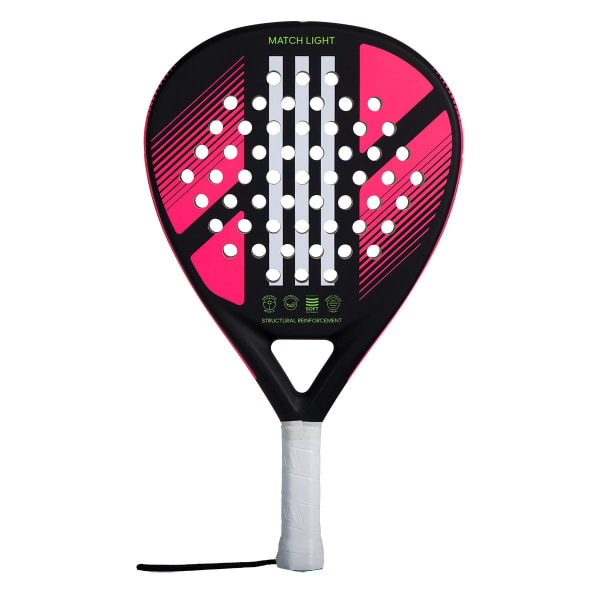
See similar rackets in stockThe Adidas Match Light 3.2 (2023) solves the classic beginner's dilemma: fibreglass face, 345-360 g, 38 mm frame and Smart Holes Lineal perforation for a padel racket that returns the ball without asking for technique in exchange. It's a pure entry-level model, launched in the 2023 season in a pink-and-lime colourway aimed at women players, though its on-court behaviour suits anyone with just a few months of padel under their belt.
Fibreglass and Soft Performance EVA: where all that ball exit comes from
Fibreglass flexes far more than a carbon weave. That flex does the heavy lifting when you don't yet generate your own arm speed: the face stores the impact energy and gives it straight back.
The medium-density Soft Performance EVA core backs up that effect without tipping into spongy foam that swallows the ball and kills direction. It absorbs the shock and keeps the response predictable shot after shot.
The result is this racket's standout trait: the ball exits almost on its own. Block a mid-height defensive shot and it lands deep off a short, compact swing — where a stiffer racket would fall short.
Who is the Adidas Match Light 3.2 actually for?
This is a beginner-level racket: players in their first months on court who need the frame to make up for technique they haven't built yet. Its flexible face, 345-360 g weight and the wide sweet spot of the teardrop shape let you sustain long rallies without punishing your arm or forcing dead-centre contact every time.
It's not a stepping-stone racket toward intermediate-advanced play. Once your arm starts generating real racket-head speed and you're chasing bite on the víbora, you'll hit its ceiling sooner than you'd like.
Tech specs
| Spec | Value |
|---|---|
| Shape | Teardrop |
| Weight | 345-360 g |
| Balance | Head-heavy |
| Face | Fibreglass |
| Core | EVA Medium (Soft Performance EVA) |
| Frame | 38 mm |
| Surface | Smooth |
| Length | 45.5 cm |
| Technologies | Smart Holes Lineal, structural reinforcement |
| Level | Beginner |
Head-heavy balance on a 345 g racket: the least obvious call in this design
The usual move for entry-level rackets is to lower the balance for easier handling. Here Adidas shifts extra mass toward the head, chasing added punch on high attacking shots.
It's a smart trade-off. Because the overall weight is so low, that head-heavy balance never turns this into a leaden racket: it adds inertia on the flat smash and the deep defensive lob, while the wrist still calls the shots at net.
The catch shows up in defence. On low balls hugging the glass, the extra mass up top means you're late to the ball if you don't set up early — the prep has to start sooner than with a head-light racket.
Shot by shot: where it forgives and where it falls short
- **Wall exit:** the racket's strongest suit. The fibreglass flex and the wide sweet spot bail out off-centre contact that would send a carbon racket straight to the frame.
- **Volley:** quick to handle thanks to the contained weight and the 45.5 cm length. Blocks the opponent's deep drives well.
- **Bandeja:** comfortable to execute, but the smooth surface costs you grip. The slice comes out flatter and the ball bounces higher than you'd like.
- **Víbora:** the shot that most exposes the lack of surface roughness and stiffness. It's there, but without the lateral bite a textured face gives you.
- **Remate por 3 (smash off the back wall):** the head-heavy balance helps the ball come out with weight behind it; the speed ceiling is set by the flexible face, not your arm.
Smart Holes Lineal and the 38 mm frame: what they actually do
The Smart Holes Lineal perforation lines the holes up in a linear pattern, which evens out the face's response in the central zone and avoids dead spots near the sweet spot.
The 38 mm frame, paired with structural reinforcement, keeps enough rim rigidity that the flex works in the centre rather than at the edges. That's what stops such a flexible racket from feeling soft when you connect high up on the face.
Player profile and ideal doubles partner
This racket suits someone playing one or two matches a week, who values keeping the rally alive over closing points fast, and wants a frame that won't beat up their arm. The power-versus-control balance is real, but modest at both ends.
As a doubles pair, it works well alongside a partner with more firepower who takes on the finishing smash, while this racket handles defence, the lob and building points from the back of the court.
Verdict: a big helping hand early on, with a clear ceiling later
The Adidas Match Light 3.2 delivers exactly what its name promises: light in hand, comfortable feel, and ball exit strong enough to keep points alive that you technically shouldn't be winning yet.
The honest caveat is the ceiling. The smooth surface and fibreglass face leave it short on spin and top-end power, so the jump to a carbon racket with denser foam will come sooner than you'd think if you improve quickly. As a first racket to learn the game without wrecking your elbow, the trade-off is well worth it.
In the brand's lineup
Within Adidas's lineup, the Match Light 3.2 positions itself as a distinctive alternative. At 77/100, it serves its purpose, though there are stronger alternatives on the market.
Frequently asked questions
Who is the Adidas Match Light 3.2 for?
The Adidas Match Light 3.2 is built for beginner level: easy to handle and forgiving. Not the ideal pick if you already have consolidated technique.
How much does the Adidas Match Light 3.2 weigh?
The Adidas Match Light 3.2 weighs 345-360g according to the manufacturer's stated specs.
What's the Adidas Match Light 3.2's PadelTestLab score?
The Adidas Match Light 3.2 scores 77/100 in our review, based on power, hardness, control, maneuverability, ball exit, sweet spot and surface roughness.
Similar alternatives
Other rackets with a similar profile and price range: