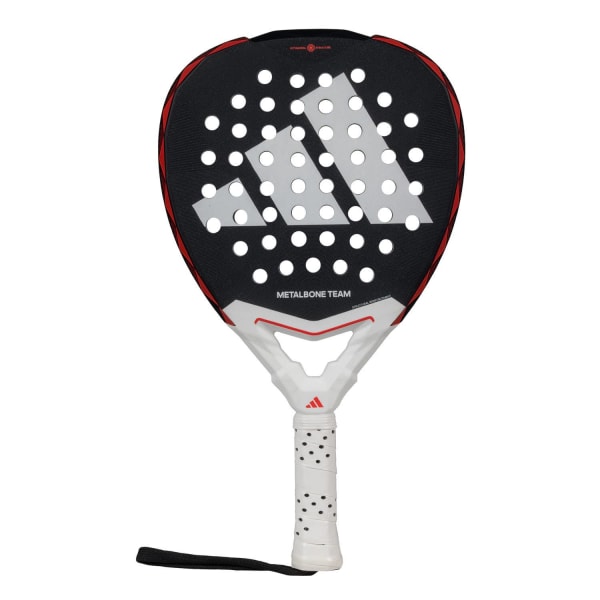
Adidas Metalbone Team 3.4 2025
✓Cross-checked with official data from Adidashow we score
PADELTESTLAB SCORE
0-100 scale
77/100
Price range
Description
Who this racket is for
Pros
- ✓Fiberglass faces over the Soft Performance EVA core send the ball flying: defensive lobs land deep and even a rushed deep volley clears the net without forcing the swing The 38mm frame with Octagonal Structure shrugs off flat smashes and viboras without that mushy give you'd expect from a soft-touch diamond The gritty Spin Blade Gritt surface bites into the ball on cut bandejas and kick serves, where spin is what keeps the ball inside the lines The 485 cm² hitting surface takes the edge off the usual diamond-shape punishment: the sweet spot isn't as forgiving as a round racket's, but off-center hits still get a pass At 360-370g with a head-heavy balance, that mass works in your favor on the smash by 3 and the three-meter exit: time your swing right and your arm barely has to accelerate
Cons
- ✗The head-heavy balance and so-so maneuverability demand early prep: on fast balls at your feet or when returning a spin serve, you'll find the racket lagging behind Control is the weak link: drop shots and short balls come out with more depth than you're after, since ball exit doesn't switch off easily Fiberglass sends less feedback to your arm than a stiff face, making it harder to pinpoint contact on blocked volleys against heavy pace This is a 2025-season model already discontinued and replaced by the 2026 Metalbone line, so finding your exact preferred weight depends on remaining stock
PADELTESTLAB SCORE
0-100 scale
77/100
It is at its lowest price since we started tracking it: €129.95, down from €139.95. We began recording on May 9.
Prices collected on 29 days between May 9 and October 15
Adidas Metalbone Team 3.4 2025: 360-370 grams, diamond shape, 38mm frame and fiberglass faces over a Soft Performance EVA core. That spec sheet already tells the story — mass up top for power, a flexible surface so your arm doesn't foot the bill.
It's the "Team" read on the Metalbone family: an offensive profile, but with a touch that doesn't demand a polished smash technique to get results.
Fiberglass and Soft Performance EVA: where all that ball exit comes from
Fiberglass flexes more than any stiff face, and that flex translates into a trampoline effect. Paired with a Soft EVA core, the result is a padel racket that gives you tons of pop on its own.
You notice it first on defense: the lob from the back of the court reaches the opposite fence without needing a full-blooded finish, and the mid-height wall ball you send doesn't die at mid-court. Deep volleys also get extra yards for free.
The trade-off is in the feedback reaching your arm. Contact feels cushioned, pleasant, but less defined than a stiff face, and that costs you on short balls: drop shots tend to run a meter longer than intended.
Octagonal Structure, Low Poly and Power Extra Grip: the stiff side of a soft racket
The frame's three technologies all exist to fix the same risk: a flexible face over soft rubber feeling out of control when you swing hard.
- **Octagonal Structure**: an octagonal tubular structure that spreads tension along the 38mm profile and keeps the head steady through full smash impact.
- **Low Poly**: adds localized stiffness to counter the fiberglass's excess flex, stopping the ball from sinking too deep into the face.
- **Power Extra Grip**: adds inertia to your swing — exactly what you want when smashing by 3, not so much when blocking at the net.
- **Spin Blade Gritt**: a gritty finish built to grab the ball on spin shots.
That roughness is what holds up the cut bandeja and the kick effect. With ball exit running this high, spin isn't a nice-to-have — it's the brake that keeps the ball in play.
What level of player is the Adidas Metalbone Team 3.4 2025 built for?
It's built for the advanced player, or the intermediate on an offensive upswing, who already commits to the net and wants a diamond that doesn't demand generating all the pace with the arm. The soft touch and generous ball exit smooth out the usual diamond-shape learning curve.
This isn't a beginner's racket: 360-370g with a head-heavy balance punishes anyone late to the ball.
Metalbone Team 3.4 tech specs
| Spec | Value |
|---|---|
| Shape | Diamond |
| Level | Advanced |
| Play style | Power |
| Balance | Head-heavy |
| Weight | 360-370 g |
| Face | Fiberglass |
| Core | Soft Performance EVA (EVA Soft) |
| Frame | 38 mm |
| Hitting surface | 485 cm² |
| Surface | Gritty (Spin Blade Gritt) |
| Technologies | Octagonal Structure, Low Poly, Power Extra Grip, Spin Blade Gritt |
Shot by shot: where it gains ground and where the weight costs you
Flat smash and smash by 3. This is where the shape earns its keep. Mass concentrated in the head drives through the high ball on its own, and the 38mm frame holds firm on impact with no twisting in the head.
Bandeja and vibora. The bandeja wants a long follow-through: with weight up top, a short stroke costs you. The vibora, on the other hand, benefits from the gritty finish and the head-heavy inertia.
Wall exit. This is the racket's unexpected strong suit. The combination of soft rubber and a flexible face pulls the ball off the back wall deep even when contact isn't clean.
Volley and block. Control is solid, not standout. Attacking volleys work fine; blocking against heavy pace demands a firm wrist, since the ball tends to come out longer than planned.
Low defense. The 485 cm² helps, but so-so maneuverability forces earlier prep. Against an opponent who plays fast at your feet, you'll feel the head weight.
Which player and pairing get the most out of it?
The ideal fit is a backhand smasher: a player who takes responsibility for finishing points up top, with the fitness to move 360-370g across three sets, and who values joint comfort over pure feedback.
As a pairing, it works well alongside a more controlling partner on a round racket who can sustain long rallies while this head is saved for closing out points.
Anyone chasing surgical precision on drop shots and short balls will find the bar too high: sky-high ball exit works directly against that style.
Verdict: accessible power with a defensive trade-off
The Adidas Metalbone Team 3.4 2025 solves the problem that usually plagues high-end diamond rackets: hitting hard without wrecking your elbow. The fiberglass and Soft Performance EVA core buy comfort and extra yards, and the frame's four technologies stop that comfort from tipping into a lack of structure.
In exchange, you give up fine control and agility. If your game lives on short balls and quick reactions at the net, there are more balanced options out there.
One last practical note: since this is a discontinued 2025 model succeeded by the 2026 Metalbone line, your choice of weight within the 360-370g range will come down to whatever stock remains.
In the brand's lineup
Within Adidas's lineup, the Metalbone Team 3.4 occupies the mid-range starting at €129.95, offering highly competitive value for its segment. At 77/100, it serves its purpose, though there are stronger alternatives on the market.
Frequently asked questions
Who is the Adidas Metalbone Team 3.4 2025 for?
The Adidas Metalbone Team 3.4 2025 targets advanced players. It needs consolidated technique and is not recommended for beginners.
How much does the Adidas Metalbone Team 3.4 2025 weigh?
The Adidas Metalbone Team 3.4 2025 weighs 360-370g according to the manufacturer's stated specs.
What's the Adidas Metalbone Team 3.4 2025's PadelTestLab score?
The Adidas Metalbone Team 3.4 2025 scores 77/100 in our review, based on power, hardness, control, maneuverability, ball exit, sweet spot and surface roughness.
How much does the Adidas Metalbone Team 3.4 2025 cost?
Current price of the Adidas Metalbone Team 3.4 2025 is 129.95€, comparing 1 shop in our finder.
Similar alternatives
Other rackets with a similar profile and price range: