Adidas Match Black 3.4 2025
✓Cross-checked with official data from Adidashow we score
PADELTESTLAB SCORE
0-100 scale
77/100
Description
Who this racket is for
Pros
- ✓The fibreglass face and Soft Performance EVA core combine to send the ball back almost by themselves: on low wall exits and volley blocks you don't need to speed up your arm to clear the net with depth The 38 mm frame widens the sweet spot, so shots that drift toward the throat still come out with direction — a real difference-maker while you're still dialing in your timing in those early months on court The teardrop shape and mid-high balance add weight to your bandeja and flat smash without turning this into a hammer, so you can attack from the net without giving up your baseline defence The Structural Reinforcement beefs up the frame exactly where glass and floor contact take their toll, and at beginner level that happens far more often than players realise It performs evenly off the back wall, at net and in the air game, so it never forces you into one style of play while you're still figuring out what suits you
Cons
- ✗The soft EVA and fibreglass face put a ceiling on power: with a fast swing the ball leaves before it fully compresses, so the smash por 3 loses that crisp, dry pop The mid-high balance demands early preparation on viboras and glass-hugging balls; get there late with your racket head and it feels heavy, leaving the shot short The smooth surface caps spin: slice and kick shots come out flatter than with a rough face, and the cut bandeja is missing that extra bite on the ball At the top end of the weight range, 375 g through a long session of overhead play can start to nag at an undertrained wrist during repeated bandejas
PADELTESTLAB SCORE
0-100 scale
77/100
Out of stock right now
None of the shops we track has it in stock right now. We last saw it on October 14 at €44.95.
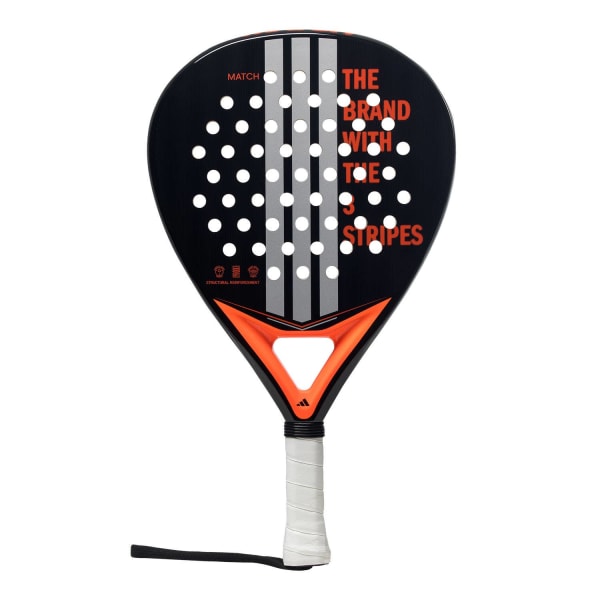
See similar rackets in stockFibreglass face, 360-375 g and a 38 mm frame: the Adidas Match Black 3.4 2025 builds its whole pitch around getting the ball off the strings without the player having to force anything. Teardrop shape, mid-high balance, Soft Performance EVA core and Smart Holes Lineal perforation for a pain-free entry into the game.
This isn't a racket that pretends to be for everyone. It's built for the beginner who doesn't yet strike the sweet spot every time and needs the racket to make up for that lack of precision.
Why fibreglass defines the feel of this teardrop racket
A fibreglass face flexes more than a rigid surface. That means the ball stays on the strings a few milliseconds longer, and that extra dwell time is exactly what a player without much arm speed needs: the material does the work for you.
The Soft Performance EVA core pulls in the same direction. It's a soft foam that compresses easily and returns the ball with a clean push rather than the sharp kick of a harder core. On court that translates into two concrete things: less vibration on off-centre hits and very generous ball exit when you're not quite in position.
The Smart Holes Lineal layout arranges the face's perforations in lines rather than scattering them randomly. That pattern shapes how the hitting surface flexes and spreads mass more evenly around the impact zone.
And the Structural Reinforcement strengthens the frame. In a beginner's hands, a racket takes far more knocks against the glass and the floor than it would with an advanced player, so that reinforcement is a practical call, not a marketing line.
Adidas Match Black 3.4 2025 specs
| Spec | Value |
|---|---|
| Shape | Teardrop |
| Weight | 360-375 g |
| Balance | Mid-high |
| Face | Fibreglass |
| Core | Soft Performance EVA |
| Frame | 38 mm |
| Surface | Smooth |
| Technologies | Structural Reinforcement, Smart Holes Lineal |
| Recommended level | Beginner |
| Playing style | All-round |
What level of player is the Adidas Match Black 3.4 2025 for?
It's built for the beginner who plays once or twice a week and is still grooving their strokes. The soft core and 38 mm frame forgive off-centre contact, and the 360-375 g weight is light enough to handle without straining the elbow. This isn't a competition padel racket.
Shot by shot: where it delivers and where it falls short
Off the back wall is where it earns its keep most. The wall exit — the shot most beginners struggle with early on — comes back deep even when you're off balance. The racket does the pushing, and the lob reaches the back of the court without much extra effort from you.
At the net, the medium-soft feel cushions fast balls nicely. Blocking volleys works fine; sharply angled or cut volleys ask for more precision than this model offers, since the smooth surface skids off the ball rather than gripping it.
On the bandeja, the mid-high balance pays off: the head carries inertia and the shot lands with real weight behind it. The trade-off is that it demands you get to the ball early — arrive late with a head-heavy racket and the shot falls short, landing in the middle of the court.
On the smash, the teardrop shape puts mass where it matters, and the flat smash performs better than you'd expect from an entry-level racket. The remate por 3 and the vibora, on the other hand, run into the material's limits: the soft core doesn't return energy explosively, so the spin you can generate is modest.
The attack-defence balance, without specialising
This racket doesn't pick a side. It's all-round in the literal sense: it doesn't excel in one specific area, but it never leaves you exposed either.
That neutrality is an asset during your first year on court, when you don't yet know whether you'll end up the backhand that builds the point or the forehand that finishes it. The racket doesn't push you toward either role.
The cost of that neutrality shows up once your level climbs. Three signs you've outgrown it:
- Your cross-court smashes keep landing mid-court because the racket won't match your acceleration.
- You try to cut the bandeja and the ball comes out flat with no lateral kick.
- You notice you can place the ball more precisely than the racket lets you.
Who should buy it — and who shouldn't
It suits the male beginner looking for a balanced racket to learn both sides of the game, and anyone returning to padel after time away who wants a soft core that won't strain the arm.
It doesn't suit the intermediate-to-advanced player who already hits hard: they'll miss that crisp response on the smash and bite on spin shots. Nor does it suit anyone hunting for a purely defensive, control-first racket, since the mid-high balance leans toward attack.
As a doubles partner, it works well alongside someone happy to play the finisher. This Adidas model builds the point and holds down the defence — leave the winning smash to the other side of the court.
In the brand's lineup
Within Adidas's lineup, the Match Black 3.4 positions itself as a distinctive alternative. At 77/100, it serves its purpose, though there are stronger alternatives on the market.
Frequently asked questions
Who is the Adidas Match Black 3.4 2025 for?
The Adidas Match Black 3.4 2025 is built for beginner level: easy to handle and forgiving. Not the ideal pick if you already have consolidated technique.
How much does the Adidas Match Black 3.4 2025 weigh?
The Adidas Match Black 3.4 2025 weighs 360-375g according to the manufacturer's stated specs.
What's the Adidas Match Black 3.4 2025's PadelTestLab score?
The Adidas Match Black 3.4 2025 scores 77/100 in our review, based on power, hardness, control, maneuverability, ball exit, sweet spot and surface roughness.
Similar alternatives
Other rackets with a similar profile and price range: