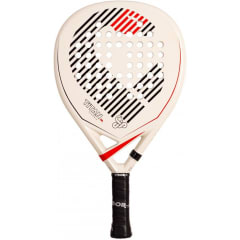
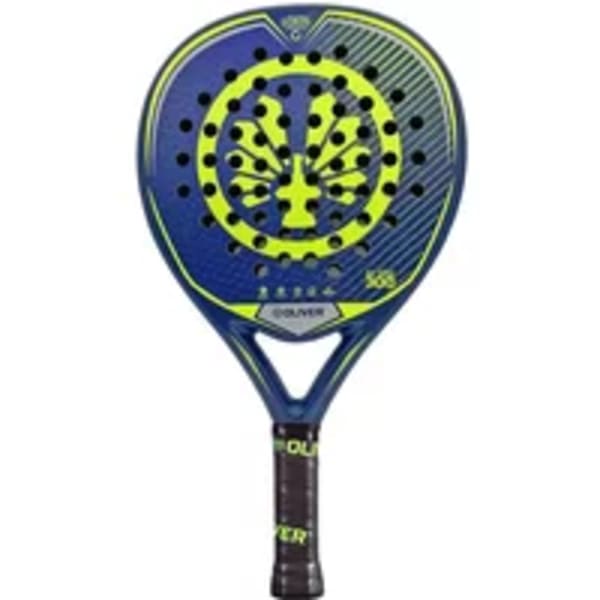
Oliver Sport Air Max 300
✓Cross-checked with official data from Oliver Sporthow we score
PADELTESTLAB SCORE
0-100 scale
77/100
Price range
Description
Who this racket is for
Pros
- ✓That 8°-10° EVA Hi-Soft core practically pushes the ball out for you on defensive lobs and block volleys - you don't need arm speed to get the ball off the back wall The soft core's generous sweet spot forgives mishits toward the throat, which matters when you're still finding your timing on the wall exit The METACARBON build keeps the 38 mm frame stable without piling on weight, so the racket doesn't sag on fast crosscourt volleys The teardrop shape and medium balance give you time to set up a bandeja, and it doesn't punish you when you're stretching for a deep ball on the backhand The 345-365 g range lets you pick your fit: go light for maneuverability at net, or heavy so the ball doesn't push your face back on defense
Cons
- ✗The soft rubber over-absorbs on the flat smash - if you're closing out points with a smash for the line or a sharp vibora, the ball comes off with little bite and gets sent straight back That generous sweet spot costs you in precision: chiquita shots tight to the glass need a drier touch than the EVA Hi-Soft gives you The fiberglass-carbon face caps this racket's ceiling; once your arm strengthens and you start finishing points up top, it runs out of legs With a 38 mm frame and soft rubber, the feel can seem overly muffled if you're coming from a stiffer racket and want more feedback in the hand
PADELTESTLAB SCORE
0-100 scale
77/100
Since April 9 it has ranged between €109.88 and €129.00. Today it sits at €129.00.
Prices collected on 65 days between April 9 and October 15
Oliver Sport Air Max 300 review: the soft teardrop racket that makes year one of padel easy
The Oliver Sport Air Max 300 is a beginner racket built on three clear decisions: teardrop shape, medium balance, an EVA Hi-Soft core rated 8° to 10°, and a 38 mm frame. A weight range of 345-365 g and a carbon-plus-fiberglass face under METACARBON construction round out a profile designed for effortless ball exit.
This isn't a racket trying to hide who it's for. The brand pitches it squarely at players starting out who want something balanced and easy to handle, and every design choice backs that up.
What level of player is the Oliver Sport Air Max 300 for?
Beginners with anywhere from a few months to a couple of seasons on court. The mix of soft rubber, teardrop shape and medium balance prioritizes ball exit and forgiveness on off-center hits over raw power. If you're already closing out points with a flat smash, this racket will start to feel like it's holding you back.
Spec sheet
| Spec | Value |
|---|---|
| Shape | Teardrop |
| Level | Beginner |
| Playstyle | All-round |
| Balance | Medium |
| Weight | 345-365 g |
| Face | Carbon + fiberglass (METACARBON) |
| Core | EVA Hi-Soft (8°-10°) |
| Frame | 38 mm |
| Technologies | METACARBON |
EVA Hi-Soft at 8°-10°: why such a soft core doesn't feel dead
Conventional wisdom says the softer the rubber, the less energy return you get. EVA Hi-Soft is built to break that rule: it compresses a lot on contact but rebounds with high energy return, so the ball still comes off the face even on a slow or scrappy swing.
On court that shows up two ways. First, a genuinely wide sweet spot: shots that land toward the throat or the frame edges still come back with reasonable depth instead of dying in the net. Second, vibration absorption - impact reaches the elbow filtered down, which matters when you're playing three or four hours a week without settled technique yet.
The trade-off is touch. Rubber at 8°-10° dampens so much that feedback in the hand gets muddy, and on shots that demand bite - a short chiquita to the back glass, a flat smash looking for a tricky bounce - the ball comes out softer than you meant it to.
METACARBON and the 38 mm frame: stiffness where it counts
If the core brings the softness, the frame has to bring the opposite or the racket turns into a trampoline. METACARBON construction is built for exactly that: structural stability without adding grams, pairing playing comfort with frame toughness.
The 38 mm profile is the standard regulation width and it's what holds that balance together. With a less stable frame, rubber this soft would let the face twist on fast crosscourt volleys or on balls arriving with real weight. Here, the racket keeps its plane firm enough to hold up.
The face blends carbon and fiberglass. Fiberglass does most of the work for comfort and flex on the hitting surface; carbon adds the stiffness and durability. It's an honest entry-level formula - you won't get the dry touch of a 100% carbon face, but you won't get its learning curve either.
How it plays, shot by shot
Defense and the wall exit. This is where it shines. The ball comes off the face with very little arm speed needed, so a defensive lob reaches deep court without forcing anything. On the backhand wall exit, that wide sweet spot bails you out on shots you barely got a piece of.
Bandeja. The medium balance and teardrop shape buy you setup time. The bandeja comes out comfortable with good directional control, though without the ball weight you'd get from a head-heavy racket.
Vibora and smash. This is where the ceiling shows. EVA Hi-Soft absorbs too much to generate the sharp snap a vibora down the middle needs, and a smash for the line comes out without much exit speed. For a player just starting out, that barely registers; for one progressing fast, it will.
Volley. Solid and stable. Blocking volleys work well because the racket does the job on its own, though attacking volleys looking to finish the point lose some sting.
Is the Oliver Sport Air Max 300 worth it?
Yes, within a fairly specific profile: first or second year on court, no elbow issues demanding even more cushioning, and a game built more around baseline rallies than net play. It delivers exactly what it promises - easy ball, protected arm, zero technical demands.
Don't buy it if you're already comfortable finishing points up top, if you want informative feedback in the hand, or if smashing is a core part of your game. In those cases, the soft rubber works against you.
A note on weight: the 345-365 g range is wide, so pick carefully. At the lower end you gain maneuverability at net and quicker reactions to fast balls; at the upper end you gain stability against heavy shots at the cost of agility. For a player under 70 kg or without much wrist strength, the lighter end is the logical call.
As a doubles pairing, it works best alongside a partner who takes the attacking role at net while this racket holds the baseline, lifts lobs and gets everything back.
In the brand's lineup
Within oliver sport's lineup, the air max 300 occupies the mid-range starting at €129, offering highly competitive value for its segment. At 77/100, it serves its purpose, though there are stronger alternatives on the market.
Frequently asked questions
Who is the Oliver Sport Air Max 300 for?
The Oliver Sport Air Max 300 is built for beginner level: easy to handle and forgiving. Not the ideal pick if you already have consolidated technique.
How much does the Oliver Sport Air Max 300 weigh?
The Oliver Sport Air Max 300 weighs 345-365g according to the manufacturer's stated specs.
What's the Oliver Sport Air Max 300's PadelTestLab score?
The Oliver Sport Air Max 300 scores 77/100 in our review, based on power, hardness, control, maneuverability, ball exit, sweet spot and surface roughness.
How much does the Oliver Sport Air Max 300 cost?
Current price of the Oliver Sport Air Max 300 is 129€, comparing 1 shop in our finder.
Similar alternatives
Other rackets with a similar profile and price range: