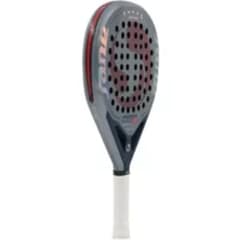
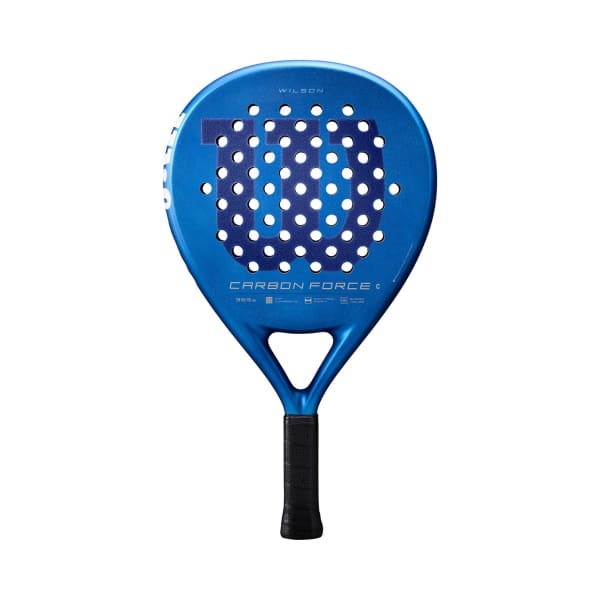
Wilson Carbon Force C
✓Cross-checked with official data from Wilsonhow we score
PADELTESTLAB SCORE
0-100 scale
78/100
Price range
Description
Who this racket is for
Pros
- ✓The soft EVA core's high ball exit helps you get lobs and deep defensive shots away with very little arm swing, especially when you've been dragged out of position after an opponent's smash. The forgiving sweet spot covers slightly off-centre contact on block volleys and rushed bandejas, which is a real help for intermediate players who don't yet find the middle of the face every time. The rough surface bites the ball on sliced bandejas and viboras, and helps you generate spin without an exaggerated wrist action. At 365 g with above-average maneuverability, quick volleys at the net and switches between defence and attack come off with reasonable agility.
Cons
- ✗Power is average: on an x3 smash or a flat smash, the arm speed has to come from you, because the racket won't hand you the finishing shot if you're looking to put points away quickly. The generous ball exit means you have to dose your shots on long blocks and when returning fast balls; if you don't shorten your swing, the ball can fly long or sit at a comfortable height for your opponent. Being an all-rounder, it doesn't stand out in any one shot: anyone after the pinpoint precision of a control racket or the punch of a pure power racket will find that neither side reaches the extreme.
PADELTESTLAB SCORE
0-100 scale
78/100
Wilson Carbon Force C review: 365 g, a carbon and fiberglass face and a soft EVA core for players who don't want to choose between attacking and defending. It's an intermediate-level all-round padel racket with a rough surface, built for competition without going to extremes on power or control.
That search for balance shapes everything that follows: which materials it uses, how the ball responds and who it suits.
Who Is the Wilson Carbon Force C For?
The Wilson Carbon Force C is designed for intermediate players and an all-round game. It's aimed at the player who already plays the bandeja, vibora and ball off the back wall with some consistency, and wants a padel racket that works as well in defence as in attack without demanding perfect contact.
It's a particularly good fit if:
- You alternate between defending and playing at the net during a match and don't want your feel to change.
- You play club tournaments or leagues and need a dependable racket more than a spectacular one.
- You're coming from a basic racket and want to step up to carbon without hitting becoming uncomfortable.
Carbon and Fiberglass Over a Soft EVA Core: What You Feel in the Hand
The face combines carbon with fiberglass. The carbon adds stiffness and precision at impact; the fiberglass softens that response and adds flexibility. The result is a carbon face that doesn't feel as harsh as a pure carbon one, with a friendlier response on medium-pace shots.
Beneath that face sits the soft EVA core, a rubber with a gentle feel. It absorbs part of the impact and gives it back as ball exit, which is why the racket responds generously even when you swing without much backswing. When you're defending against the glass or throwing up an emergency lob, that behaviour works in your favour.
The rough surface completes the package. The texture grips the ball at contact and makes spin easier, both on sliced bandejas and on viboras with sidespin.
Wilson Carbon Force C Specs
| Spec | Value |
|---|---|
| Level | Intermediate |
| Playing style | All-round |
| Weight | 365 g |
| Face | Carbon and fiberglass |
| Core | EVA Soft |
| Surface | Rough |
Smash, Bandeja and Back-Wall Play: How It Performs on Court
Bandeja and vibora. This is where the rough surface makes itself felt. The ball comes off with spin and stays low after the bounce, and the forgiving sweet spot lets you play the bandeja with margin even when you only just reach the ball. The vibora asks for a little more wrist, but the grip helps you put sidespin on the ball.
x3 smash and flat smash. This is where the racket is honest with you: power is average and the shot is down to you. With good arm technique the smash goes through with enough weight; if you rely on the racket to do the work, it will fall short.
Defence and back-wall play. This is its best side. The high ball exit sends the ball back easily from the back of the court, and the chiquitas and blocks after the wall come off with reasonable control. A defensive lob goes up without effort.
Volleys. At 365 g with above-average maneuverability, the racket reacts well in fast exchanges at the net. It isn't one of the lightest, so it helps to have a well-conditioned shoulder in long matches.
Where the Wilson Carbon Force C Falls Short
An all-round padel racket gives up the extremes. The Carbon Force C doesn't have the power of someone who smashes to close out the point, nor the surgical precision of a pure control racket.
The same generosity that helps in defence means you need to dose your shots in containment play: on long blocks and fast-ball returns, the ball can sail long if you don't shorten your swing.
Verdict: Is the Wilson Carbon Force C Worth Buying?
Yes, if you're an intermediate player looking for a no-surprises racket that gives you ball exit, a wide sweet spot and a comfortable feel on court. Its combination of carbon with fiberglass and a soft EVA core makes it a coherent option for competing without forcing your arm.
It isn't the best choice if your game is built on finishing points with heavy smashes, or if you need pinpoint control on fast balls. For those profiles, a racket more specialised in power or control makes more sense. For everyone else, it's an honest, versatile tool.
In the brand's lineup
Within Wilson's lineup, the Carbon Force C occupies the mid-range starting at €139.95, offering highly competitive value for its segment. With an overall score of 78/100, it's a solid choice within its price range.
Frequently asked questions
Who is the Wilson Carbon Force C for?
The Wilson Carbon Force C fits the intermediate level. Suited to players with a technical base who want to progress without jumping to a competition racket.
How much does the Wilson Carbon Force C weigh?
The Wilson Carbon Force C weighs 365g according to the manufacturer's stated specs.
What's the Wilson Carbon Force C's PadelTestLab score?
The Wilson Carbon Force C scores 78/100 in our review, based on power, hardness, control, maneuverability, ball exit, sweet spot and surface roughness.
How much does the Wilson Carbon Force C cost?
Current price of the Wilson Carbon Force C is 139.95€, comparing 1 shop in our finder.
Similar alternatives
Other rackets with a similar profile and price range: