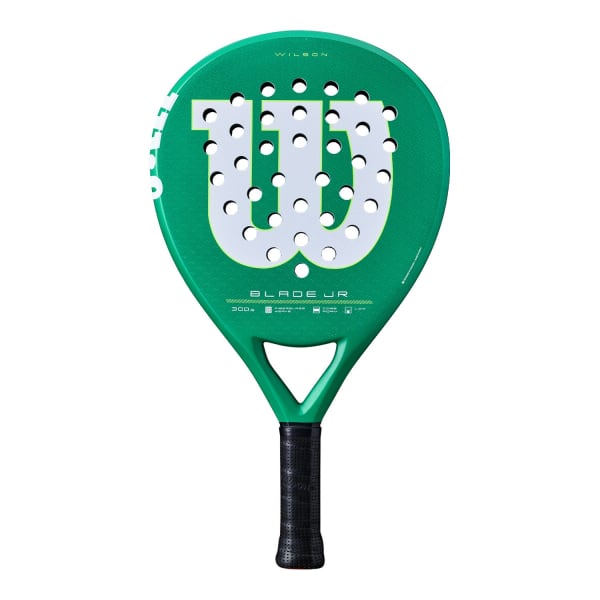
Wilson Blade JR V4
✓Cross-checked with official data from Wilsonhow we score
PADELTESTLAB SCORE
0-100 scale
81/100
Price range
Description
Who this racket is for
Pros
- ✓That 300g weight paired with the low balance keeps the head feeling almost neutral, so kids get to the reflex volley in time and drive the racket through the swing without dragging the elbow behind them. The foam core cushions the hit and sends the ball back with real depth on its own, so a defensive lob from the baseline lands deep in the opponent's court without needing adult-level power. The teardrop shape and generous sweet spot forgive the off-center contact that's typical of wall exits, where juniors still misjudge the bounce. The Spin Effect Texture grips the ball just enough to start producing cut bandejas and topspin forehands with genuine bite, not just flat, floaty shots.
Cons
- ✗That controlled power shows up on the smash: flat put-aways come down more to placement than pure kill shot, and against opponents who defend well, points often have to be replayed. The low balance takes mass out of the tip, which hurts the vibora aimed at the back glass — there just isn't enough swing weight to really drive the ball down from the side. With a soft core and fiberglass face, a junior who already hits with pace will feel the racket's limited pop and start asking for something crisper sooner than expected. The fixed 300g weight leaves no room to size up: if the player is big for their age, the racket ends up feeling too light on fast blocked volleys.
PADELTESTLAB SCORE
0-100 scale
81/100
300g on the nose, low balance and a teardrop shape: the Wilson Blade JR V4 brings the DNA of the adult Blade line down to junior hands. A fiberglass face, Core Foam core and a textured surface with Spin Effect Texture add up to a padel racket built so young players learn to strike the ball properly from day one.
This isn't a scaled-down blank with a logo slapped on. It's a coherent setup where every technical choice points the same direction: keeping a kid's arm fresh for the whole match.
Why 300g and a low balance change the way a junior swings
Weight and how that mass is distributed are the first things you notice. With a low balance, the swing weight sits close to the hand and the head feels light through the swing.
That translates into a quicker swing and less accumulated fatigue. A junior swinging a heavy racket tends to compensate with the shoulder and arrives late on the ball; here they get there in time and can set up the shot with proper technique, not whatever the weight allows.
On the reflex volley this pays off immediately. The racket turns over fast and the block comes out clean even when the ball is jammed in tight to the body.
Fiberglass and Core Foam: the soft combo that adds depth without extra effort
The fiberglass face flexes more than a stiffer weave and gives back some of the impact energy. Underneath, the Core Foam works as a shock absorber, soaking up the hit and releasing the ball with a soft, elongated feel.
The practical result is a very generous ball exit. Juniors don't need adult-level racket speed to send the ball deep, and that's exactly what keeps a baseline rally alive.
The trade-off is in the feedback. A soft setup feels pleasant but isn't crisp — when the player really wants to accelerate through the ball, the racket gives back less pop than they're asking for.
Who is the Wilson Blade JR V4 really for?
This is an entry-level racket for junior players still building their technical game, with an all-round profile. The 300g weight, low balance and foam core all prioritize maneuverability, forgiveness and arm protection over raw power. It's a strong fit for academy sessions, training and recreational-level matches.
Specs at a glance
| Spec | Value |
|---|---|
| Shape | Teardrop |
| Weight | 300 g |
| Balance | Low |
| Face | Fiberglass |
| Core | Foam (Core Foam) |
| Surface | Textured |
| Technologies | Sharp Hole Technology, Duo Grid, Spin Effect Texture |
| Level | Beginner |
| Playstyle | All-round |
Sharp Hole Technology, Duo Grid and Spin Effect Texture: what each one actually does
- **Sharp Hole Technology** works on the face's hole pattern, the area that decides how much the hitting surface flexes and how impact vibration gets spread out.
- **Duo Grid** arranges that hole pattern in two densities, so the response isn't uniform across the face — the center behaves differently from the outer zones.
- **Spin Effect Texture** is the surface roughness itself. It's what lets a junior start cutting the bandeja and brushing up on forehands with spin you can actually see on the bounce.
Put together, the payoff is a wide sweet spot — the single most valuable trait of this Wilson racket for the player it's built for.
Shot by shot: where it delivers and where it falls short
Wall exits. This is where it shines. The teardrop shape and generous sweet spot forgive off-center contact, which is the most common mistake when kids are still learning to judge the bounce off the glass.
Baseline rallies. The foam does the heavy lifting: defensive lobs come out deep and high without the kid having to muscle the swing.
Bandeja. Solid. The racket whips through quickly, the texture bites into the ball, and you can cut it toward the side wall with control.
Smash. The ceiling. Power is capped and the low balance doesn't add mass at the tip, so the flat smash counts more for placement than raw speed. The vibora aimed at the back glass needs swing weight this racket simply doesn't have.
Volleys. Stable and comfortable, with a soft touch that makes the dropshot easy, though it lacks the punch to put volleys away outright.
Verdict: an honest racket for learning, with a defined ceiling
The Wilson Blade JR V4 does exactly what a junior needs: it doesn't punish the arm, it hands out depth for free, and it lets kids start playing with real spin. The textured surface and wide sweet spot speed up genuine on-court learning.
That ceiling arrives sooner than some parents would like. Once a player develops real racket speed and starts smashing with intent, the lack of power and head mass becomes a real limitation.
A smart pick for academy play and early matches. If the kid is already competing and looking to finish points at the net, it's time to look at a setup with more weight and a higher balance.
In the brand's lineup
Within Wilson's lineup, the Blade JR V4 is one of the most accessible options starting at €99.95, perfect for getting started without a heavy outlay. Its overall score of 81/100 places it among the best all-round rackets we've reviewed.
Frequently asked questions
Who is the Wilson Blade JR V4 for?
The Wilson Blade JR V4 is built for beginner level: easy to handle and forgiving. Not the ideal pick if you already have consolidated technique.
How much does the Wilson Blade JR V4 weigh?
The Wilson Blade JR V4 weighs 300g according to the manufacturer's stated specs.
What's the Wilson Blade JR V4's PadelTestLab score?
The Wilson Blade JR V4 scores 81/100 in our review, based on power, hardness, control, maneuverability, ball exit, sweet spot and surface roughness.
How much does the Wilson Blade JR V4 cost?
Current price of the Wilson Blade JR V4 is 99.95€, comparing 1 shop in our finder.
Similar alternatives
Other rackets with a similar profile and price range: