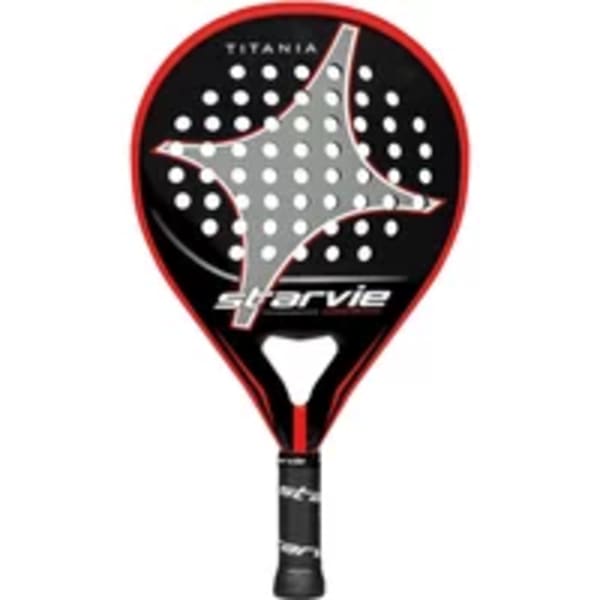
Starvie Titania Soft
✓Cross-checked with official data from Starviehow we score
PADELTESTLAB SCORE
0-100 scale
79/100
Description
Who this racket is for
Pros
- ✓The Soft 30 core kicks the ball back with its own pace: on low wall exits and emergency lobs you don't need to muscle the swing to dig the ball out from the back The fibreglass face flexes more than a rigid layup and opens up a bigger sweet spot, so off-centre contacts on the backhand volley still hold their line Power Balance in the heart spreads the weight and filters out some of the vibration reaching the grip, which you'll notice over long matches or if you've had elbow trouble before The round shape with a mid balance keeps the head light on its feet: the bandeja sets up with barely any effort and you can still adjust your wrist late when your opponent throws a crossed lob at you The soft touch lets you carve dropshots and cut balls at the net with that 'ball stuck on the strings' feel, without the sharp kick-back that sends the ball flying past the baseline
Cons
- ✗The power ceiling shows up on the flat smash through the middle: the soft rubber eats part of the impact and the ball lands with less sting than you'd expect coming from a stiffer racket Against hard-hitting, flat-ball opponents, the fibreglass face can feel a touch too elastic, making it hard to block deep volleys without them drifting long A fast vibora demands a crisp, dry response this racket just doesn't give: it comes off with spin, but without the exit speed you'd get from a stiffer, head-heavy frame The spec sheet puts it at advanced level, but an advanced player who builds their game around the flat smash will find its soft character more limiting than comfortable
PADELTESTLAB SCORE
0-100 scale
79/100
Out of stock right now
None of the shops we track has it in stock right now. We last saw it on August 21 at €119.00.
See similar rackets in stockPlenty of round-shaped padel rackets simply get the job done without complaint. The Starvie Titania Soft plays a different game entirely: a full fibreglass face and a Soft 30 core sit inside a 38mm frame so the ball practically exits on its own, with Power Balance technology built into the heart. Round shape, mid balance, and a clear control identity backed by fast ball exit.
Fibreglass over Soft 30 rubber: the science behind the easy rebound
The fibreglass face is the single decision that defines this padel racket. Fibreglass flexes more on impact than a stiffer carbon face, and that extra give translates into a soft, elastic feel, with the ball staying on the strings a fraction longer.
That extra dwell time is what lets you place the ball with intent instead of just sending it back. On flat balls aimed at the body, the face cushions rather than rebounds, so your block comes out controlled.
The Soft 30 core pulls in the same direction from the inside. It's a soft-density EVA that compresses under low swing speed and gives that energy back on the release — hence the generous ball exit, probably the single most recognisable trait of this racket.
The 38mm frame keeps things within the market standard. It's not chasing the rigidity of a beefed-up thick frame; instead it lets deformation spread across the whole hitting surface and supports the wide sweet spot that the fibreglass-plus-soft-core combo creates.
Is the Starvie Titania Soft a control racket or a power racket?
It's a control racket with ball exit well above average. The fibreglass face and Soft 30 core combo sends the ball back with its own pace without demanding extra arm speed, but its ceiling on the flat smash sits below what you'd get from a stiffer, more head-heavy frame.
Shot by shot: where the Titania Soft shines and where it falls short
Wall exit. This is where the Titania Soft earns its name. The soft rubber lifts dead balls off the glass with minimal effort, and the mid balance lets you arrive late without the racket dragging on you.
Bandeja. The light head and round shape set the hitting plane up with almost no effort. You get long, cut bandejas with great consistency; the racket forgives a less-than-perfect strike.
Vibora. The weak spot. The fibreglass face generates spin but not the crisp, dry response that accelerates the ball off the bounce. If your net game leans on a fast vibora, this isn't your tool.
Smash off the back wall (por 3). Works better than you'd expect, because you don't need maximum power here — you need height, angle control and a dependable sweet spot. All three are on tap.
Flat smash. This is where it costs you. Some of the energy gets absorbed by the core's compression, and the ball lands with less weight than a stiffer racket would deliver.
Volleys. Comfortable and directional when blocking, a touch too elastic when your opponent hits hard and you're chasing maximum depth.
Power Balance: the difference you feel in your wrist, not on the scoreboard
Power Balance works on weight distribution in the heart and on the vibration that travels up to the grip. It's not a technology that adds ball speed — it's one that cuts down the mechanical noise of each shot.
In practice, that means less punishment on off-centre hits and a cleaner-feeling third set. For anyone nursing elbow or forearm niggles, that detail is worth more than an extra ten kilometres per hour of ball speed.
Starvie Titania Soft: full spec sheet
| Spec | Value |
|---|---|
| Shape | Round |
| Balance | Medium |
| Playstyle | Control |
| Level | Advanced |
| Face | Fibreglass (100%) |
| Core | EVA Soft 30 |
| Frame | 38 mm |
| Technology | Power Balance |
What type of player is this Starvie racket really for?
The spec sheet files it under advanced level, but it's worth unpacking what that means here. It's not a demanding racket in the usual sense — it doesn't punish mistakes or require surgical technique. The 'advanced' part is knowing how to make the most of what it offers.
Who gets the most out of it:
- Baseline players who build the point with lobs and deep balls rather than outright winners.
- Anyone looking to progress without sacrificing comfort on contact, who needs the racket to help out on ball exit.
- Players with sensitive elbows or wrists coming off stiffer frames.
- Backhand-siders who need a dependable hitting plane for repeated bandejas, match after match.
As a pairing, it works well alongside a partner running a head-heavy power racket who takes on the finishing smash while you hold the rally together.
Verdict: comfort first, punch second
The Starvie Titania Soft delivers exactly what its name promises. It's a soft-touch racket with a wide sweet spot and easy rebound that cuts down on physical wear over a match and keeps your ball-in percentage high.
In exchange, you accept a capped power ceiling and a less crisp response than rigid builds give you. If your game is decided on the flat smash, that trade-off will cost you. If it's decided in the long rally, it's a trade worth making.
This racket asks for honesty with yourself before honesty about the racket: pick the Titania Soft if you'd rather finish the match with a healthy arm and the ball still in play.
In the brand's lineup
Within Starvie's lineup, the Titania Soft positions itself as a distinctive alternative. With an overall score of 79/100, it's a solid choice within its price range.
Frequently asked questions
Who is the Starvie Titania Soft for?
The Starvie Titania Soft targets advanced players. It needs consolidated technique and is not recommended for beginners.
What's the Starvie Titania Soft's PadelTestLab score?
The Starvie Titania Soft scores 79/100 in our review, based on power, hardness, control, maneuverability, ball exit, sweet spot and surface roughness.
Similar alternatives
Other rackets with a similar profile and price range: