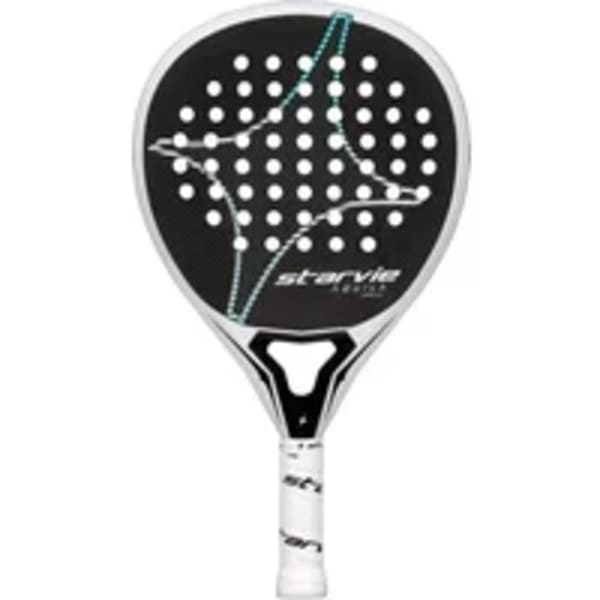
Starvie Aquila Pro
✓Cross-checked with official data from Starviehow we score
PADELTESTLAB SCORE
0-100 scale
81/100
Description
Who this racket is for
Pros
- ✓The 100% 3K carbon face paired with Pro 50 rubber delivers a crisp, dry response on smashes: the ball comes off flat with minimal contact time, perfect for flat smashes and remate por 3 Power Balance loads the head without sacrificing control, so cut vibora and deep bandeja shots hold their line even when you're swinging fast The pronounced surface texture bites into the ball on sliced shots: bandejas stay low and finishing liftados pick up real spin The Reinforcement Torsion System shows up on off-center hits toward the frame: the racket resists twisting and keeps its direction on blocked volleys The teardrop shape with a medium-high balance gives you diamond-level pop without fully giving up net maneuverability
Cons
- ✗The hard rubber and tight sweet spot punish off-center contact: outside the face's core the ball dies and you feel vibration through the forearm Ball exit is short — on defense from the back and on emergency lobs, you have to supply all the energy yourself; it won't gift you depth The medium-high balance demands earlier prep on rushed wall exits; get to the ball late and the head-heavy weight sends you off cross-court With a 350-385g weight range, units at the top end can strain the elbow in long matches if your arm isn't well conditioned
PADELTESTLAB SCORE
0-100 scale
81/100
Out of stock right now
None of the shops we track has it in stock right now. We last saw it on August 2 at €154.90.
See similar rackets in stockThe StarVie Aquila Pro is a 3K carbon teardrop racket built in Azuqueca de Henares with dense, hard Pro 50 rubber, Power Balance technology, and a weight range of 350 to 385 grams. Nothing about its build is designed to forgive: this is an advanced player's racket that converts technique into power — and punishes the lack of it.
What sets the StarVie Aquila Pro apart in the teardrop category
Teardrop shapes are the classic compromise format, but StarVie deliberately tips the scales here. Power Balance redistributes mass toward the head to add pop without wrecking control, and the result is a padel racket that behaves closer to a soft diamond than a traditional teardrop.
That has real consequences. The sweet spot isn't generous — it sits high and compact, exactly where it needs to be, and hitting it delivers a violent response. Miss it, and you feel the hard rubber giving little back while the frame transmits the shock straight to your arm.
| Spec | Value |
|---|---|
| Shape | Teardrop |
| Weight | 350-385 g |
| Balance | Medium-high |
| Face | 3K Carbon |
| Core | EVA Pro 50 (hard) |
| Surface | Rough |
| Level | Advanced |
| Playstyle | All-round |
3K carbon and Pro 50 rubber: why this combo hits so sharp
3K carbon has a more open weave than higher-density layups, giving it a touch of controlled flex compared to stiffer builds. On the Aquila Pro it runs through both the carbon face and the tubular frame, and that material continuity explains the homogeneous feel on impact: there's no point where the racket's character shifts.
Underneath sits the hard Pro 50 rubber. It's a density that compresses very little and rebounds fast, so contact time between ball and face is short. On court, that means the ball leaves flat and taut, following the trajectory you gave it — not one the racket decides for you.
The Reinforcement Torsion System reinforces the structure against twisting. You notice it on off-center hits toward the top edge — that half-shanked smash you still manage to connect with: the racket doesn't torque, and the ball keeps its line even as it loses pace.
The Anatomic Bridge Design works on the bridge, the zone that channels the most vibration into your hand. With rubber this hard, that detail isn't cosmetic — it's what keeps the whole package tolerable through a three-set match.
Shot-by-shot: where the Aquila Pro shines and where it leaves you exposed
Smash. This is its home turf. The flat smash comes off at a speed you wouldn't expect from a teardrop shape, and the remate por 3 benefits from the head-heavy weight to drive the ball high off the glass.
Vibora and bandeja. The textured face bites and generates real spin. The cut vibora stays low with pronounced lateral exit; the bandeja holds depth if you commit to the swing, though it demands more arm than a head-light racket would.
Volleys. Blocking volleys are excellent thanks to the frame's stiffness. The finishing volley needs center contact — miss the sweet spot and the ball loses a lot of steam.
Defense and wall exits. This is where the racket collects its toll. Ball exit is short and the medium-high balance demands early prep. The emergency lob from the back doesn't come easy — you have to generate it yourself with your shoulder. If your game lives off defending and waiting for the opponent's mistake, this isn't your racket.
Who is this StarVie racket built for?
The StarVie Aquila Pro targets advanced players with solid technique and good timing. It needs an arm that can generate its own racket-head speed, because the hard rubber and contained ball exit don't hand you free energy. Below that level, the racket feels dead and beats up your forearm.
It's a particularly strong fit for:
- **Backhand players who attack through the middle** — the head-heavy weight turns every high ball into a finishing opportunity.
- **Aggressive all-rounders** — this isn't a one-dimensional power racket; it sustains rallies if you're hitting center.
- **Players moving on from hard rackets** — the jump from a soft rubber is abrupt and you'll feel it in the first few sessions.
As a doubles pairing, it works best alongside a partner with a more defensive profile and comfortable ball exit, someone who can sustain the rally while the Aquila Pro hunts for the winner.
Verdict: real power in exchange for real demands
What this model delivers is consistent from top to bottom: 3K carbon on face and frame, hard Pro 50 rubber, and mass pushed toward the head via Power Balance. Everything points the same direction — hitting hard while keeping the ball under control.
What it charges for that is just as clear. A compact sweet spot, little help on defense, and a weight range that climbs to 385 grams on the heaviest units — something to watch if you carry any elbow issues.
If you're after a teardrop racket that forgives mishits and gives you an easy ball exit, this StarVie option will frustrate you. But if you hit center, generate your own racket-head speed, and want a racket that transmits exactly what you ask of it, the Aquila Pro delivers without compromise.
In the brand's lineup
Within starvie's lineup, the aquila pro positions itself as a distinctive alternative. With an overall score of 81/100, it's a solid choice within its price range.
Frequently asked questions
Who is the Starvie Aquila Pro for?
The Starvie Aquila Pro targets advanced players. It needs consolidated technique and is not recommended for beginners.
How much does the Starvie Aquila Pro weigh?
The Starvie Aquila Pro weighs 350-385g according to the manufacturer's stated specs.
What's the Starvie Aquila Pro's PadelTestLab score?
The Starvie Aquila Pro scores 81/100 in our review, based on power, hardness, control, maneuverability, ball exit, sweet spot and surface roughness.
Similar alternatives
Other rackets with a similar profile and price range: