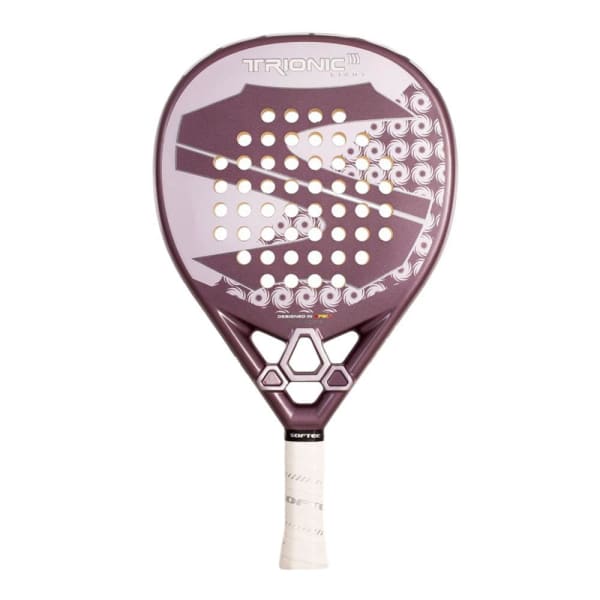
Softee Trionic Light
✓Cross-checked with official data from Softeehow we score
PADELTESTLAB SCORE
0-100 scale
79/100
Description
Who this racket is for
Pros
- ✓The Extrasoft EVA inside the 38 mm frame sends the ball back with barely any effort: on volley blocks and defensive lobs from the back of the court, the ball comes out deep without you needing to speed up your arm. The mid-low balance at 320-340 g keeps the head light in your hand, which pays off on fast crosscourt volleys and when you're rushing a wall exit and short on time. The teardrop shape with a hybrid lean spreads a generous sweet spot across the upper-mid area of the face: off-centre bandeja contact doesn't punish you the way it would on a pure diamond. The smooth-finish fiberglass face cushions impact and cuts down on vibration through the elbow, a real plus if you're putting in several hours on court a week. The Trionic Core keeps the face stable at the moment of contact, which translates into a cut vibora that's far more predictable than you'd expect from a soft racket in this range.
Cons
- ✗The Extrasoft EVA goes flat on the smash: if you're relying on power from the back of the court to close out points, the ball comes off with less weight than expected and your opponent gets it back. The mid-low balance takes inertia away from the smash por 3; putting the ball away means compensating with technique and arm speed rather than the racket's own weight. The smooth surface caps how much extreme slice you can generate: on the pinchada and the kick serve you won't bite into the ball the way you would with a rough-textured face. At 320 g, the low end of the range, a strong-armed player may find the frame a touch soft when blocking hard smashes off the back wall.
PADELTESTLAB SCORE
0-100 scale
79/100
Out of stock right now
None of the shops we track has it in stock right now. We last saw it on May 10 at €74.90.
See similar rackets in stockSoftee Trionic Light review: a soft teardrop racket built for wristy, all-court play
The Softee Trionic Light is a control-oriented padel racket with a teardrop shape, mid-low balance, fiberglass face and an Extrasoft EVA core mounted in a 38 mm frame. Weight runs between 320 and 340 grams, and the defining piece of tech is the Trionic Core, the central block that gives the model its name. Softee itself pitches it as an intermediate-level racket built for maneuverability rather than raw power.
That positioning isn't just marketing spin — it matches exactly what the racket delivers on court. This isn't a racket built to hit harder; it's built to help you reach more balls and send them back with less effort.
Softee Trionic Light specs at a glance
| Spec | Value |
|---|---|
| Shape | Teardrop |
| Weight | 320-340 g |
| Balance | Mid-low |
| Level | Intermediate |
| Playstyle | Control |
| Face | Fiberglass |
| Core | Extrasoft EVA |
| Frame | 38 mm |
| Surface | Smooth |
| Technology | Trionic Core |
What does the Trionic Core actually do for your shots?
The Trionic Core is a structured core that acts as a stabilising piece at the centre of the hitting face. Its stated job is twofold: hold the racket together at impact and support a clean ball exit.
In practice, it's the second part you notice most. Extrasoft EVA is a foam that compresses heavily and rebounds fast, and that's exactly where this padel racket earns its character: the ball comes off deep almost without asking for it.
The risk with such a soft foam is a lack of hold — a face that flexes and sends the ball wherever it wants. The core reins in some of that drift, which is why the cut vibora comes out more predictable than you'd expect from a racket with this kind of soft feel.
Shot by shot: how it plays
Defence and wall exits. This is where it shines. At 320-340 g with a mid-low balance, the head sits light in your hand, so you get to balls that a higher-balance racket would leave you chasing. Lobs go deep without straining the shoulder.
Bandeja. The teardrop shape spreads a generous sweet spot across the upper-mid zone. Off-centre contact doesn't punish you the way it would on a diamond, so repeated bandejas hold their depth even when you don't catch them dead centre.
Vibora. It works, with caveats. The Trionic Core gives you just enough hold to direct it, but the smooth surface doesn't bite into the ball like a rough face would. You get direction, not an aggressive spin effect.
Smash. This is where the trade-off shows up. The Extrasoft EVA goes flat on a flat smash and the mid-low balance adds no extra inertia. The smash por 3 is still doable, but it demands technique and arm speed — the racket won't hand you the extra metres.
Volleys. Very comfortable. Blocks come off clean and the ball exits deep off a short stroke, handy when the point speeds up at the net.
Who is the Softee Trionic Light actually for?
Short answer: an intermediate player who prioritises positioning, defence and rhythm over the winning smash, and who values comfort on the joints. The contained 320-340 g weight and the extra-soft foam make it especially suited to anyone putting in several hours a week who doesn't want to load up their elbow.
Three player profiles it suits well:
- **The defensive baseline player** who lives off long lobs, clean wall exits and grinding opponents down.
- **The player nursing elbow or shoulder issues** who needs genuine cushioning without dropping down to a beginner racket.
- **The player stepping up from a round-shaped racket** looking for a bit more upside in the upper face without the punishment of a diamond shape.
As a doubles partner, it works best alongside someone with a harder, more attacking racket: you build the point and hold down the defence, your partner finishes it off.
Where this Softee racket falls short
Being honest about this racket means being upfront about what it isn't. It's not a racket for closing out points on power. If your game leans on the flat smash or the smash por 3 as a go-to weapon, the combination of extra-soft foam and mid-low balance is going to leave you short.
It's also not the pick if you're chasing extreme spin. The smooth surface cuts down on bite for the pinchada and the kick serve compared with a rough-textured finish.
And there's a weight nuance worth flagging: at the bottom end of the range, a strong-armed player might find the frame a touch soft when blocking hard smashes coming in fast off the back wall. If you swing a heavy arm, aim for the top end of the weight range.
Verdict on the Softee Trionic Light
This is a racket that's consistent with itself. The Trionic Core, the Extrasoft EVA and the fiberglass face all pull in the same direction: maximum ease of ball exit, quick handling and forgiveness on off-centre hits, in exchange for giving up raw power.
Within the intermediate level Softee positions it at, it delivers exactly what it promises. A safe buy if your padel game is built on defence; the wrong buy if you like to finish points from above.
In the brand's lineup
Within softee's lineup, the trionic light positions itself as a distinctive alternative. At 79/100, it serves its purpose, though there are stronger alternatives on the market.
Frequently asked questions
Who is the Softee Trionic Light for?
The Softee Trionic Light fits the intermediate level. Suited to players with a technical base who want to progress without jumping to a competition racket.
How much does the Softee Trionic Light weigh?
The Softee Trionic Light weighs 320-340g according to the manufacturer's stated specs.
What's the Softee Trionic Light's PadelTestLab score?
The Softee Trionic Light scores 79/100 in our review, based on power, hardness, control, maneuverability, ball exit, sweet spot and surface roughness.
Similar alternatives
Other rackets with a similar profile and price range: