Softee Trionic Fiber Nano
✓Cross-checked with official data from Softeehow we score
PADELTESTLAB SCORE
0-100 scale
81/100
Price range
Description
Who this racket is for
Pros
- ✓The raised 3D Nano Mesh bites into the ball on cut shots: your bandeja comes off the strings with enough spin to die at the back glass without needing extra arm speed. The glass-fibre face flexes hard on contact and sends the ball back almost on its own on rushed volley blocks and tight wall exits, situations where a stiffer face would leave you short of the net. The EVA Soft core soaks up mishits and forgives the timing errors typical of an intermediate game, without hammering your elbow or wrist through long matches. With even balance and a teardrop shape, the racket whips through fast cross-court reaction volleys and lets you correct your wrist at the last second against an incoming vibora.
Cons
- ✗EVA Soft compresses too much on flat smashes hit at full power: the ball comes off with less terminal speed than a firmer rubber would give, so you're better off smashing for the angle than for depth. The glass-fibre face feels soft and a touch muted; players coming from a carbon face will find the feedback on exact contact point blurrier on finishing volleys. At up to 375 g in the top of its weight range, the racket starts to feel heavy in the final stretch of a match for less conditioned arms, especially through chained bandeja sequences. This isn't a racket to grow into: once your game speeds up and you're looking to close points with a hard smash for the win, the soft combo runs out of terminal punch.
PADELTESTLAB SCORE
0-100 scale
81/100
Since April 18 it has ranged between €94.95 and €178.00. Today it sits at €178.00.
Prices collected on 80 days between April 18 and October 15
Softee Trionic Fiber Nano review: glass fibre, EVA Soft and 3D Nano Mesh
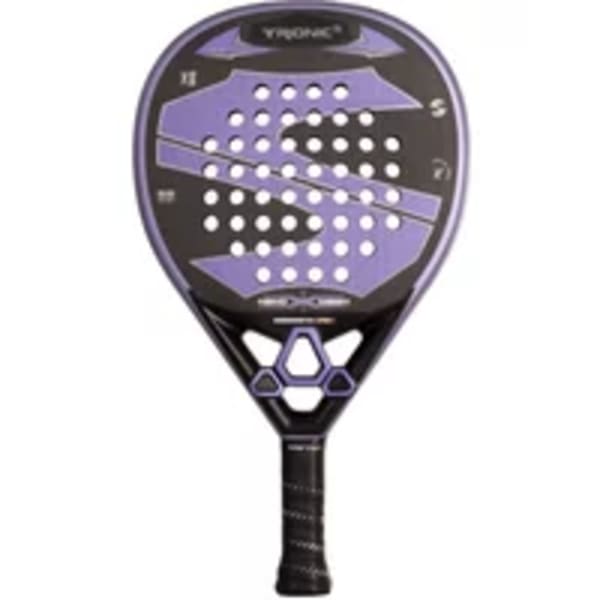
The Softee Trionic Fiber Nano is the Nano Mesh-coated variant of the Trionic Fiber line: teardrop shape, 38 mm frame, even balance, glass-fibre face, EVA Soft core and a weight range from 350 to 375 grams. It's a padel racket built for the intermediate player who mixes defence and attack rather than specialising in either.
The "Nano" tag isn't just branding. The Nano Mesh is applied in 3D across the hitting surface, and that texture changes two things: how the racket grips the ball on cut shots, and how much ball exit you get without accelerating your arm.
What does the Nano Mesh coating actually add over the glass-fibre face?
Nano Mesh is a three-dimensional textured coating whose stated job is to boost ball exit without giving up control. On court that shows up as extra grip at the moment of contact: cut a bandeja and you can feel the ball hold on the face for a fraction longer before releasing.
It's built on a glass-fibre face. Glass fibre flexes far more than carbon, so the racket behaves like a trampoline: it absorbs the impact, deforms, and gives it back. That elasticity is what drives this racket's generous ball exit.
The trade-off is feedback. Glass fibre delivers a soft, slightly muted touch, and it won't tell you with the same precision exactly where you made contact. Anyone used to a carbon face will find the response noticeably duller.
Softee Trionic Fiber Nano specs
| Spec | Value |
|---|---|
| Shape | Teardrop |
| Weight | 350-375 g |
| Balance | Even |
| Face | Glass fibre (Nano Mesh) |
| Core | EVA Soft |
| Frame | 38 mm |
| Surface | 3D texture |
| Technology | Nano Mesh |
| Level | Intermediate |
| Playstyle | All-round |
EVA Soft and the 38 mm frame: what you gain and what it costs you
The EVA Soft core is a low-density rubber that compresses easily. Its main job here is twofold: filtering vibration away from the elbow, and widening the area of the face where an off-centre hit still comes off clean.
That wide sweet spot is exactly what makes this racket usable for a real intermediate player, the kind who doesn't always catch the ball dead centre. A wall rebound that catches you half-turned still gets back over the net, just with a bit less pace.
The cost shows up on the smash. Soft rubber compresses under a fast swing and gives back less terminal energy than you put into it. A flat smash aimed deep loses pace; an angled smash relying more on wrist than raw power works far better.
The 38 mm frame is the regulation standard and doesn't add extra stiffness over thinner profiles, but it does hold the structure together without hardening the overall feel.
How does the Trionic Fiber Nano play, shot by shot?
- **Defence and wall exits**: its best terrain. The glass fibre plus EVA Soft combo returns depth almost effortlessly, bailing you out on defensive lobs when you arrive late.
- **Bandeja**: the 3D texture lets you cut with real spin without needing extra arm speed. It comes off controlled with a low bounce.
- **Vibora**: decent but unremarkable. The soft rubber takes away some of the sharp snap this shot demands.
- **Volley**: even balance and the teardrop shape make the racket turn quickly on reaction shots; block volleys feel very comfortable, while finishing volleys ask you to find the gap rather than lean on power.
- **Smash for the point**: playable, but this isn't a racket that puts balls away. Better used to open up the court than to close the point.
Who is this Softee racket really for?
For the intermediate all-rounder who plays the point with patience, comes to net when the moment calls for it, and doesn't build their game around finishing points in one shot. The even-balance teardrop shape doesn't push you toward either extreme.
It's an especially good fit for anyone carrying elbow or wrist niggles: the glass-fibre-plus-EVA-Soft combo is about as forgiving as it gets for impact absorption.
As a doubles partner, it works best alongside a harder-hitting player. This racket sustains the rally and lets you build the point; leave the killer smash to the other side of the court.
Quick verdict: is the Trionic Fiber Nano worth it?
Yes, if you want a manageable racket that's easy on the arm and offers generous ball exit at intermediate level. No, if your game already leans on hitting hard: the EVA Soft core and glass-fibre face prioritise comfort and control over terminal power, and you'll hit the ceiling as soon as you speed up your swing.
The scenario where it disappoints is clear: a player progressing fast who starts demanding real damage on the smash. There, the racket falls short and it's time to move up a tier.
The scenario where it delivers is just as clear: long matches, back-of-court rallies, plenty of wall play, and an arm that's grateful the ball comes off the strings without a fight.
In the brand's lineup
Within softee's lineup, the trionic fiber nano occupies the mid-range starting at €178, offering highly competitive value for its segment. With an overall score of 81/100, it's a solid choice within its price range.
Frequently asked questions
Who is the Softee Trionic Fiber Nano for?
The Softee Trionic Fiber Nano fits the intermediate level. Suited to players with a technical base who want to progress without jumping to a competition racket.
How much does the Softee Trionic Fiber Nano weigh?
The Softee Trionic Fiber Nano weighs 350-375g according to the manufacturer's stated specs.
What's the Softee Trionic Fiber Nano's PadelTestLab score?
The Softee Trionic Fiber Nano scores 81/100 in our review, based on power, hardness, control, maneuverability, ball exit, sweet spot and surface roughness.
How much does the Softee Trionic Fiber Nano cost?
Current price of the Softee Trionic Fiber Nano is 178€, comparing 1 shop in our finder.
Similar alternatives
Other rackets with a similar profile and price range: