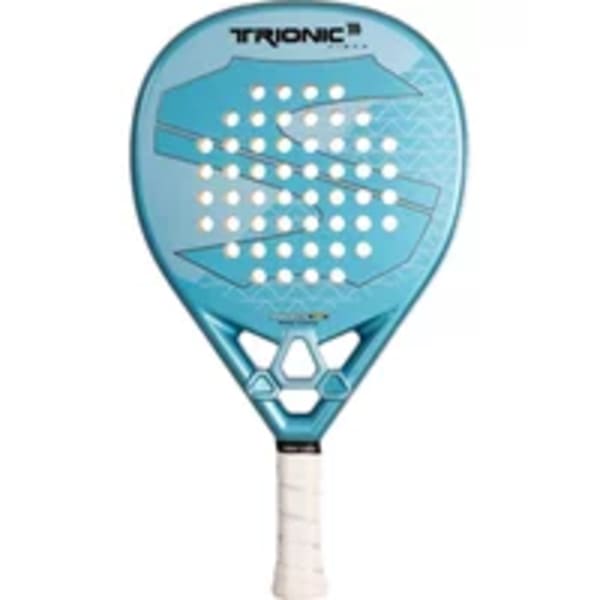
Softee Trionic Fiber
✓Cross-checked with official data from Softeehow we score
PADELTESTLAB SCORE
0-100 scale
77/100
Description
Who this racket is for
Pros
- ✓That Soft EVA core paired with the fibreglass face delivers seriously fast ball exit: on a blocked volley or a defensive lob from the back you get depth without having to accelerate your arm The teardrop shape with medium balance spreads the weight just right, so the racket still gets to the crossed bandeja in time while keeping enough mass behind a flat smash A generous sweet spot for a teardrop racket: off-centre hits off the back wall or on low volleys barely lose depth, which anyone still working on centring the ball will appreciate The 38mm frame and the soft feel of the fibreglass filter out vibration on return-of-serve shots, a real plus if you're carrying elbow niggles or grinding through long matches A 355-370g weight range lets you pick the lighter build for backhand volleys or the heavier one to add momentum from the back of the court
Cons
- ✗The soft rubber soaks up energy on the smash by 3 and on the vibora: anyone chasing a crisp, decisive finish will notice the ball comes off bouncier than they'd like The smooth face bites less than a textured surface, so cut shots and kick effects lose some sting compared to rackets with a rougher finish Being a medium-balance teardrop, it doesn't give you the full maneuverability of a round racket: a quick block at net after a tight smash means you need to prep earlier The very elastic feel can feel imprecise for a hard hitter who wants to know exactly where the ball dies on a cut volley
PADELTESTLAB SCORE
0-100 scale
77/100
Out of stock right now
None of the shops we track has it in stock right now. We last saw it on October 14 at €64.95.
See similar rackets in stockSoftee Trionic Fiber Review: The Soft Teardrop Racket That Does the Work For You
The Softee Trionic Fiber is a teardrop-shaped padel racket with a fibreglass face, Soft EVA core, 38mm frame and a weight range of 355 to 370 grams. Its medium balance and generous sweet spot put it squarely in intermediate territory — the player who defends one point and attacks the next, and needs a racket that won't punish either instinct.
This isn't a flashy showpiece. It's a match-day tool for anyone grinding through a three-hour Sunday session who wants to walk off court without a sore forearm.
Who Should Play With the Softee Trionic Fiber?
Intermediate players with an all-round style. The Soft EVA and fibreglass combo produces heavily assisted ball exit: the racket returns depth without you needing full arm speed, which matters when your smash technique isn't fully locked in but your court positioning already is.
Advanced players who hit hard will find the feel too elastic for their liking. Complete beginners, on the other hand, can lean on it thanks to the size of the sweet spot.
Tech Specs
| Spec | Value |
|---|---|
| Shape | Teardrop |
| Weight | 355-370 g |
| Balance | Medium |
| Face | Fibreglass |
| Core | Soft EVA |
| Frame profile | 38 mm |
| Surface | Smooth |
| Level | Intermediate |
| Playstyle | All-round |
Fibreglass and Soft EVA: What This Combo Actually Does
Fibreglass flexes more than carbon fibre. It deforms further on contact and releases that stored energy as the ball leaves, which translates into fast ball exit and a soft feel in the hand.
Soft EVA pulls in the same direction: a low-density foam that compresses easily. Paired with the fibreglass face, the result is a racket that does the heavy lifting on blocked shots and long defensive rallies.
The frame is a single-piece mixed-material build, which adds structural stiffness without hardening the feel. That's why such a soft racket doesn't feel unstable on an off-centre hit.
The trade-off is well known: some of that energy stays trapped in the compressing foam instead of transferring to the ball. You'll feel it on a flat smash aimed at the back wall — the Trionic Fiber closes points through placement and depth, not raw pace.
Shot-by-Shot Breakdown
Defence and wall exits. This is where it shines brightest. The wide sweet spot forgives off-centre contact, and the flex in the face sends lobs deep with minimal effort. Fast walls get handled with a short, compact swing.
Bandeja. The medium balance lets the head arrive on time. The bandeja comes out controlled and with solid depth, if without the bite you'd get from a textured surface.
Vibora and smash by 3. The weakest link. The soft rubber cushions the impact and the ball comes off with more bounce than you'd want for a finishing shot. It works better played for angle than for raw power.
Volleys. Comfortable and stable. The racket absorbs pace on fast exchanges and a defensive block volley comes out deep almost by itself. On a very fine cut volley, the elastic feel costs you a touch of precision.
Three Player Profiles This Racket Suits
- **The intermediate player stepping up.** Needs a padel racket that won't punish off-centre hits while their technique is still developing.
- **The player managing elbow issues.** The 38mm frame plus the soft face/core combo filters out a noticeable amount of vibration on returns and forced volleys.
- **The patient baseline player.** Anyone who builds points with lobs and long exchanges will get real mileage from the assisted ball exit on every rally.
Who it doesn't suit: the power hitter who closes points on the smash and wants to feel a crisp, decisive strike. That player needs harder rubber and a carbon face.
Choosing Your Weight: 355g or 370g
That 15-gram range changes the racket's character more than you'd expect.
At the lighter end (355g), the Trionic Fiber gains hand speed for net play and for backhand volleys in the deuce position. At the heavier end (370g), it picks up momentum and stability against heavy balls from the back of the court.
If you play the right side and rarely smash, the heavier build gives you more depth. If your game lives at the net, go light.
Verdict: The Honest Take on What It Delivers (and Doesn't)
The Softee Trionic Fiber delivers exactly what its spec sheet promises: comfort, easy ball exit and a wide margin for error, all inside a teardrop shape that still keeps some mass behind the shot.
This isn't an attacking racket. The smooth surface limits spin on cut shots and kicks, and the Soft EVA caps how much real power you can generate on the smash. Anyone looking to close points by 3 should look toward rackets with a denser core and a rougher face.
As an all-round, intermediate-level racket with a 38mm frame and a forgiving sweet spot, this Softee model does its job well: keeping the ball in play with low effort and giving the player time to get into position. That's its value proposition, and it delivers on it without pretending to be something it's not.
In the brand's lineup
Within softee's lineup, the trionic fiber positions itself as a distinctive alternative. At 77/100, it serves its purpose, though there are stronger alternatives on the market.
Frequently asked questions
Who is the Softee Trionic Fiber for?
The Softee Trionic Fiber fits the intermediate level. Suited to players with a technical base who want to progress without jumping to a competition racket.
How much does the Softee Trionic Fiber weigh?
The Softee Trionic Fiber weighs 355-370g according to the manufacturer's stated specs.
What's the Softee Trionic Fiber's PadelTestLab score?
The Softee Trionic Fiber scores 77/100 in our review, based on power, hardness, control, maneuverability, ball exit, sweet spot and surface roughness.
Similar alternatives
Other rackets with a similar profile and price range: