Softee Carbon 3K
✓Cross-checked with official data from Softeehow we score
PADELTESTLAB SCORE
0-100 scale
81/100
Price range
Description
Who this racket is for
Pros
- ✓The rough surface grips the ball noticeably on cut bandejas and topspin viboras: the kick comes through with more bite than you'd expect from a racket in this segment The medium-density Black EVA core gives a firm response when blocking high volleys, without the runaway bounce that forces you to hold back at net The teardrop shape with medium balance lets you close the face late on wall exits without the weight dragging your arm ahead of your body The 38 mm frame keeps the face rigid on off-centre hits and stops the twisting that creeps in when you're defending deep lobs with your body turned
Cons
- ✗Ball exit is limited: defending from the back, you have to push cross-court lobs with shoulder and hip because the rubber doesn't give much back on its own The sweet spot on the teardrop sits above centre and isn't especially wide; flat smashes hit low on the face come out muted At 370 g toward the top of the range with a firm-feeling rubber, the closing sets of a match take their toll on the wrist if the weight isn't matched to your arm
PADELTESTLAB SCORE
0-100 scale
81/100
Since March 28 it has ranged between €108.95 and €165.00. Today it sits at €165.00.
Prices collected on 70 days between March 28 and October 15
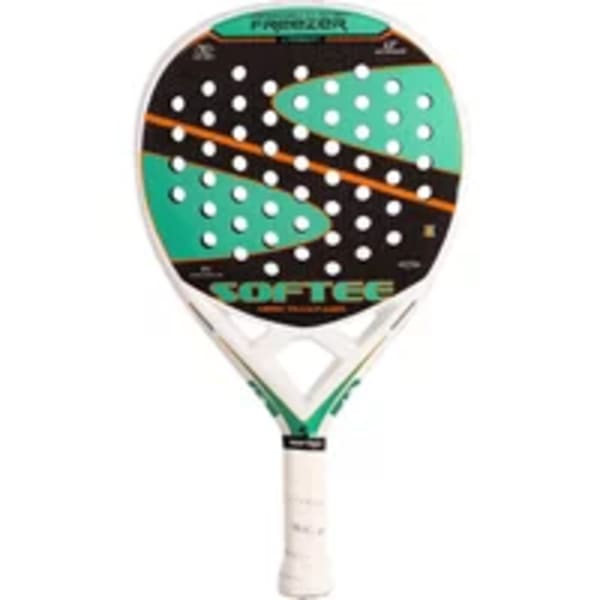
A 3K carbon face over a medium-density Black EVA core: the Softee Carbon 3K nails the jump into carbon with a 355-370 g teardrop shape, medium balance, 38 mm frame and rough finish. It's an all-round padel racket that leans slightly toward control over raw power.
What 3K carbon actually means on the hitting face
3K isn't a marketing label — it describes the carbon weave itself, with 3,000-filament strands woven in a more open pattern than tighter, denser weaves.
That openness has a real physical effect. The face flexes a touch more before releasing the ball, and that extra millisecond of contact is exactly what stops the "hitting a board" feel that puts off so many intermediates on their first carbon padel racket.
Underneath, the medium-density Black EVA core is doing the real character-shaping work. This rubber doesn't sink under impact — the return comes back compact and crisp, with no parasitic bounce.
Together they produce a feel that's both firm and elastic. Not the softness that forgives a late swing, nor the hard rubber block that punishes your arm by the end of a match.
Softee Carbon 3K spec sheet
| Spec | Value |
|---|---|
| Shape | Teardrop |
| Weight | 355-370 g |
| Balance | Medium |
| Face | 3K carbon |
| Core | Black EVA (medium density) |
| Frame | 38 mm |
| Surface | Rough |
| Level | Intermediate |
| Playstyle | All-round |
Who is the Softee Carbon 3K actually built for?
This one's aimed at intermediate players with repeatable technique who want an all-round racket leaning toward control. The 355-370 g teardrop with medium balance asks for arm speed to generate pace, but rewards you with precision on bandejas, volleys and wall-hugging balls.
Anyone still building their flat hitting is going to find this a demanding racket. The medium-density rubber doesn't hand you free ball exit — you have to generate the acceleration from the shoulder, and if the swing comes up short the ball dies mid-court.
Where the sweet spot sits on a 38 mm teardrop
The teardrop shape places the optimal hitting zone somewhat above the geometric centre of the face. It's not the generous sweet spot of a round racket, nor the tall, narrow window of a diamond — it sits in between, which in practice means solid forgiveness on natural net play and less margin for error on smashes.
The 38 mm profile brings what you'll appreciate most in this setup: lateral stiffness. Defending a deep lob with your body turned, or scrambling to a ball tight against the glass, the face doesn't twist and direction holds true.
Shot by shot: where it shines and where it comes up short
- **Bandeja and vibora.** This is where this Softee racket is at its best. The bite from the rough surface amplifies the cut, the bandeja comes out flat with a dead bounce, and the topspin vibora picks up a kick that's hard to read from the back of the court.
- **Smash.** Works well when the contact is clean and high. The core's firmness transmits energy rather than absorbing it, but it won't hand you power for free — the flat smash still lives or dies on technique, not the material.
- **Wall exit.** Medium balance lets you prepare late and close the face with your wrist without the weight dragging the swing. One of its genuine strengths.
- **Volley and block.** Crisp, predictable response. The ball doesn't jump off the face, which makes blocking deep against mid-height smashes far easier.
- **Back-court defence.** The weak spot. A long lob needs full body drive; arm alone and the ball falls short, gifting the net.
The rough finish is what you'll notice most on court
On a racket with this profile, the rough finish isn't cosmetic. It's the difference between a bandeja that bounces away and one that dies dead next to the back glass.
It's also what makes up for the limited ball exit: when you can't win the point on raw pace, you win it on spin and placement. Cut shots and touch drops into the open court both benefit directly from that bite.
Worth knowing: the roughness wears down with court time. The first month on this racket is its best month.
Player profile and ideal doubles partner
This suits the net player who builds the point: deep bandejas, vibora to open up the angle, and the smash only when the ball actually calls for it. Someone who values knowing exactly where the ball is going to land over squeezing out an extra bit of pace.
As a doubles pairing, it works well alongside a partner running a power-and-ball-exit racket. The split is clear: one player closes out points, this teardrop sustains the rally and dictates placement.
It's not the pick for the pure basher expecting the racket to do the work, nor for a player who still needs help getting the ball out of the back court.
Verdict: technical honesty over fireworks
The Softee Carbon 3K delivers exactly what its build promises: 3K carbon for a feel that never turns hostile, medium-density Black EVA for a firm response, a 38 mm frame to keep the face stable, and a rough surface built to live off spin.
What it won't do is give you power for free. At 355-370 g with this rubber, every deep ball is on your arm to produce — and that's the line between the player who'll love this racket and the one who'll struggle with it.
For an intermediate with settled technique who wants control without giving up the smash, the equation adds up.
In the brand's lineup
Within softee's lineup, the carbon 3k occupies the mid-range starting at €165, offering highly competitive value for its segment. With an overall score of 81/100, it's a solid choice within its price range.
Frequently asked questions
Who is the Softee Carbon 3K for?
The Softee Carbon 3K fits the intermediate level. Suited to players with a technical base who want to progress without jumping to a competition racket.
How much does the Softee Carbon 3K weigh?
The Softee Carbon 3K weighs 355-370g according to the manufacturer's stated specs.
What's the Softee Carbon 3K's PadelTestLab score?
The Softee Carbon 3K scores 81/100 in our review, based on power, hardness, control, maneuverability, ball exit, sweet spot and surface roughness.
How much does the Softee Carbon 3K cost?
Current price of the Softee Carbon 3K is 165€, comparing 1 shop in our finder.
Similar alternatives
Other rackets with a similar profile and price range: