RS Padel Rialto Pro 3.0
✓Cross-checked with official data from RS Padelhow we score
PADELTESTLAB SCORE
0-100 scale
81/100
Price range
Description
Who this racket is for
Pros
- ✓The aluminised 3K carbon with a soft rubber core gives a connected feel on the ball. You notice it when placing short bandejas and when resetting the point with a deep lob. The rough surface with the RS 3D surface pattern bites the ball on the vibora and the cut bandeja. The spin comes with little effort if you already know how to slice and brush the ball. With the teardrop shape, medium balance and 355-375 g, this padel racket moves just as quickly on a net volley as it does in a defensive shot from mid-court. RS Stabil Driver on the sides and the Radial Tight pattern widen the usable hitting area. A high block or a low ball dug out off the wall still goes out with direction.
Cons
- ✗Ball exit is moderate because of the soft rubber. On a par 3 or a flat smash, almost all the power comes from your arm rather than the racket. The sweet spot is not large. Badly off-centre hits are still penalised, and the system of holes and side reinforcements reduces the punishment but does not remove it. The 3D rough surface pays off if you know how to generate spin. Players who hit flat and without slice get little from that grip, and anyone looking for a racket that finishes the point on its own will come up short.
PADELTESTLAB SCORE
0-100 scale
81/100
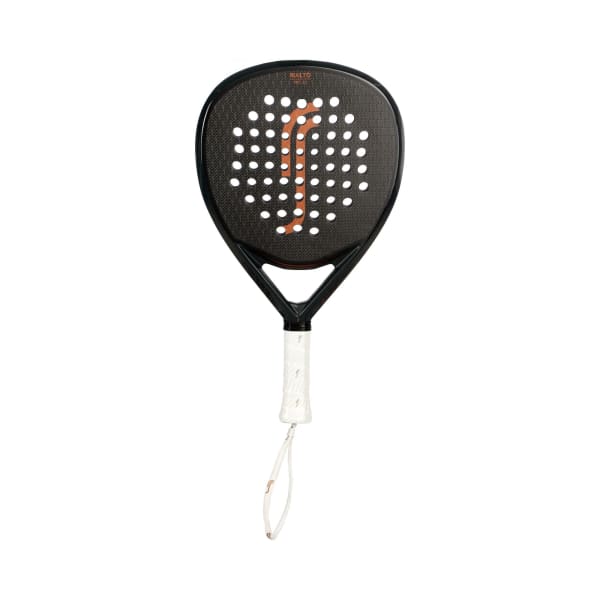
RS Padel Rialto Pro 3.0 2026: aluminised 3K carbon, 355-375 g, a 38 mm frame and RS Stabil Driver in a versatile, medium-balance teardrop designed for the advanced player.
It is the third generation of the Rialto Pro line. The line had an earlier version linked to Cayetano Rocafort in 2023, but this 3.0 is not a signature racket. It is designed for a type of player rather than for one specific player.
RS Padel Rialto Pro 3.0 review: teardrop shape and medium balance
The teardrop shape places the sweet spot at mid-height on the face. With a medium balance, the head is neither pushed forward nor left behind. The racket moves equally well on a net volley and in a defensive shot from mid-court.
The weight runs from 355 to 375 g depending on the unit. It is a racket with enough mass for the bandeja to go out with intent, and restrained enough to play several sets without the shoulder noticing.
Together, they sketch a versatile profile with control as its strongest point and maneuverability above average. Power is good, but it is not what defines the model.
| Technical data | Value |
|---|---|
| Shape | Teardrop |
| Weight | 355-375 g |
| Balance | Medium |
| Face | Aluminised 3K carbon |
| Core | RS EVA Adaptive Pro Rubber Soft (soft EVA) |
| Frame | 38 mm |
| Surface | Rough, 3D |
| Playing style | Versatile |
| Level | Advanced |
| Technologies | RS 3D surface pattern, RS Stabil Driver, RS Radial Tight hole pattern |
Aluminised 3K carbon and soft rubber: how does it feel in the hand?
The aluminised 3K carbon forms a stable carbon face that puts feel ahead of catapult. The ball stays on the face for an instant, and that is welcome when the job is to place the ball rather than push it.
The RS EVA Adaptive Pro Rubber Soft core is soft rubber. It absorbs part of the impact, lengthens the contact and softens the feeling of a harsh, dry hit. The trade-off is a moderate ball exit: on a par 3, you supply the energy.
The rough surface with the RS 3D surface pattern provides grip for spin. You can make use of it on the cut bandeja, the kick of the vibora and the topspin lob. The texture benefits players who already know how to brush the ball more than those who hit flat.
Do the RS Stabil Driver and Radial Tight really forgive off-centre hits?
RS Stabil Driver reinforces the sides to limit twisting when the ball lands far from the centre. RS Radial Tight rearranges the holes to widen the usable area. Those are the brand's design approaches, and on court the picture is more nuanced.
With a teardrop shape and medium balance, the margin for error is reasonable, not generous. A high block or a low ball dug out off the wall still goes out with direction. What the racket does not do is turn a badly timed shot into a good one.
On court: bandeja, vibora, ball off the wall and smash
Bandeja and vibora. This is where it performs best. The firm feel and the grip of the surface let you slice the ball, keep it low and direct it precisely into the corner. The vibora comes out with spin without needing an exaggerated swing.
Defence and ball off the wall. The maneuverability helps you reach late and still control the height. Coming off the wall, control matters more than power: the ball leaves clean and deep, though without the momentum of a more explosive racket.
Volley. The medium balance and restrained weight make the racket respond quickly at the net. Block volleys come out stable, while attacking ones depend on you supplying the shot.
Smash. It works for the placed par 3 and for the flat finishing smash when you have time. For driving the ball down through sheer force, this is not the most suitable model.
Who is the RS Padel Rialto Pro 3.0 for?
It is for advanced players, or strong intermediates with solid technique, who prioritise placing the ball and building the point over finishing it with force. It suits those who alternate between defence and the net, and falls short if you want a racket that finishes the point by itself.
- Suits: players who slice the ball, use spin and build the point with patience.
- Pairs well with: a partner who finishes with authority while you provide direction and consistency.
- Less suitable for: anyone who needs the racket to supply power and forgive every hit outside the sweet spot.
Where the RS Padel Rialto Pro 3.0 falls short
The soft rubber and the 3K carbon prioritise feel, and that comes at a price in power. Anyone coming from a racket with more ball exit will notice the ball asks for a fuller swing.
The 3D roughness pays off when there is technique behind it. Without spin in the shot, it is a feature that goes to waste. And the sweet spot, although protected by the side reinforcements, is still that of a teardrop: you have to look for the centre.
Verdict: a teardrop to build the point, not to finish it
The RS Padel Rialto Pro 3.0 works as a tactical racket. It is comfortable, maneuverable and stable, with a feel that helps place the ball and a grip that rewards spin.
It is not the choice for the pure hitter. It is the choice for the advanced player who plays with their head, values precision on bandejas and viboras, and is willing to supply the power with their own arm.
In the brand's lineup
Within RS Padel's lineup, the Rialto Pro 3.0 occupies the mid-range starting at €169.95, offering highly competitive value for its segment. Its overall score of 81/100 places it among the best all-round rackets we've reviewed.
Frequently asked questions
Who is the RS Padel Rialto Pro 3.0 for?
The RS Padel Rialto Pro 3.0 targets advanced players. It needs consolidated technique and is not recommended for beginners.
How much does the RS Padel Rialto Pro 3.0 weigh?
The RS Padel Rialto Pro 3.0 weighs 355-375g according to the manufacturer's stated specs.
What's the RS Padel Rialto Pro 3.0's PadelTestLab score?
The RS Padel Rialto Pro 3.0 scores 81/100 in our review, based on power, hardness, control, maneuverability, ball exit, sweet spot and surface roughness.
How much does the RS Padel Rialto Pro 3.0 cost?
Current price of the RS Padel Rialto Pro 3.0 is 169.95€, comparing 1 shop in our finder.
Similar alternatives
Other rackets with a similar profile and price range: