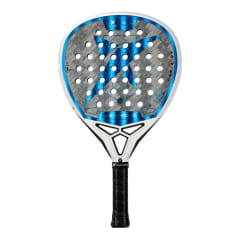
Royal Padel Japan Pro Azul
✓Cross-checked with official data from Royal Padelhow we score

PADELTESTLAB SCORE
0-100 scale
78/100
Price range
Description
Who this racket is for
Pros
- ✓The soft high-density polyethylene core delivers seriously long ball exit — the ball floats itself off the face on a blocked volley or a defensive lob from the back; the 3D Hex surface texture genuinely bites on topspin and spin shots, with a very noticeable effect on cut viboras toward the back glass; head-heavy balance in an oversize shape means real inertia on the smash and the bandeja por 3, so you don't have to muscle the arm to bury the ball; the fiberglass face filters vibration better than an equivalent carbon face, letting you play 90 minutes without hammering your elbow or wrist; carbon reinforcements in the frame hold the diamond profile together on off-center hits in a way glass-only power frames simply can't match
Cons
- ✗At 380g and with a head-heavy balance, a rushed defensive wall exit demands early prep — arrive late on a low ball and the head just won't turn in time; the sweet spot sits high and runs narrow for an oversize shape, so hits low on the face bleed a lot of pace; the softness of the polyethylene core takes bite off a crisp mid-court volley block, forcing you to tighten your grip so it doesn't sail long; this isn't a fine-control racket — on dropshots and long back-wall exchanges it gives up precision compared to round, medium-balance shapes
PADELTESTLAB SCORE
0-100 scale
78/100
It is at its lowest price since we started tracking it: €200.00, down from €259.95. We began recording on March 21.
Prices collected on 40 days between March 21 and October 15
Royal Padel Japan Pro Azul Review: The Soft-Hitting Diamond That Doesn't Punish Your Arm
The Royal Padel Japan Pro Azul is an oversize diamond padel racket weighing 360-380g with a head-heavy balance, a Fibertech fiberglass face, a soft high-density polyethylene core, and a 3D Hex textured surface. On paper it reads as a pure power stick; in hand it feels a lot friendlier than that spec sheet suggests.
The racket also circulates under the name "Tomita Kazuki Japan Pro," pointing to some connection with the Japanese player, though that link isn't fully confirmed. Either way, the name fits the intent: an attacking racket built on the soft-touch philosophy Royal Padel has championed for decades.
Royal Padel Japan Pro Azul Specs
| Spec | Value |
|---|---|
| Shape | Diamond |
| Level | Advanced |
| Playstyle | Power |
| Weight | 360-380 g |
| Balance | High (head-heavy) |
| Face | Fiberglass (Fibertech) |
| Core | Polyethylene (EVA) |
| Surface | Rough, 3D texture |
| Technologies | 3D Hex texture, Fibertech |
How Can a Power Racket Feel This Soft?
The trick is separating two things people usually lump together: geometry and materials. The geometry on this padel racket is aggressive — diamond shape, head-heavy balance, oversize head — and that's what generates impact inertia. The materials are the opposite story: Fibertech fiberglass and a soft high-density polyethylene core.
The result is a racket that pushes through mass rather than stiffness. The ball doesn't rocket off on a hard, dry rebound — it leaves because the head is heavy and swinging with momentum. That completely changes how it feels in your hand.
Fiberglass flexes more than carbon at contact and returns energy with a slight delay. That delay is what you read as "touch": the ball stays on the strings a fraction longer and leaves on a longer, flatter trajectory.
Where the 3D Hex Texture Actually Makes a Difference
The hexagonal surface texture is one of the few rough-face treatments you notice immediately on court. Not on flat drives, where it's irrelevant, but on anything carrying spin.
On a cut vibora toward the back glass, the grip is obvious — the ball comes off with more sidespin and dies faster after the bounce. On a topspin drive from the back, the 3D Hex lets you lift the ball comfortably over the net without losing depth.
Low slice shots benefit too. On a smooth-faced racket, a mid-height cut tends to skid off; here, the rough 3D grain holds the ball just long enough for the full spin to transfer.
One caveat: texture wears down. It's a consumable, not a permanent trait, and high-volume weekly players will notice the bite fading over a few months.
Shot-by-Shot Breakdown: Where It Shines and Where It Costs You
Smash and bandeja por 3. This is home turf. At the top end of the weight range (380g) with head-heavy balance, the head drops on its own — no need to accelerate the arm to put the ball away. Drop to the lighter 360g build and you trade a bit of punch for better repeatability.
Bandeja. The soft polyethylene core works in your favor here in an unexpected way. The bandeja doesn't sail long easily because the racket doesn't over-rebound, which lets you play a controlled mid-height shot and drop it into the corner without fear of overhitting.
Volley. This is the most split-personality shot. A deep blocked volley feels effortless thanks to generous ball exit, but a crisp mid-court volley block demands a firmer grip — the core's absorption takes off bite and the ball can run long.
Defense and wall exit. This is where the profile costs you. Head-heavy balance on an oversize shape means the head is slow to turn, and a rushed wall exit demands very early preparation. Arrive late on a low ball and no amount of wrist snap will save you.
Lob. Surprisingly comfortable. Long ball exit lets you send the lob deep without forcing the swing, even from awkward positions.
What Level of Player Is the Royal Padel Japan Pro Azul For?
Short answer: upper-intermediate to advanced players with an offensive, net-based game. The weight and head-heavy balance demand an already-solid smash technique and strong defensive positioning. A mid-level player still developing technique will find it sluggish from the back and hard to control on rushed balls.
The ideal fit is a backhand-side power hitter who lives off the smash por 3 and the vibora, and who has ruled out other power rackets due to joint discomfort. The fiberglass-and-soft-EVA combo filters vibration noticeably better than an equivalent rigid carbon racket, and that's probably its strongest selling point.
As a doubles pairing, it works best alongside a builder-style partner who can sustain rallies from the back, since this isn't a racket designed to win points through long-range precision.
Verdict: Power Through Mass, Not Stiffness
The Japan Pro Azul solves a real problem: giving diamond-shape power to players who can't tolerate the harshness of a high-end carbon racket. It gets there through mass and geometry rather than material stiffness, and the 3D Hex texture adds a layer of spin control that's uncommon in this segment.
In exchange, there are three trade-offs to accept. The sweet spot, shifted high on the face, is narrow for an oversize shape and punishes low contact. Defensive maneuverability is limited. And in the fine game of dropshots and long back-wall rallies, it cedes ground to a round, medium-balance shape.
If control is your top priority, this isn't your racket, and no amount of surface texture will change that. If you want soft-feeling power and have the level to handle 380g with the weight up top, it's a coherent proposition from start to finish.
In the brand's lineup
Within royal padel's lineup, the japan pro sits at the premium tier starting at €200. It's a serious investment, but justified if you want top-tier materials and peak performance. At 78/100, it serves its purpose, though there are stronger alternatives on the market.
Frequently asked questions
Who is the Royal Padel Japan Pro Azul for?
The Royal Padel Japan Pro Azul targets advanced players. It needs consolidated technique and is not recommended for beginners.
How much does the Royal Padel Japan Pro Azul weigh?
The Royal Padel Japan Pro Azul weighs 360-380g according to the manufacturer's stated specs.
What's the Royal Padel Japan Pro Azul's PadelTestLab score?
The Royal Padel Japan Pro Azul scores 78/100 in our review, based on power, hardness, control, maneuverability, ball exit, sweet spot and surface roughness.
How much does the Royal Padel Japan Pro Azul cost?
Current price of the Royal Padel Japan Pro Azul is 200€, comparing 1 shop in our finder.
Similar alternatives
Other rackets with a similar profile and price range: