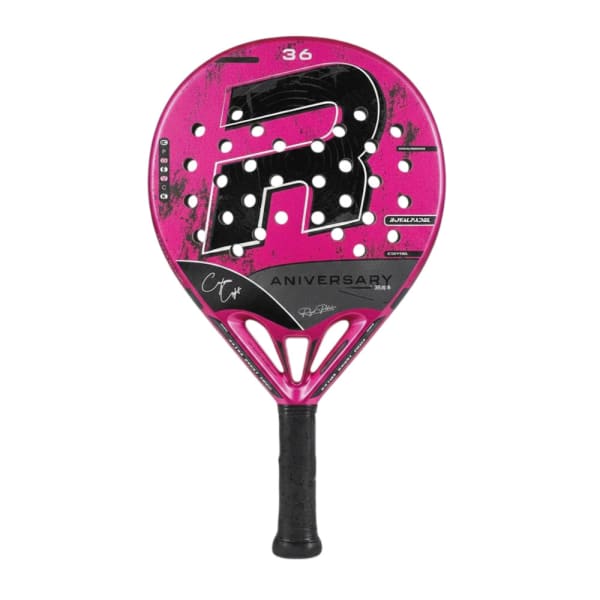
Royal Padel 36 Aniversario Pink Light Edition
✓Cross-checked with official data from Royal Padelhow we score
PADELTESTLAB SCORE
0-100 scale
83/100
Price range
Description
Who this racket is for
Pros
- ✓The high-density polyethylene core soaks up impact on wall exits and defensive lobs, so the ball comes off the face on its own without you forcing the arm; the double-layer aluminized Fiber Tech face gives a soft, highly informative feel on block volleys, letting you feel exactly where contact happens before redirecting it; at 350-365g with a low balance the racket swings into position fast during tight net exchanges and lets you fix rushed hip-height volleys on the fly; the rough 3D HEX finish bites into the ball for cut bandejas and backspin dropshots, holding the spin longer on artificial turf courts; and the Shock Absorption system cuts residual vibration on off-centre hits — a real selling point if your elbow's been giving you trouble but you still want to play four days a week
Cons
- ✗Power isn't this racket's game: on a flat smash down the line you'll need to supply the drive yourself with body and timing, because the racket won't give energy back for free; the low balance takes inertia away from the vibora and the smash into the back glass, so the arm does more work than it would with a head-heavy racket; an advanced player used to a carbon face will notice the softer glass fiber lacking that crisp, punchy response when hunting winners; and the 38mm frame and control-oriented profile force you to build the point — if your game is about finishing fast off the first ball, this racket will slow you down
PADELTESTLAB SCORE
0-100 scale
83/100
It is at its lowest price since we started tracking it: €239.95, down from €320.00. We began recording on March 23.
Prices collected on 66 days between March 23 and October 15
The Royal Padel 36 Aniversario Pink Light Edition is a 350-365 gram teardrop racket built around a double-layer aluminized Fiber Tech glass fiber face, a high-density polyethylene core, a 38mm frame and a rough 3D HEX finish. It's a package designed not to hit harder, but to hit hard without your elbow footing the bill.
Why this Royal Padel racket is a control racket wearing a competition label
The marketing calls it a competition racket, but the build tells a different story. When a brand skips carbon on the faces and stacks double-layer glass fiber over a high-density polyethylene core, that's a control-and-comfort profile talking, not a power one.
That positioning is no accident — this racket is built with tennis elbow prevention in mind. The Shock Absorption system and the choice of soft materials both point the same direction, and the racket's stated strength is control over power.
Getting that straight before you buy saves disappointment later. If you're after a padel racket that turns an average arm into a hammer, this isn't it.
Royal Padel 36 Aniversario Pink Light Edition: full specs
| Spec | Value |
|---|---|
| Shape | Teardrop |
| Weight | 350-365 g |
| Balance | Low |
| Face | Glass fiber (Fiber Tech, double aluminized layer) |
| Core | High-density polyethylene |
| Frame | 38 mm |
| Surface | Rough, 3D HEX |
| Playstyle | Control |
| Level | Advanced |
| Technologies | Shock Absorption, Fiber Tech, 3D HEX |
How does Fiber Tech compare to a carbon face on court?
Glass fiber flexes more than carbon on contact. That stretches out the milliseconds the ball stays glued to the face and turns the shot into feedback: you can tell whether you've caught the ball on the sweet spot or clipped the frame.
On block volleys that feel is pure gold. The ball dwells on the face just long enough to angle it and drop it at your opponent's feet instead of spraying it off with no control.
The trade-off is that the response never turns crisp. Going for a winner at the net, the face pushes back less than a carbon weave would, so you need to supply more racket-head speed yourself.
The rough 3D HEX finish claws back some of that ground a different way: instead of speed, it offers grip. The cut bandeja comes off with extra rotation, and the backspin dropshot dies quicker.
The polyethylene core and 38mm frame: where you actually feel it
High-density polyethylene is a slow-rebound rubber with stable behaviour in cold conditions. It won't fire up when the court's hot or go dead when the temperature drops, so the response stays predictable session after session.
Paired with the 38mm frame, that adds up to a wide, forgiving sweet spot. Slightly off-centre hits don't punish you with that nasty vibration that shoots up the forearm.
That's where the Shock Absorption system earns its keep for real, not just on the spec sheet. If you're coming back from elbow trouble, this soft-material combination is about as forgiving as a padel racket gets.
Who is this racket actually for?
An advanced player who builds the point, defends a lot, and values placement over raw pace. The low balance and 350-365g weight make the racket quick to handle — you get to rushed volleys in time and can adjust the racket face almost at the last instant.
It suits the backhand side especially well: the player who works long wall exchanges, lifts deep defensive lobs, and waits for the opponent to break down. In doubles, it pairs nicely with a partner who supplies the finishing power from the air.
It's not the right fit for an aggressive drive-and-finish player who lives on closing points in two shots. That player will feel the racket comes up short on power for the smash down the line and lacks inertia on the vibora.
Shot-by-shot feel
- **Wall exit**: excellent. The ball comes off the face with barely any effort, even on low balls tight to the glass.
- **Defensive lob**: the soft core makes it easy to add depth without straining the shoulder.
- **Bandeja**: comfortable and precise; the 3D HEX adds extra cut to keep the ball low.
- **Volley**: highly informative, with a wide margin for error on off-centre contact.
- **Vibora and smash**: the weak point. It lacks head-heavy inertia and the face doesn't give energy back, so you need to generate the shot with technique, not the racket.
The verdict: measured comfort, capped power
The Royal Padel 36 Aniversario Pink Light Edition solves a very specific problem — playing a lot of padel without wrecking your arm — and it solves it with a coherent set of materials: glass fiber, high-density polyethylene and an anti-vibration system that's more than window dressing.
What it asks in return is that you accept its power ceiling. This is a racket for the player who wins points because the opponent misses, not because they smash it away.
If that's your game, and your elbow has already sent you a warning or two, this is one of the few rackets on the market that combines high-level control, real maneuverability and genuine shock absorption without ever feeling like a beginner's racket.
In the brand's lineup
Within royal padel's lineup, the 36 aniversario pink light edition sits at the premium tier starting at €239.95. It's a serious investment, but justified if you want top-tier materials and peak performance. Its overall score of 83/100 places it among the best control rackets we've reviewed.
Frequently asked questions
Who is the Royal Padel 36 Aniversario Pink Light Edition for?
The Royal Padel 36 Aniversario Pink Light Edition targets advanced players. It needs consolidated technique and is not recommended for beginners.
How much does the Royal Padel 36 Aniversario Pink Light Edition weigh?
The Royal Padel 36 Aniversario Pink Light Edition weighs 350-365g according to the manufacturer's stated specs.
What's the Royal Padel 36 Aniversario Pink Light Edition's PadelTestLab score?
The Royal Padel 36 Aniversario Pink Light Edition scores 83/100 in our review, based on power, hardness, control, maneuverability, ball exit, sweet spot and surface roughness.
How much does the Royal Padel 36 Aniversario Pink Light Edition cost?
Current price of the Royal Padel 36 Aniversario Pink Light Edition is 239.95€ – 299.95€, comparing 3 shops in our finder.
Similar alternatives
Other rackets with a similar profile and price range: