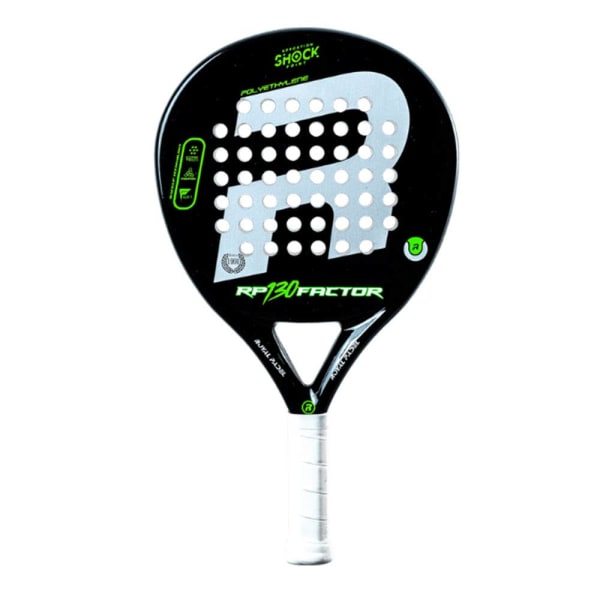
Royal Padel 130 Factor
✓Cross-checked with official data from Royal Padelhow we score
PADELTESTLAB SCORE
0-100 scale
78/100
Price range
Description
Who this racket is for
Pros
- ✓The soft polyethylene core sends the ball back with barely any effort: on defensive lobs from the back of the court, you'll reach the opponent's glass without needing to speed up your arm The Shock Absortion system filters out much of the vibration from off-centre hits, a real plus if you're carrying elbow or shoulder niggles and play three or four days a week The round shape with medium balance sits the sweet spot dead centre and makes it huge: bandejas and volleys come out clean even when contact drifts a couple of centimetres off-centre The carbon face... wait, the fibreglass face is more elastic than carbon and holds up better against wall and floor knocks, something anyone still working on their distance control will appreciate Weight spread between 350 and 370g leaves room to pick a lighter build for quicker hands at net, or a heavier one to block fast-paced balls
Cons
- ✗With just 71 in effective power, a flat smash down the middle falls short: if you're looking to close out the point in one shot, you'll need to go for the smash by 3 or find the exit through the back fence The fibreglass and smooth surface bite less than a textured carbon face: the vibora and cut bandeja lose their effect, and the bounce comes out flatter than you'd expect The medium-soft touch dampens so much that little feedback reaches the hand; advanced players who dial in direction by feel will find it a bit muted A minimum weight of 350g isn't light for an entry-level racket: in long matches, anyone without much wrist strength will feel it in the arm during the closing volleys
PADELTESTLAB SCORE
0-100 scale
78/100
Since March 20 it has ranged between €79.95 and €94.98. Today it sits at €94.98.
Prices collected on 95 days between March 20 and October 15
Royal Padel 130 Factor Review: The Beginner-Friendly Racket That Goes Easy on Your Arm
The Royal Padel 130 Factor has one very specific job within the brand's lineup: to be the padel racket that takes an intermediate player from a beginner's stick to serious padel without the usual toll of vibration and dead shots. A 38mm frame, fibreglass face, soft polyethylene core, weight of 350 to 370g and a proprietary system called Shock Absortion. Round shape, medium balance, smooth surface. No carbon, no promises of raw power — just control.
Who Should Play With the Royal Padel 130 Factor?
It's built for the intermediate player who can already place the ball but doesn't yet find the centre of the racket every time. The round shape and medium balance combine to create a huge, well-centred sweet spot, and the soft polyethylene core turns an off-centre hit into a ball that still carries direction instead of dying in the net. This is a forgiving racket, not a basher's racket.
Fibreglass and Soft Polyethylene: Why This Pairing Just Works
Fibreglass is the most elastic material commonly used in a padel racket's hitting surface. It flexes more than carbon, stores that flex, and releases it back into the ball. The practical result is a very generous ball exit: the deep defensive lob you need to reset when you've been pulled out of position comes off the strings without you having to rush your arm through it.
The soft polyethylene core reinforces that same idea. It's an EVA-style core that compresses easily and extends contact time, so the ball sits on the face for a few extra milliseconds. That's where the real control lives — you can redirect a fast ball at the last moment because the racket doesn't spit it straight back out.
The trade-off is an honest one. Everything you gain in ball exit and forgiveness, you lose in crisp response. A flat smash from the middle of the court with this racket won't close points on power; it closes them on placement.
What Does the Shock Absortion System Actually Do?
Shock Absortion is a vibration-dampening system built into the racket's structure, designed to cut down the load that hits your elbow and shoulder on impact. This isn't throwaway marketing on a racket in this segment: anyone coming from a rigid beginner racket and stepping up to three or four sessions a week is exactly the profile at risk of tennis elbow.
Combined with the flex of the fibreglass face and the softness of the core, the whole package soaks up a lot of the shock from off-centre contact. The flip side: less feedback reaches your hand. An advanced player used to steering shots by feel will find it a touch muted.
Royal Padel 130 Factor Specs
| Spec | Detail |
|---|---|
| Shape | Round |
| Level | Intermediate |
| Play style | Control |
| Weight | 350-370g |
| Balance | Medium |
| Face | Fibreglass |
| Core | Soft Polyethylene |
| Frame | 38mm |
| Surface | Smooth |
| Technology | Shock Absortion |
Shot by Shot: Where It Shines and Where It Falls Short
Off the back wall. This is its best terrain. A ball that comes off the glass low and tight needs a racket that can lift it without forcing the swing, and the soft polyethylene core does exactly that. You get depth with a short, compact motion.
Bandeja. Very reliable for direction and height. The wide sweet spot lets you play it with a straighter arm and send the ball out controlled to the side glass. What you won't get is a cut bandeja that dies on the bounce: the smooth surface and fibreglass face don't bite much, so the slice is subtle and the bounce comes out flatter than expected.
Vibora. This is its weakest shot by far. The vibora lives on sidespin and speed, and this Royal Padel model struggles to generate either with ease. You can still hit it, but as a placed attacking ball rather than an outright winner.
Smash. The smash by 3 works well because directional control is strong and the racket lets you pick your angle. The flat smash down the centre, on the other hand, needs more punch than this model offers — it comes out slower than expected, giving your opponent time to defend.
Volley and hand speed. The medium balance and round shape help with blocking and reaction time, but a minimum weight of 350g isn't light for an entry-level racket. In long matches, anyone with an untrained wrist will feel it during the closing volleys.
Player Profile and Ideal Partner
- **Intermediate players with a history of elbow or shoulder trouble.** The main reason to pick this over any rigid racket in a similar range.
- **Backhand-side players who build the point.** Defend, lob, wait for the opening, and attack when the ball sits up. This racket has your back.
- **Players stepping up from beginner level.** The fibreglass face holds up well against wall and floor contact while you're still dialling in your distances.
Skip it if your game is built around smashing hard and closing points in two shots. As a doubles partner, it works best alongside someone who does finish points: you sustain the rally, your partner puts it away.
Verdict
The Royal Padel 130 Factor delivers exactly what it promises: an entry point into serious padel that puts control ahead of power. Standout ball exit, a huge sweet spot, and genuine shock absorption. In exchange, you get limited punch on the flat smash, muted bite from the smooth surface, and a dampened feel that gives demanding players little feedback to work with.
If you value a racket that'll stick with you for a couple of seasons while your arm adjusts to more court time, this is a sound buy. If you already hit hard and want your arm speed rewarded, this isn't your racket.
In the brand's lineup
Within Royal Padel's lineup, the 130 Factor is one of the most accessible options starting at €94.98, perfect for getting started without a heavy outlay. At 78/100, it serves its purpose, though there are stronger alternatives on the market.
Frequently asked questions
Who is the Royal Padel 130 Factor for?
The Royal Padel 130 Factor fits the intermediate level. Suited to players with a technical base who want to progress without jumping to a competition racket.
How much does the Royal Padel 130 Factor weigh?
The Royal Padel 130 Factor weighs 350-370g according to the manufacturer's stated specs.
What's the Royal Padel 130 Factor's PadelTestLab score?
The Royal Padel 130 Factor scores 78/100 in our review, based on power, hardness, control, maneuverability, ball exit, sweet spot and surface roughness.
How much does the Royal Padel 130 Factor cost?
Current price of the Royal Padel 130 Factor is 94.98€ – 104€, comparing 2 shops in our finder.
Similar alternatives
Other rackets with a similar profile and price range: