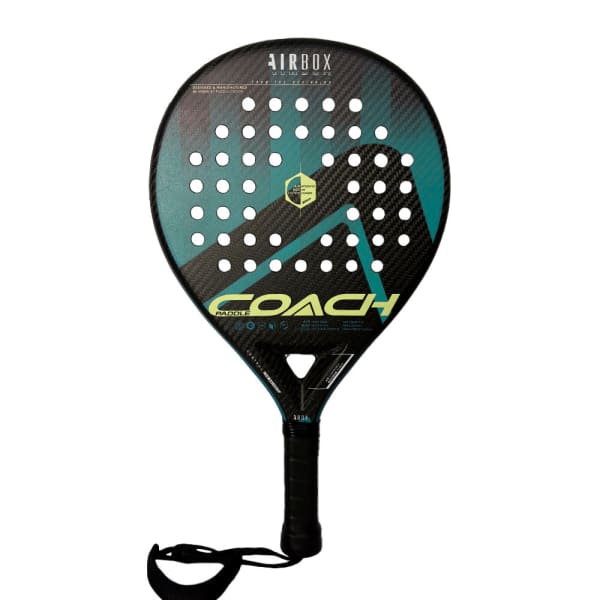
Paddle Coach Airbox Control 2024
✓Cross-checked with official data from Paddle Coachhow we score
PADELTESTLAB SCORE
0-100 scale
81/100
Price range
Description
Who this racket is for
Pros
- ✓The round shape and low balance let the racket turn on its own in your hand: on a reaction volley after a crosscourt smash, the face is already set before you have to force the forearm. The sweet spot is wide and sits right in the heart of the racket, so bandejas hit slightly off-centre near the top edge still come out with direction and without that jarring vibration that throws off your footing. The Airbox system, an internal air chamber, helps on the deep defensive shot: the exit ball off the back wall comes out with less arm effort than an equivalent control racket without that chamber would ask for. The medium-density Black EVA core paired with the 3K carbon face gives a contained but not dead response: the ball doesn't run long on the dejada or the return block, which is exactly where points get won with this profile. The 360-370 g weight is manageable through long matches: by the third set the bandeja doesn't fall apart because the arm can still hold the repetition.
Cons
- ✗Ball exit is understated: on a flat smash from the back of the court the racket doesn't help you out, and if you're looking to close the point in one shot you'll have to supply all the arm acceleration yourself. The surface is smooth, so the vibora and the cut pinchada bite less than they would on a racket with a textured face built to grip the ball: you generate the effect with technique, not with the material. The low balance costs inertia on the smash by 3: with little weight in the head, the racket doesn't drive through on its own, and the smash relies more on placement than on power. A player with an established smash will find it lacking on the finishing shot; this racket delivers when the game plan is to wear the opponent down, not when the plan is to put it away.
PADELTESTLAB SCORE
0-100 scale
81/100
Since May 7 it has ranged between €119.00 and €130.95. Today it sits at €130.95.
Prices collected on 57 days between May 7 and October 15
Paddle Coach Airbox Control 2024: The Round Padel Racket Built Around an Air Chamber
The Paddle Coach Airbox Control 2024 is a round-shaped control racket with a smooth 3K carbon face, a medium-density Black EVA core, a weight of 360-370 g and a low balance. Its standout feature is the Airbox system, an internal air chamber designed to improve ball exit on defensive shots.
It's an uncommon profile: nearly every racket aimed at the intermediate player tries to offset control with a bit of extra punch. This Paddle Coach model does the opposite and pushes maneuverability to the extreme.
What Does the Airbox System Bring to the Paddle Coach Airbox Control?
Airbox is an internal air chamber built into the racket's construction. Its stated job is to help ball exit on defensive shots: returning deep balls with less arm effort, particularly on the wall exit and the recovery lob.
In practice that translates into something concrete. When you barely reach a ball hugging the back glass and all you can do is block it, the racket helps the lob reach the far end of the court instead of dying in the middle and gifting the smash.
This isn't power: it's defensive assistance. That distinction matters, because ball exit on attacking shots stays contained and still has to be driven by technique.
Paddle Coach Airbox Control 2024: Full Spec Sheet
| Spec | Value |
|---|---|
| Shape | Round |
| Weight | 360-370 g |
| Balance | Low |
| Face | 3K Carbon |
| Core | Black EVA (medium hardness) |
| Surface | Smooth |
| Technology | Airbox |
| Recommended level | Intermediate |
| Playstyle | Control |
Smooth 3K Carbon and Black EVA: Why This Combo Won't Forgive Sloppy Technique
3K carbon is an open-weave fabric, more flexible and less stiff than high-density carbons. It delivers a forgiving response on impact and a generous sweet spot, at the cost of the rigidity that gives instant pop.
The medium-density Black EVA core is the logical complement. Not the soft foam that trampolines everything back, nor the hard EVA that needs arm speed to wake up. It's a middle ground that keeps the ball under control on the block, the dejada and the finishing volley.
The face is smooth: no texture, no grip-oriented finish. That has a direct on-court consequence: the vibora and the cut bandeja depend on your racket angle and wrist speed, not on the material biting the ball. A player with well-built cut technique will barely notice; someone coming from a racket with a textured, grippy face will notice a lot.
How It Performs, Shot by Shot
- **Volley and net block.** This is its best territory. The low balance and 360-370 g weight let you react to fast balls at the body with the face already set. The maneuverability is among the highest you'll find in a round shape.
- **Bandeja.** Comes out with direction and is repeatable. The wide, centred sweet spot forgives slightly off-centre contact, which is exactly what an intermediate player needs to lock in the shot.
- **Wall exit.** This is where the Airbox does its work. The ball comes out with less effort than you'd expect from a pure control racket, letting you recover position without burning out your arm.
- **Smash by 3 and flat smash.** Its declared weak point. With no head inertia and understated ball exit, the racket won't drive through on its own: the smash relies more on placement than on pace.
- **Vibora.** Works as a direction-changing, rhythm-breaking shot rather than a winner. The smooth surface limits how much effect you can put on it.
Who Is This Padel Racket Really For?
For an intermediate player who builds the point rather than trying to end it in one shot. This model is geared toward a defensive, control-first style: consistency, precision and wearing the opponent down before going for power.
It's a particularly good fit for someone in a technical progression phase who needs a racket that won't punish slightly off-centre contact while they're still grooving their bandeja, vibora and wall exit. Also a good call for players who feel it in the arm and want contained weight and balance.
As a doubles pairing, it works well alongside a partner who does have a finishing shot: one keeps the ball in play and opens up the gap, the other closes it out.
It's not the racket for a player who already smashes well and wants to close out points by 3. That profile will find it short on power within two weeks.
Airbox Control vs. Airbox Attack: Two Directions, Same Model
Paddle Coach splits the Airbox system across two versions with opposite intent. The Paddle Coach Airbox Attack prioritises power; the Control version reviewed here prioritises maneuverability and control.
| Airbox Control 2024 | Airbox Attack | |
|---|---|---|
| Priority | Maneuverability and control | Power |
| Typical use | Building the point | Finishing the point |
If you're torn between the two, the real question isn't level — it's role on court: which player in your pair is the one who actually finishes the points.
Verdict: A Racket That's Honest About What It Offers
The Paddle Coach Airbox Control 2024 does exactly what it promises, and does it well. It's maneuverable, the sweet spot is wide and well-centred, and the Airbox brings a genuine defensive edge that pays off in long rallies.
What it doesn't do is hide its lack of punch. The combination of low balance, contained ball exit and a smooth face puts the smash and the vibora squarely in the player's hands. That's a deliberate trade-off, not a design flaw, but it's worth knowing before you buy.
It pays off if your game is built on getting one more ball back than your opponent. It won't pay off if your match plan revolves around putting it away.
In the brand's lineup
Within paddle coach's lineup, the airbox control occupies the mid-range starting at €130.95, offering highly competitive value for its segment. With an overall score of 81/100, it's a solid choice within its price range.
Frequently asked questions
Who is the Paddle Coach Airbox Control 2024 for?
The Paddle Coach Airbox Control 2024 fits the intermediate level. Suited to players with a technical base who want to progress without jumping to a competition racket.
How much does the Paddle Coach Airbox Control 2024 weigh?
The Paddle Coach Airbox Control 2024 weighs 360-370g according to the manufacturer's stated specs.
What's the Paddle Coach Airbox Control 2024's PadelTestLab score?
The Paddle Coach Airbox Control 2024 scores 81/100 in our review, based on power, hardness, control, maneuverability, ball exit, sweet spot and surface roughness.
How much does the Paddle Coach Airbox Control 2024 cost?
Current price of the Paddle Coach Airbox Control 2024 is 130.95€, comparing 1 shop in our finder.
Similar alternatives
Other rackets with a similar profile and price range: