Kuikma Power Carbon
✓Cross-checked with official data from Kuikmahow we score
PADELTESTLAB SCORE
0-100 scale
79/100
Price range
Description
Who this racket is for
Pros
- ✓The 12K carbon face over a medium Black EVA core gives a firm feel and clear acceleration on the x3 smash and the vibora when you hit in front of your body. The diamond shape's high balance puts the mass in the head: the flat smash and the forceful ball exit off the wall gain momentum without forcing the arm. The rough surface helps you put spin on cut bandejas and topspin smashes, so the ball bites the wall and kicks up awkwardly for your opponent. The Shock Block System in the handle dampens the harsh impact of a stiff material, which is welcome in long sessions with lots of consecutive smashes.
Cons
- ✗With a high balance, late defence gets heavy: a blocked volley or a wall exit with the ball glued to the glass forces you to start your preparation earlier, and you will miss if you arrive just in time. The sweet spot is smaller than on a round padel racket: hitting off-centre on a bandeja or an emergency lob noticeably costs you power and precision. Maneuverability is limited by the combination of weight at the top of the range (361-375 g) and high balance; in fast volley exchanges at the net your arm tires sooner.
PADELTESTLAB SCORE
0-100 scale
79/100
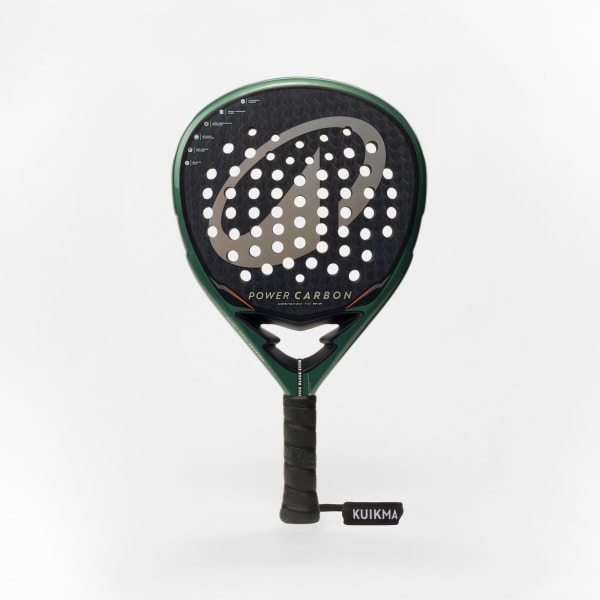
The Kuikma Power Carbon brings together a diamond shape, 12K carbon, 361-375 g and a high balance in a single idea: acceleration. With a 38 mm Twin Tube Carbon frame, it is a padel racket for players who finish points from above and accept the price of that aggressiveness.
Who Is the Kuikma Power Carbon Best Suited To?
This is an advanced-level, power-game model. It demands refined technique: early preparation, contact in front of the body and good timing. If you arrive with the ball already past you, or you tend to hit off-centre, this padel racket will give you more errors than winners.
For the player who has already mastered the x3 smash and the vibora and wants more acceleration, it makes sense. For someone still consolidating their technique, it does not.
12K Carbon and Black EVA: Two Materials Pushing in the Same Direction
The 12K carbon face is a rigid surface. It transmits energy almost without absorbing it, which translates into a crisp feel and a ball that leaves the racket fast when the strike is clean.
The medium Black EVA core does not soften it completely. It adds some compression so the ball does not feel like it is hitting a plank, but the overall response stays firm. It is a racket that asks you to supply the arm speed and gives it back without losses in return.
The rough texture of the face adds an extra: on cut bandejas and smashes with spin, the ball picks up more rotation, and you notice it when it bounces off the back wall.
Twin Tube Carbon, Shock Block System and Evolutive Hole Size, One by One
The three technologies on the spec sheet each serve a different purpose on court:
- **Twin Tube Carbon:** the 38 mm frame is the skeleton of the diamond. It provides torsional rigidity, so the hitting surface does not deform when you hit hard and the direction of the smash is maintained.
- **Shock Block System:** it sits in the handle. It filters some of the vibration generated by such a stiff racket, which matters for the elbow and forearm of anyone who smashes a lot.
- **Evolutive Hole Size:** the hole size evolves across different zones of the hitting surface, a design solution intended to balance the response of the face.
Kuikma Power Carbon Specs and Numbers
| Technical detail | Value |
|---|---|
| Shape | Diamond |
| Weight | 361-375 g |
| Balance | High |
| Face | 12K carbon |
| Core | Black EVA (medium) |
| Frame | 38 mm |
| Surface | Rough |
| Technologies | Twin Tube Carbon, Shock Block System, Evolutive Hole Size |
| Level | Advanced |
| Playing style | Power |
Smashes, Viboras and Bandejas: Where the Kuikma Power Carbon Wins and Where It Struggles
The smash is where this racket justifies itself. The high balance and the stiffness of the face turn a full swing into a deep, flat smash, and the x3 comes out fast if you hit it at the right height. The vibora, with an open face and sidespin, makes good use of the rough surface.
The bandeja is more demanding. If you hit it in the middle of the hitting surface it comes out long and with spin; if you drift towards the edge, you lose depth and the ball drops short. Control is decent, not generous: it rewards placement, not improvisation.
What Happens When You Defend with a Head-Heavy Padel Racket?
This is where the bill arrives. In defence, with the ball tight against the glass or bouncing after the wall exit, the weight in the head slows your reaction. A recovery lob or a drop volley at the net comes out worse than with a head-light racket, because you have to move more mass in less time.
Maneuverability falls below round rackets of similar weight. On fast crosscourt volleys, you need to shorten your swing and have the racket prepared in advance.
Kuikma Power Carbon Verdict: Who Should Play It and Who Should Look Elsewhere
The Kuikma Power Carbon suits the advanced player who builds their game on smashes and volleys, takes the net decisively and has solid technique. It works well alongside a partner who defends and builds the point, leaving the finishing smash to whoever carries this racket.
It is not the choice for those who play a lot from the back of the court, for those who want forgiveness on off-centre hits, or for those whose arm suffers with firm rackets over 360 g. If your game depends on defence and consistency, a round, medium-balance padel racket will win you more points than this diamond.
With the right technique, it delivers exactly what it promises: direct power, rigidity and spin in a padel racket built to attack.
In the brand's lineup
Within Kuikma's lineup, the Power Carbon occupies the mid-range starting at €109.99, offering highly competitive value for its segment. With an overall score of 79/100, it's a solid choice within its price range.
Frequently asked questions
Who is the Kuikma Power Carbon for?
The Kuikma Power Carbon targets advanced players. It needs consolidated technique and is not recommended for beginners.
How much does the Kuikma Power Carbon weigh?
The Kuikma Power Carbon weighs 361-375g according to the manufacturer's stated specs.
What's the Kuikma Power Carbon's PadelTestLab score?
The Kuikma Power Carbon scores 79/100 in our review, based on power, hardness, control, maneuverability, ball exit, sweet spot and surface roughness.
How much does the Kuikma Power Carbon cost?
Current price of the Kuikma Power Carbon is 109.99€, comparing 1 shop in our finder.
Similar alternatives
Other rackets with a similar profile and price range: