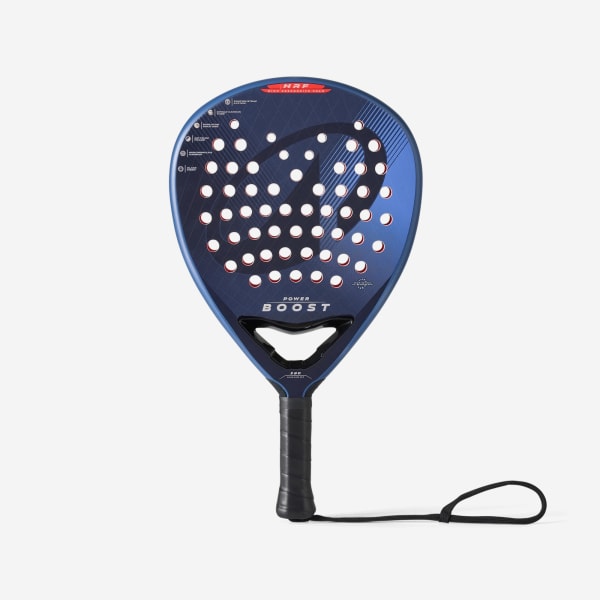
Kuikma Power Boost
✓Cross-checked with official data from Kuikmahow we score
PADELTESTLAB SCORE
0-100 scale
79/100
Price range
Description
Who this racket is for
Pros
- ✓The soft High Responsive Foam (HRF) EVA core boosts ball exit, so the x3 smash and the flat smash come off fast without a full swing, which helps when you're short of time. The rough glass fibre face bites the ball on viboras and topspin smashes, producing more spin and kick than a smooth surface, especially off the back wall. The double-tube carbon frame limits twisting on off-centre hits, keeps your precision on hard shots and adds durability to a racket made for hitting hard. The Grip Shock Block in the handle reduces vibration, which is welcome in long sessions of repeated smashes that load the elbow and wrist. At 360 g it adds mass at impact without feeling heavy on block volleys or on quick position changes at the net.
Cons
- ✗The high ball exit makes defence harder: when you block a fast ball it's tough to keep it low and short, and the ball tends to fly deeper than you intended. The bandeja demands more slice and less acceleration; too much arm sends it deep and leaves it sitting high for your opponent, which punishes anyone who doesn't control their swing well. The diamond shape and a moderate sweet spot punish off-centre hits on drop shots and delicate volleys, where it calls for a very measured stroke.
PADELTESTLAB SCORE
0-100 scale
79/100
The Kuikma Power Boost brings together three very clear construction choices: a glass fibre face with a rough finish, a soft EVA core with High Responsive Foam (HRF) and a double-tube carbon frame, all at 360 g. It's a diamond-shaped padel racket for advanced players who want power without swinging their arm flat out.
Its approach is simple: get the ball out fast with minimal swing. That philosophy shapes everything else, from the feel on the bandeja to what it demands in defence.
Who Is the Kuikma Power Boost For?
The Kuikma Power Boost is aimed at advanced players with an attacking game. Its diamond shape, power-oriented playing style and soft core are all about finishing points off easily, but a head that is less forgiving than a round one means you need to place your shot well to get the most from it.
Rough Glass Fibre and HRF: Where the Ball Exit Comes From
The glass fibre face is more flexible than a stiff carbon face, and that flex acts like a spring on contact. Combined with the HRF core, a soft EVA foam designed to accelerate ball exit, the ball leaves the face faster than the speed your arm put into it. That's why the racket performs well on short strokes.
You notice it most off the back wall: when the ball arrives with little energy, the Kuikma Power Boost still sends back a deep ball without needing a full whip of the arm.
The rough finish adds a second effect. It grips the ball on sliced and topspin shots, so the vibora and the kick on the smash come out with more bite. It doesn't replace good technique, but it amplifies the technique you already have.
Double-Tube Carbon Frame: Stability When You Hit Hard
The double-tube carbon frame reinforces the structure of the head. On court that means less twisting when you strike off-centre on a flat smash or an x3 smash, and a more precise response than a more flexible frame would give. It also helps durability, a valuable point in a racket used for hitting hard.
At 360 g, the weight sits at a sensible point: it adds mass at impact and is restrained enough that volleys and position changes don't feel heavy. Maneuverability is decent, not outstanding.
Kuikma Power Boost Specs
| Dato técnico | Valor |
|---|---|
| Forma | Diamante |
| Peso | 360 g |
| Cara | Fibra de vidrio, acabado rugoso |
| Núcleo | EVA blanda, High Responsive Foam (HRF) |
| Marco | Carbono de doble tubo |
| Tecnología de mango | Grip Shock Block |
| Nivel | Avanzado |
| Tipo de juego | Potencia |
Where the Kuikma Power Boost Falls Short: Defence, Bandeja and Delicate Volleys
The same core that gives you free ball exit penalises fine control. In defence, when you need to slow down a fast ball and return it low, the racket tends to prolong the rebound and the ball flies deeper than expected. You have to cushion the ball with your wrist and adjust your distance to the point of contact.
The bandeja is the most sensitive shot. To keep it short and low you have to slice more and accelerate less; with this padel racket, a slight excess of arm turns it into a ball that runs away to the back of the court and sits high for your opponent.
On block volleys it performs well, because the ball exit helps you find depth with very little swing. On drop shots and touch volleys, though, the soft feel of the EVA and the diamond head call for a very measured stroke. The sweet spot is moderate, so precision depends on hitting close to the centre.
Grip Shock Block: What Your Arm Will Thank You For
The handle features Grip Shock Block, a system designed to reduce vibration. On a power racket used for relentless smashing, filtering some of the impact protects the elbow and wrist over long sessions.
It doesn't replace good technique or a proper warm-up, but it's a useful detail for an advanced player who plays several times a week.
Who Should Choose This Kuikma Padel Racket?
- **Suits** advanced players whose main weapon is the smash: flat smash, x3 smash and vibora.
- **Suits** anyone who goes to the net to close out the point and wants power without lengthening the swing.
- **Suits** a partner who builds the point with control and leaves the finishing to you.
- **Doesn't suit** anyone who builds from defence and prioritises the short bandeja and low balls.
- **Doesn't suit** players who still can't control the speed of their swing, because the ball exit amplifies mistakes.
Verdict: Power in Exchange for Control
If your game is decided by the smash and you want the ball to come off with little effort, the Kuikma Power Boost delivers. High Responsive Foam, a rough glass fibre face and a double-tube carbon frame make for a coherent package aimed at a single goal.
The price is control: defence and the bandeja need more adjustment, and the sweet spot isn't wide. For an advanced player who knows how to measure their swing, it's a well-executed attacking model. Anyone who builds from the back of the court will find control-oriented options more comfortable.
In the brand's lineup
Within Kuikma's lineup, the Power Boost is one of the most accessible options starting at €79.99, perfect for getting started without a heavy outlay. With an overall score of 79/100, it's a solid choice within its price range.
Frequently asked questions
Who is the Kuikma Power Boost for?
The Kuikma Power Boost targets advanced players. It needs consolidated technique and is not recommended for beginners.
How much does the Kuikma Power Boost weigh?
The Kuikma Power Boost weighs 360g according to the manufacturer's stated specs.
What's the Kuikma Power Boost's PadelTestLab score?
The Kuikma Power Boost scores 79/100 in our review, based on power, hardness, control, maneuverability, ball exit, sweet spot and surface roughness.
How much does the Kuikma Power Boost cost?
Current price of the Kuikma Power Boost is 79.99€, comparing 1 shop in our finder.
Similar alternatives
Other rackets with a similar profile and price range: