Hbl Get
✓Cross-checked with official data from Hblhow we score
PADELTESTLAB SCORE
0-100 scale
79/100
Price range
Description
Who this racket is for
Pros
- ✓The round shape's centred sweet spot forgives hits two fingers off the shaft — the ball still holds its line even on rushed volleys or scrappy wall exits. The glass fibre face flexes and releases the ball with a trampoline-like spring, so deep lobs and groundstrokes come off the racket without needing to muscle the swing. The soft EVA core and anti-vibration treatment filter the shock away from your elbow, which you'll feel after two hours of lessons when your technique is still a bit rigid. Low balance keeps the mass down near the grip so the racket whips through fast, letting you reach low cross-court volleys and net blocks without feeling rushed.
Cons
- ✗The power ceiling is low: on a flat smash the glass fibre cushions the ball right when you want stiffness, so closing out points with raw pace isn't really on the menu. The smooth surface barely grips the ball, meaning both the vibora and a cut x3 come out flatter and with less spin than the shot demands. Low balance costs you inertia on long bandejas from the back of the court, so you have to compensate with footwork and body weight since the racket won't do the pushing for you. It runs out of road as your level rises — anyone already defining points with confidence will notice within a few months that this racket is holding their attacking game back.
PADELTESTLAB SCORE
0-100 scale
79/100
Since May 7 it has ranged between €43.95 and €50.25. Today it sits at €50.25.
Prices collected on 76 days between May 7 and October 15
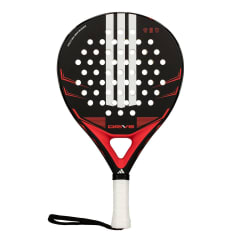
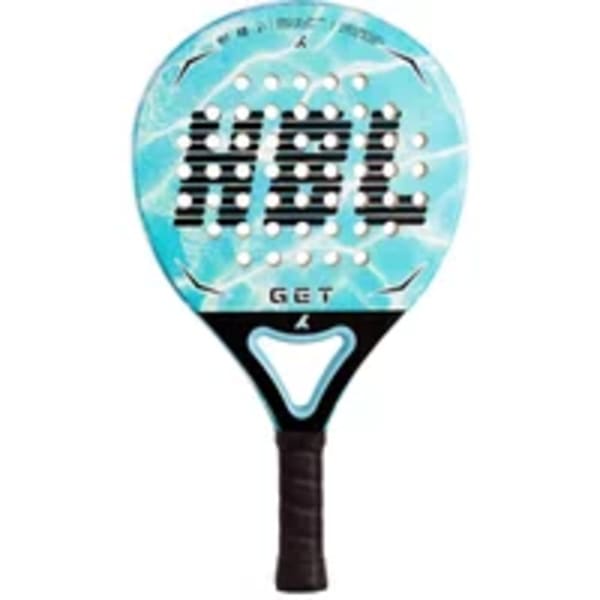
Round-shaped, with a glass fibre face and a soft EVA core, the HBL Get sums up its whole approach in a 38mm frame and low balance built so your first year of padel doesn't turn into a fight with the racket. No carbon, no tour pro backing it, no big season narrative — just a beginner padel racket engineered to forgive mistakes.
In an entry-level range, that counts for more than a spec sheet full of acronyms.
What does a glass fibre face actually give you over a stiff carbon face?
Glass fibre flexes more than a rigid weave under the same impact. That flex holds the ball on the string bed for a few extra milliseconds and sends it back with a springy, trampoline feel — exactly what you need when you're not yet generating your own arm speed.
The soft EVA core pulls in the same direction: plush rubber, a cushioned feel, and a much less harsh impact in the hand. The HBL Get also adds an anti-vibration treatment aimed at cutting arm fatigue, which matters when your contact point is still off-centre and your elbow is still tense.
The trade-off is worth being upfront about: that same flex eats into peak power. The racket carries you through medium-paced rallies on its own, but it has no ceiling for a flat smash aimed at the back glass.
Shape, balance and 38mm — the geometry that defines this racket
In a round shape the sweet spot sits at the geometric centre of the face — the widest, easiest zone to find under pressure. That's why this racket responds almost identically whether you strike dead centre or two fingers above or below it.
Low balance shifts the weight down toward the grip. That means quick handle speed and a racket that gets to the low volley in time, though it loses inertia when you try to drive a long bandeja from the back of the court.
38mm is the maximum frame thickness the rules allow, and here it's used to hold usable hitting surface and stability — not to stiffen up the response.
| Spec | Value |
|---|---|
| Shape | Round |
| Balance | Low |
| Face | Glass fibre |
| Core | Soft EVA |
| Frame | 38mm |
| Surface | Smooth |
| Playstyle | Control |
| Level | Beginner |
How does the HBL Get actually play, shot by shot?
The HBL Get feels at home on volleys, short bandejas and wall exits thanks to its wide sweet spot and low balance, and it runs out of steam on the smash. This is a control racket built to place the ball and sustain the point rather than end it in one shot.
- **Volley:** short, predictable response. The soft rubber absorbs your opponent's pace so the ball doesn't sail long on the block.
- **Wall exit:** this is where the racket makes its best case. The face springs the ball back off the glass without needing a full swing.
- **Bandeja:** comfortable on the short, cross-court version; on the deep bandeja you need to add body weight, since the low balance's inertia doesn't do the work for you.
- **Vibora and cut x3:** the smooth surface barely bites the ball. Both come out flatter and with less spin than the shot calls for.
- **Flat smash:** the weak point. The face flexes when you need stiffness, and the ball leaves with less pace than you put into it.
- **Defence and lobs:** a high ball exit lets you throw up deep lobs without straining the shoulder, even from awkward positions.
What level of player is this HBL racket built for?
Beginners, no question. This profile suits someone who's been on court for months rather than years, plays two or three matches a week, and is still grooving the mechanics of the bandeja and the wall exit.
It also works well for tennis converts with a stiff arm who need a racket that cushions impact while they rework their swing, or for a player coming back from elbow trouble who wants something soft.
As a doubles partner, this HBL model needs someone willing to carry the attacking load — the HBL Get holds the point, places the ball and gets it back, but it doesn't finish rallies.
Where it sits in the HBL lineup
HBL builds its beginner range around the HBL Get, the HBL Starter and the HBL Starter Light, all sharing the same philosophy of accessible materials and a soft response. Above that sits the HBL Strike Evo Pro line, which occupies the top tier of the catalogue.
Its price point is firmly entry-level, and that context explains its technical choices far better than any marketing copy could.
Verdict: comfort first, power ceiling later
The HBL Get delivers on what it promises. It forgives mishit balls, protects the arm and keeps the ball in play — exactly what you need while you're still learning to build the point from the back of the court.
What it won't do: hit hard. Neither the flat smash nor the vibora find the material they're asking for here, and a player who's already defining points with confidence will hit the ceiling within a few months.
If you're after a transitional racket with more stiffness and bite, look elsewhere. If you want your first racket to learn on without wrecking your elbow, this one adds up.
In the brand's lineup
Within hbl's lineup, the get is one of the most accessible options starting at €50.25, perfect for getting started without a heavy outlay. At 79/100, it serves its purpose, though there are stronger alternatives on the market.
Frequently asked questions
Who is the Hbl Get for?
The Hbl Get is built for beginner level: easy to handle and forgiving. Not the ideal pick if you already have consolidated technique.
What's the Hbl Get's PadelTestLab score?
The Hbl Get scores 79/100 in our review, based on power, hardness, control, maneuverability, ball exit, sweet spot and surface roughness.
How much does the Hbl Get cost?
Current price of the Hbl Get is 50.25€ – 54.89€, comparing 2 shops in our finder.
Similar alternatives
Other rackets with a similar profile and price range: