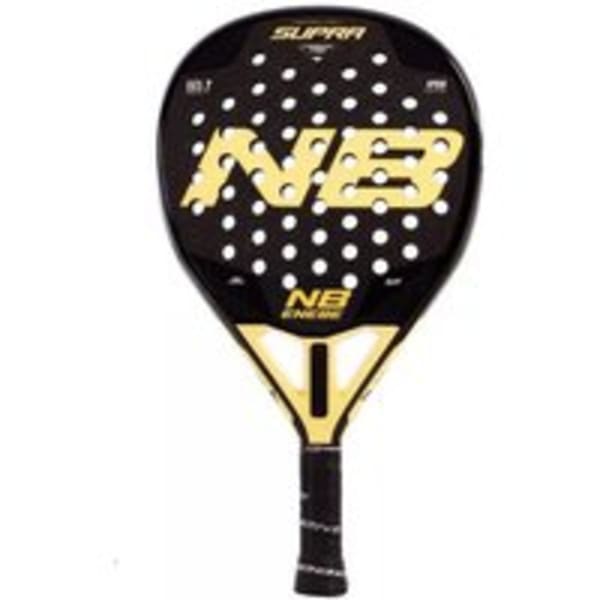
Enebe Supra
✓Cross-checked with official data from Enebehow we score
PADELTESTLAB SCORE
0-100 scale
80/100
Price range
Description
Who this racket is for
Pros
- ✓The sandy, rough face genuinely bites the ball: on cut bandejas and lifted viboras you can feel the bounce break sideways instead of skidding flat The teardrop shape with medium balance keeps the sweet spot in a neutral zone, so you can volley from mid-court without dragging weight through your forearm The Black EVA HR3 Medium core gives a controlled response on contact: the ball doesn't fire off on its own, which you'll appreciate on block volleys and short dropshots The 38 mm frame packs mass into the profile and stabilises the head when you're smashing for the back glass, so the racket face doesn't twist on off-centre hits A 360-375 g weight range gives you room to pick a lighter build for defensive play or a heavier one for extra inertia on the smash
Cons
- ✗Ball exit is understated: on defensive lobs from the back of the court you have to supply the arm yourself, the racket won't hand you depth for free The medium-to-firm core punishes off-centre contact; scramble to a wall exit and catch the ball high on the face, and it'll fall short The teardrop shape shifts the sweet spot above the geometric centre, so low shots and defensive volleys demand precise contact Built for advanced players: below that level, the stiffness-plus-weight combo takes a toll on the elbow over long sessions
PADELTESTLAB SCORE
0-100 scale
80/100
It is at its lowest price since we started tracking it: €119.95, down from €159.95. We began recording on April 23.
Prices collected on 62 days between April 23 and October 15
Enebe Supra Review: The Sandpaper-Faced Racket Built for Spin
The Enebe Supra ships in a teardrop shape with a 3K carbon face, a Black EVA HR3 Medium core, a 38 mm frame and a 360-375 g weight range. It's a medium-balance padel racket aimed at all-round advanced players, and its standout trait doesn't even show up on the spec sheet — it's in the touch: a coarse, sandpaper-like surface built to grip the ball.
What does the Enebe Supra's sandy finish actually do?
The rough texture on the face is engineered to boost spin, and that shows up in two specific shots.
On the cut bandeja, the ball comes off with extra backspin and dies before it reaches the back glass, buying you time to reset at the net. On the vibora, the sideways lift is more pronounced and the bounce kicks off toward the side wall instead of skidding straight.
It's a real edge, but one with an expiry date: any rough surface loses bite as court hours pile up. The first few months are when it's sharpest.
3K carbon and Black EVA HR3 Medium: what each layer does
The 3K carbon is an open-weave fabric. Next to tighter-weave carbons, it gives a slightly more elastic, less rigid face, which softens contact without turning mushy.
The Black EVA HR3 Medium core is the handbrake of the setup. A medium-density foam that doesn't hand back energy for free: the ball sits on the face a beat longer and leaves where you send it, not where the racket decides. That's why this Enebe model rewards players who bring their own racket-head speed rather than leaning on the material to do the work.
The 38 mm profile rounds things out by adding structural stiffness to the frame — it's what keeps the head from twisting on off-centre smashes.
Enebe Supra spec sheet
| Spec | Value |
|---|---|
| Shape | Teardrop |
| Weight | 360-375 g |
| Balance | Medium |
| Face | 3K Carbon |
| Core | Black EVA HR3 Medium |
| Frame | 38 mm |
| Surface texture | Sandy/rough |
| Level | Advanced |
| Playstyle | All-round |
Shot-by-shot: how the Supra plays
Smash to the back glass. This is where the racket shines. The 38 mm frame and the heavier end of the weight range provide enough inertia to keep the hitting plane true on contact. Go for a build closer to 375 g and the flat smash gains extra penetration.
Bandeja. The medium balance lets you reach the contact point comfortably without any dragging sensation. The rough face does the rest.
Volley. The medium core blocks well. Contention volleys come off short and controlled — ideal for players who like to build the point patiently.
Defence and wall exits. The weak spot. Ball exit is muted, so lobbing from the back of the court demands a full arm swing and sharp timing. Scramble to a wall exit and catch the ball above the sweet spot, and it'll land mid-court, gifting the net to your opponents.
Who is the Enebe Supra racket for?
For an advanced, all-round player who values control over free power.
It suits these player profiles especially well:
- **The patient net player**, who builds the point with block volleys and cut bandejas before finishing at the net.
- **The clean-technique hitter**, who generates their own racket speed and doesn't need the racket to lend it.
- **The backhand player chasing spin**, since the sandy surface rewards lift and cut over flat hitting.
It's not the right fit if you're coming from a racket with generous ball exit and you play a lot of defensive lobs — you'll notice you have to work harder to reach the back of the court.
Quick answer: is this a control racket or a power racket?
It's an all-round racket leaning toward control. The teardrop shape and 38 mm frame deliver power when contact is clean and centred, but the Black EVA HR3 Medium core reins in ball exit. The result: direction and precision over free-flowing pace.
Playing partner and weight range
The 360-375 g range leaves room to fine-tune. If you play backhand and take on most of the bandejas and smashes, go for the top of the range — the extra inertia helps on overhead shots.
If you're the drive-side player who rotates a lot and covers the net, a build closer to 360 g keeps things manoeuvrable for fast volley exchanges.
As a pair, it pairs well with a partner running a racket with more generous ball exit on the other side of the court, to cover the defensive phases.
Verdict: control with bite, at the cost of arm work
The Enebe Supra is honest about what it delivers. It gives you grip on the ball, stability on the smash and reliable control at the net, but it asks you to supply the energy yourself.
The limitations are clear: understated ball exit, a sweet spot concentrated high in the teardrop, and a firmness that punishes off-centre hits. None of that is a flaw — it's the trade-off for a racket built around precision.
If your game runs on spin, placement and point construction, this racket delivers. If you want the racket to row for you on defence, look at a softer-core option with livelier ball exit.
In the brand's lineup
Within enebe's lineup, the supra occupies the mid-range starting at €119.95, offering highly competitive value for its segment. With an overall score of 80/100, it's a solid choice within its price range.
Frequently asked questions
Who is the Enebe Supra for?
The Enebe Supra targets advanced players. It needs consolidated technique and is not recommended for beginners.
How much does the Enebe Supra weigh?
The Enebe Supra weighs 360-375g according to the manufacturer's stated specs.
What's the Enebe Supra's PadelTestLab score?
The Enebe Supra scores 80/100 in our review, based on power, hardness, control, maneuverability, ball exit, sweet spot and surface roughness.
How much does the Enebe Supra cost?
Current price of the Enebe Supra is 119.95€ – 141€, comparing 2 shops in our finder.
Similar alternatives
Other rackets with a similar profile and price range: