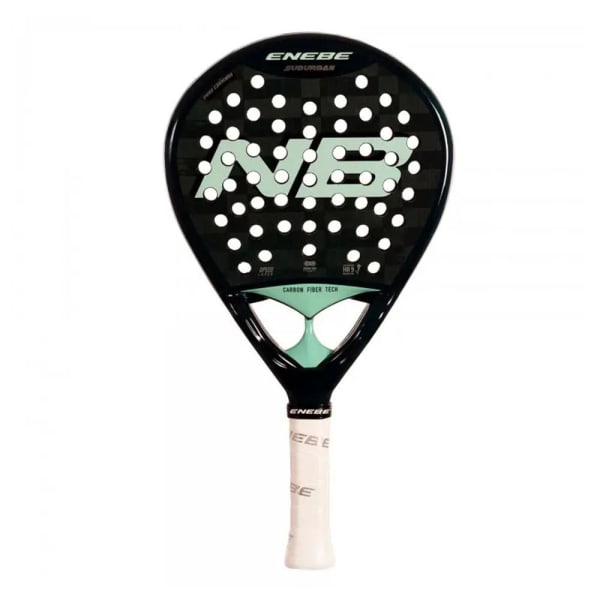
Enebe Suburban Green 12K
✓Cross-checked with official data from Enebehow we score
PADELTESTLAB SCORE
0-100 scale
81/100
Price range
Description
Who this racket is for
Pros
- ✓The 12K carbon face barely flexes on contact, so the smash por 3 and flat overhead come out with a tight trajectory and real directional control, without that trampoline effect that throws off your aim The rough surface grips the ball just enough for the vibora to come off with genuine spin and for topspin drives to actually curve, not just fly straight toward the back glass The HR9 EVA Pro core has short compression and instant rebound: feed it arm speed and it fires the energy straight back, letting you close points on attacking volleys without sending the ball long The medium balance partly offsets the diamond shape and lets you get under the ball on a bandeja more easily than the weight distribution would suggest
Cons
- ✗The sweet spot sits high and narrow because of the diamond mold; off-center contact stings the wrist and the ball noticeably loses depth Ball exit is on the tight side: a defensive lob from the back with a checked swing falls short, and you need to follow through fully for the ball to actually travel The medium-high density rubber doesn't absorb pace on delicate touches, so dejadas and chiquitas need a big reduction in hand speed or the ball bounces long On a tight wall exit you need to be well positioned with a solid base; relying on wrist alone leaves the ball sitting up in mid-court
PADELTESTLAB SCORE
0-100 scale
81/100
It is down 12% from its highest price: from €131.95 to €115.90. Tracked since March 20.
Prices collected on 148 days between March 20 and October 15
12K carbon over a 38 mm diamond-shaped mold: the Enebe Suburban Green 12K is built around an HR9 EVA Pro core and a weight range of 355-370 g. Those four specs explain most of how this racket plays before you've even hit a ball.
It's an all-court racket, but one that gives back exactly what you put in. Bring arm speed and it responds instantly; hold back and it goes flat.
What a 12K weave actually changes versus a softer face
A 12K carbon weave packs 12,000 filaments per tow, so the weave is denser and the face deforms far less on impact. On court that means less dwell time for the ball on the hitting surface, and a faster, more predictable exit.
The trade-off is an honest one: the face won't bail you out of a mishit. Nail the contact point and the feel is surgical; miss it and the ball dies short with no depth, and the shock travels straight up your forearm.
The HR9 EVA Pro core pulls in the same direction. Medium-high density, short compression, instant rebound. It's not a rubber that stores and releases energy in two stages — it's one that gives back almost exactly what you fed it.
The rough surface ties it all together and adds what stiffness alone can't: bite. The ball sits on the face a fraction longer before leaving, and that's where topspin starts to actually curve and the vibora stops being a directional shot and becomes one with real rotation.
| Tech spec | Value |
|---|---|
| Shape | Diamond |
| Weight | 355-370 g |
| Balance | Medium |
| Face | 12K Carbon |
| Core | HR9 EVA Pro |
| Profile / frame | 38 mm |
| Surface | Rough |
| Level | Advanced |
| Playstyle | All-court |
Who should actually be playing with the Enebe Suburban Green 12K?
This one's for advanced players with clean technique and sharp timing. The combination of a stiff 12K carbon face, HR9 EVA Pro rubber and a diamond shape demands centered contact and self-generated racket speed; in return it delivers fast exit, crisp response and real directional control on offense. This is not a padel racket for beginners.
Where it shines: smash por 3, vibora and bandeja
From the net up is where this racket shows its best side. The diamond weight distribution loads mass above the geometric center, adding extra swing weight right where the smash needs it.
On the smash por 3, the face doesn't give, and the ball comes out tight with the flat trajectory you need to clear the net cleanly and keep the bounce low. The flat smash behaves the same way: high pace, minimal lateral spread.
The vibora is probably the shot that makes the most of that rough surface. The bite lets you cut the ball sharply and pin it against the side glass with a short, compact swing.
The bandeja is the pleasant surprise for a shape like this. The medium (not head-heavy) balance lets you get under the ball without the lag that usually punishes heavier-headed diamonds. You still need to prepare early, but you're not consistently caught late.
On the attacking volley, that crisp, dry response works in your favor: the ball doesn't sail long because the rubber isn't giving back more than it should.
Defense and wall exits: the price you pay
Here's where it gets demanding. The sweet spot is high and narrow, and ball exit is tight. A defensive lob from the back with a checked swing comes up short, and against a pair that closes the net well, that's a lost point.
On a tight wall exit you need to arrive set, with a solid leg base, following through completely. Try to save it with wrist alone and the ball sits up in mid-court.
Touch shots are also a challenge. The medium-high density rubber doesn't absorb pace, so dejadas and chiquitas require dialing hand speed way down or the ball bounces long. They're playable, but nothing comes for free here.
Four tweaks to get the most out of it
- Start your preparation earlier than usual on defense: the head-loaded swing weight needs that extra margin to arrive with the face square.
- Aim for contact above the center of the string bed, not dead center. That's where this mold's power actually lives.
- Follow through on groundstrokes. With this rubber, a checked swing simply doesn't travel.
- At net, favor the short, cut shot over the long flat one — the rough surface does more damage than raw pace.
What you gain and what you give up with the Suburban Green 12K
You get a racket that doesn't lie to you: the ball goes exactly where you send it, and the smash comes out exactly as fast as you swing it. The stiff build with its 38 mm profile keeps the frame stable when the rally speeds up.
What you pay is physical and technical demand. At 355-370 g in a diamond layout, this racket punishes a messy smash technique, and long match afternoons will make themselves felt.
It suits the net-rushing player who wants to close points fast, ideally paired with a partner who can hold up in long backcourt exchanges. If your game is built on defending, lobbing and waiting for the opponent's mistake, this Enebe is going to ask for more than it gives back.
In the brand's lineup
Within Enebe's lineup, the Suburban Green 12K occupies the mid-range starting at €115.9, offering highly competitive value for its segment. With an overall score of 81/100, it's a solid choice within its price range.
Frequently asked questions
Who is the Enebe Suburban Green 12K for?
The Enebe Suburban Green 12K targets advanced players. It needs consolidated technique and is not recommended for beginners.
How much does the Enebe Suburban Green 12K weigh?
The Enebe Suburban Green 12K weighs 355-370g according to the manufacturer's stated specs.
What's the Enebe Suburban Green 12K's PadelTestLab score?
The Enebe Suburban Green 12K scores 81/100 in our review, based on power, hardness, control, maneuverability, ball exit, sweet spot and surface roughness.
How much does the Enebe Suburban Green 12K cost?
Current price of the Enebe Suburban Green 12K is 115.9€ – 165€, comparing 3 shops in our finder.
Similar alternatives
Other rackets with a similar profile and price range: