Enebe Space 2.0
✓Cross-checked with official data from Enebehow we score
PADELTESTLAB SCORE
0-100 scale
79/100
Price range
Description
Who this racket is for
Pros
- ✓The medium-hard density Professional Black EVA core gives you that dead, flat response on your smash: the ball comes off low and fast without the springy bounce that throws your timing off The teardrop shape with medium balance keeps the weight centred enough to close out backhand volleys mid-court without the racket running away from you The 38 mm carbon frame holds firm on off-centre contact during a low block, when the ball arrives with pace off the back glass The smooth 12K carbon face gives you a clean, direct feel on the cut bandeja: you know exactly where you made contact without having to watch the ball
Cons
- ✗The smooth, textureless face limits the bite you get on your vibora and serve kick; if your game leans on topspin, you'll feel less grip than on a rough-textured face The medium-hard core punishes anything outside the sweet spot: a wall exit that arrives just slightly off-centre falls short if you don't catch it clean At 355-370 g with a power-oriented profile, it demands a trained arm and sharp timing; over long matches the elbow feels the lack of cushioning Ball exit gives you nothing for free on defence: emergency lobs from the back need you to drive through the shot, not just block it
PADELTESTLAB SCORE
0-100 scale
79/100
It is down 36% from its highest price: from €197.95 to €127.55. Tracked since March 20.
Prices collected on 146 days between March 20 and October 15
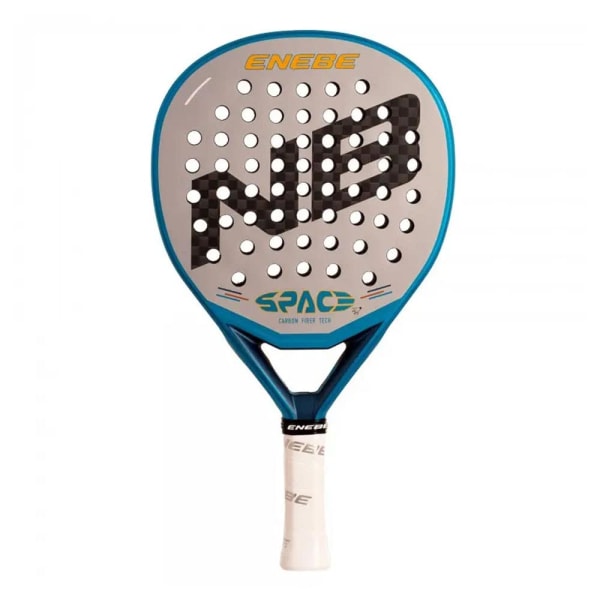
The Enebe Space 2.0 (2026) is a teardrop padel racket weighing 355-370 g with a smooth 12K carbon face, Professional Black EVA core and a 38 mm frame: built for the advanced player who attacks from the net and doesn't need the racket doing the work for them.
Enebe positions it in the 2026 catalogue as the successor to the Enebe Space 2025, sticking to what worked: dead, direct touch that gives nothing away if you don't find the centre.
What does "dead touch" actually mean on the Enebe Space 2.0?
Dead touch is that sensation of the ball leaving the face instantly rather than sitting on it: short contact time, minimal dwell, immediate return. On the Space 2.0 it comes from pairing a medium-hard density Professional Black EVA core with a smooth 12K carbon face that barely flexes on impact.
The practical upshot: a flat smash comes off fast and low, but any mis-hit shows up in your hand right away.
Enebe Space 2.0 specs
| Spec | Value |
|---|---|
| Shape | Teardrop |
| Weight | 355-370 g |
| Balance | Medium |
| Face | 12K Carbon |
| Surface | Smooth |
| Core | Medium EVA (Professional Black EVA) |
| Frame | 38 mm |
| Level | Advanced |
| Playstyle | Power |
Smooth 12K carbon on a 38 mm frame: what each piece brings
12K carbon is a high-stiffness weave, but not an extreme one. Compared with finer fibres, it feeds back more information on contact without turning glassy, which is why this Enebe model feels so communicative on short volleys and drop shots, where knowing exactly how much ball you're carrying matters.
The smooth finish is a deliberate offensive call. You gain crispness on flat, driven shots and lose bite on topspin: your vibora comes out faster but less closed, and the serve kick won't bounce as high as it would off a rough-textured face.
The 38 mm carbon frame is what holds the whole package together. A profile that thick shrugs off off-centre impact without noticeable twist, which is why the racket feels so solid on a low block when your opponent is driving the ball at you with pace from the back.
The Professional Black EVA core ties it all together. It's a medium-density rubber that sits closer to the firm end of the spectrum than the soft one: minimal compression, quick rebound, and it needs arm speed to really deliver.
Shot by shot: how it plays
Smash. This is its signature shot. The dense core doesn't store elastic energy, so the ball leaves with exactly the speed you put into it, on a flat, predictable line. Players with clean smash technique will love it; anyone leaning on the racket to make up the difference won't.
Bandeja. The direct feel of the 12K carbon face lets you cut with precision and drop the ball deep down the line. The teardrop shape's medium balance keeps the racket from getting ahead of you in the prep.
Vibora. This is where the smooth face shows its limits. The shot comes out fast and penetrating, but without the side spin a textured surface would give you. It works better as a flat, closed vibora than a heavily spun one.
Wall exit. The demanding part. The ball doesn't jump off the face on its own: catch it slightly off and just block, and it falls short, handing over the middle of the court. Time it clean and centred, though, and the response is precise.
Defence and lobs. Technique required. An emergency lob off the back needs you to drive through it, not just present the racket. In prolonged defence, your arm does the work.
Volleys. The medium balance and 38 mm frame give you the stability to close out points mid-court without the racket getting away from you on a tight backhand volley.
Who is this racket actually for?
The profile is clear: an advanced, attacking player who comes to net to finish points and has already grooved their contact point. The Enebe Space 2.0 rewards ball-strikers and punishes anyone still finding their centre inconsistently.
- **Yes, if** you hit flat, chase ball speed, and prefer dead touch over comfort.
- **Yes, if** you play most points at the net and your defence is tactical rather than pure survival.
- **No, if** you're coming from a soft round racket and want an easy transition.
- **No, if** your game relies on spin: the smooth face won't give you the topspin you're after.
- **No, if** you're carrying elbow or shoulder issues; the dense core offers no cushioning.
As a pairing racket, it works well alongside a more defensive, round-shaped partner who can sustain the rally while the Space 2.0 closes it out up top.
Verdict on the Enebe Space 2.0
This is a padel racket that delivers exactly what it promises: power and control for a player who already knows how to hit. The balance between the two is more measured than the "extra power" label suggests — the teardrop shape's medium balance and the 38 mm frame give you noticeably more precision than you'd expect from a purely offensive model.
Its two trade-offs are real and worth knowing going in: the sweet spot doesn't forgive off-centre contact, and the smooth face trims your spin repertoire. If your game is flat and aggressive, neither will bother you. If you rely on topspin or need the racket to bail you out in defence, there are better options out there.
Within Enebe's range, this model continues the line set by the Enebe Space 2025, keeping the same dead-touch, competition-focused philosophy.
In the brand's lineup
Within Enebe's lineup, the Space 2.0 occupies the mid-range starting at €127.55, offering highly competitive value for its segment. At 79/100, it serves its purpose, though there are stronger alternatives on the market.
Frequently asked questions
Who is the Enebe Space 2.0 for?
The Enebe Space 2.0 targets advanced players. It needs consolidated technique and is not recommended for beginners.
How much does the Enebe Space 2.0 weigh?
The Enebe Space 2.0 weighs 355-370g according to the manufacturer's stated specs.
What's the Enebe Space 2.0's PadelTestLab score?
The Enebe Space 2.0 scores 79/100 in our review, based on power, hardness, control, maneuverability, ball exit, sweet spot and surface roughness.
How much does the Enebe Space 2.0 cost?
Current price of the Enebe Space 2.0 is 127.55€ – 197.95€, comparing 4 shops in our finder.
Similar alternatives
Other rackets with a similar profile and price range: