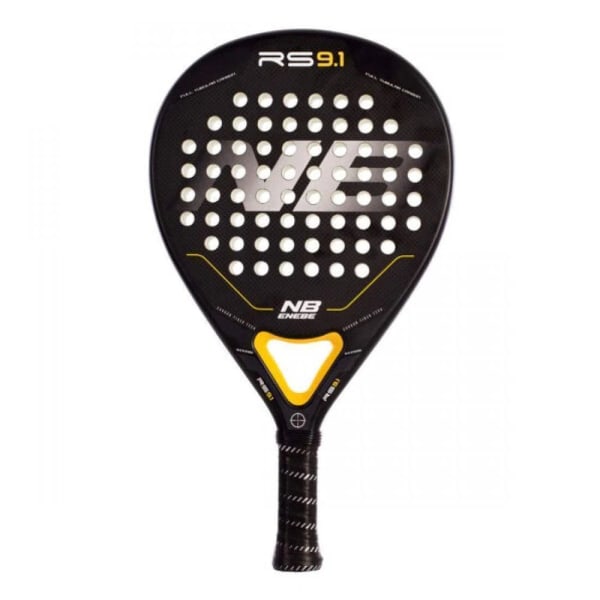
Enebe RS 9.1 Amarillo
✓Cross-checked with official data from Enebehow we score
PADELTESTLAB SCORE
0-100 scale
79/100
Price range
Description
Who this racket is for
Pros
- ✓The round shape's massive sweet spot forgives off-centre contact: mid-height volleys and blocked shots close to the body come out clean instead of dying in the net. The White EVA HR3 core rebounds quickly after impact and sends the ball back with depth off the wall, exactly where a player still building arm speed needs the help. A 38 mm frame and even balance let you snap the racket face around fast on the bandeja and on last-second adjustments under a deep lob, without losing your hitting plane. Fiberglass flexes more than a carbon weave and soaks up a good chunk of vibration on long defensive exchanges, which your elbow and wrist will thank you for over a long match. The 360-375 g weight range lets you go lighter for a sliced backhand or heavier to hold up on a finishing volley.
Cons
- ✗The fiberglass face loses bite on a flat smash down the 3 line: the ball comes out fast but without the crisp pop a stiffer face gives, so points run longer than they should. The smooth surface limits grip on a cut bandeja and on the víbora; spin depends almost entirely on your technique rather than the material doing any work for you. Even balance makes the racket easy to handle, but it leaves little mass up front on the smash: power has to come from technique and weight transfer, not the racket itself. A stronger high-intermediate player who already hits hard will notice the medium-density EVA compress and give back less than they're putting into full-speed shots.
PADELTESTLAB SCORE
0-100 scale
79/100
It is down 57% from its highest price: from €149.95 to €64.95. Tracked since March 20.
Prices collected on 98 days between March 20 and October 15
Fiberglass face, White EVA HR3 core and a 38 mm frame: the Enebe RS 9.1 Amarillo (360-375 g, round shape) is built around one clear idea — get the ball out cleanly even when contact doesn't land dead centre on the face.
This isn't a competition racket and doesn't pretend to be. It's a progression padel racket, built for players who already move well on court but haven't yet found consistent arm speed.
Fiberglass and White EVA HR3: how the RS 9.1 splits the workload
Fiberglass flexes considerably more than a carbon weave. That elasticity comes with an obvious trade-off — less crisp feedback on contact — and one clear payoff: forgiveness. The face bends and springs back, so a ball struck off-centre doesn't just die on you.
The White EVA HR3 core, with its High Recovery formula, pushes in the same direction. It's a medium-density EVA that compresses under light force and snaps back into shape quickly, returning energy without demanding a perfect strike or a fast wrist.
Combine that with the 38 mm profile and round shape, and you get a very wide sweet spot, centred and sitting fairly low, almost right above the handle. That's the defining trait of this racket, ahead of anything else on the spec sheet.
What level of player is the Enebe RS 9.1 Amarillo built for?
For intermediate players on the way up, and for advanced beginners who want a racket that'll see them through a full season of learning without falling short after three months.
Its character is all-round with a clear lean towards control: it places the ball better than it punishes it. Anyone after a racket that closes out points on its own at the smash should be looking at higher-balance, stiffer-core shapes instead — here, the power has to come from you.
Enebe RS 9.1 Amarillo: full spec sheet
| Spec | Value |
|---|---|
| Shape | Round |
| Weight | 360-375 g |
| Balance | Medium |
| Face | Fiberglass |
| Core | Medium EVA — White EVA HR3 |
| Frame | 38 mm |
| Surface | Smooth |
| Technology | EVA HR3 High Recovery |
| Level | Intermediate |
| Playstyle | All-round |
Shot by shot: where the RS 9.1 delivers and where it falls short
Ball exit off the wall. The racket's strongest argument. The HR3 core compresses, rebounds and sends the ball back with depth without you needing to speed up your arm; a deep side-wall ball stops being a lost cause and turns into a solid lob.
Volleys. The even balance keeps the head stable, and the low sweet spot means blocks close to the body come off without vibration. For a finishing volley, it's worth going towards the top of the weight range to keep the penetration you need.
Bandeja. Turns over quickly and lets you correct your contact height late. The limit is the smooth surface: cut and bounce height depend entirely on your technique, since the face doesn't bite into the ball.
Víbora. Demands wrist work and good timing. The fiberglass damps things down right when you want a crisp sound off the face, so the ball comes out longer and less venomous than you're after.
Smash down the 3 and flat smash. Time to be honest here: the ball comes out fast but without punch. With even balance and a core that compresses under load, a smash down the 3 rarely closes the point against opponents who read the back wall well.
Defence and lobbing. Comfortable and stable. This is where the face's flex works in your favour and where the racket lets you rally long without punishing your joints.
How much power does a round fiberglass racket like this actually give you?
The Enebe RS 9.1 Amarillo delivers medium power. Enough to close out points with deep volleys and mid-height smashes, but it falls short of a high-balance carbon racket. Speed here comes from easy ball exit and a wide sweet spot, not from a crisp, rigid impact.
Who it partners best with on court
It suits the player who holds the rally together, comes to net with a plan and finishes points with placement rather than force. It works especially well on the backhand side of a pairing where the drive side already brings the power, because this racket covers exactly what that side needs: handling, forgiveness and a bandeja you can repeat easily.
If both players in a pair are using soft, low-balance rackets, points will drag on. Worth knowing that before you buy.
Verdict: forgiveness over firepower
- **Buy it if** you're coming from a stiff racket that's punishing your elbow, if your misses come from off-centre hits rather than lack of power, or if you're still building your bandeja and wall exit game.
- **Think twice if** you already smash down the 3 with precision or want aggressive spin: the smooth surface and medium-density core will give you back less than you put in.
- **Skip it if** you compete and need a crisp, predictable response on every full-speed impact.
The RS 9.1 does one thing well — building confidence in your ball-striking — and knowingly gives up another — raw power. For the right player, that trade-off pays off over a full season.
In the brand's lineup
Within Enebe's lineup, the RS 9.1 Amarillo is one of the most accessible options starting at €64.95, perfect for getting started without a heavy outlay. At 79/100, it serves its purpose, though there are stronger alternatives on the market.
Frequently asked questions
Who is the Enebe RS 9.1 Amarillo for?
The Enebe RS 9.1 Amarillo fits the intermediate level. Suited to players with a technical base who want to progress without jumping to a competition racket.
How much does the Enebe RS 9.1 Amarillo weigh?
The Enebe RS 9.1 Amarillo weighs 360-375g according to the manufacturer's stated specs.
What's the Enebe RS 9.1 Amarillo's PadelTestLab score?
The Enebe RS 9.1 Amarillo scores 79/100 in our review, based on power, hardness, control, maneuverability, ball exit, sweet spot and surface roughness.
How much does the Enebe RS 9.1 Amarillo cost?
Current price of the Enebe RS 9.1 Amarillo is 64.95€, comparing 1 shop in our finder.
Similar alternatives
Other rackets with a similar profile and price range: