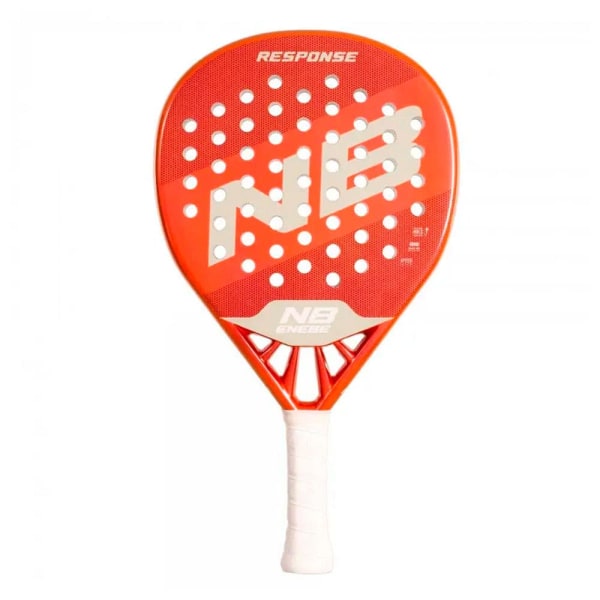
Enebe Response Orange 2025
✓Cross-checked with official data from Enebehow we score
PADELTESTLAB SCORE
0-100 scale
78/100
Description
Who this racket is for
Pros
- ✓The fiberglass face flexes on contact and gives the ball a trampoline-style rebound, so a defensive lob from the back wall comes off without needing a full swing. The medium-density White EVA HR3 core soaks up impact and, paired with the monobloc frame construction, leaves the elbow with minimal vibration after a two-hour session. The sweet spot runs wide for a teardrop shape: a bandeja still climbs with height even when you catch the ball a couple of centimetres below dead centre. The medium balance on a 360-370g frame keeps your reaction sharp enough on blocked volleys that a fast crosscourt ball at your feet doesn't catch you late.
Cons
- ✗The smooth surface doesn't bite much, so the vibora comes out flatter and bounces higher — easy to read and defend off the back wall for a well-positioned opponent. The flat smash doesn't break through. With medium balance and modest weight, closing out a smash by 3 relies on your own technique rather than the racket, and it'll keep coming back against solid defence. The fiberglass flex mutes feedback: it's hard to tell a clean cut volley from a pushed one, and an advanced player will miss that extra bit of touch. The 360-370g weight range feels heavier than it looks on less conditioned arms — forearm fatigue tends to creep in by the third set.
PADELTESTLAB SCORE
0-100 scale
78/100
Out of stock right now
None of the shops we track has it in stock right now. We last saw it on August 2 at €57.90.
See similar rackets in stockEnebe Response Orange 2025: the fiberglass padel racket that does the work for you
Iridescent orange finish, 38mm profile, teardrop shape and a weight range of 360 to 370 grams. The Enebe Response Orange 2025 pairs fiberglass faces with a medium-density White EVA HR3 core, centred balance and a smooth surface.
Everything on the spec sheet points the same way: getting the ball off your racket without a fight.
What "fiberglass face" actually feels like on court
Fiberglass flexes more than any stiff weave. On contact, the face gives just a fraction, cradles the ball, and fires it back with a trampoline effect.
On court, the translation is simple: you don't need a clean strike for the ball to clear the net. The face deforms, pushes the ball on, and a defensive lob that would die mid-court off a stiffer racket reaches the back wall here.
The trade-off is feel. A flexible face filters out sensation — it's harder to pinpoint exactly where the ball hit, and harder still to feel the difference between a crisp cut volley and a pushed one.
White EVA HR3: a medium rubber that cushions without deadening the shot
The White EVA HR3 core sits at medium density, and it's the smartest call in the whole build. A soft rubber under a fiberglass face would have made for a slow, dead racket; a hard rubber would have cancelled out the fiberglass advantage entirely.
Right in the middle, you get a plush first touch that firms up under pressure, with solid impact absorption. Combined with the monobloc frame construction, vibration reaching the elbow stays low — a real selling point if you're carrying forearm niggles.
Enebe Response Orange 2025: full spec sheet
| Spec | Value |
|---|---|
| Shape | Teardrop |
| Weight | 360-370 g |
| Balance | Medium |
| Face | Fiberglass |
| Core | White EVA HR3 (medium EVA) |
| Frame | 38 mm |
| Surface | Smooth |
| Level | Intermediate |
| Playstyle | All-round |
Who should actually buy the Enebe Response Orange 2025?
This one's built for the intermediate player still finding their game — third or fourth category amateur level, playing two or three times a week, who hasn't yet built consistent arm speed. Fiberglass, medium rubber and centred balance combine to give ball exit with minimal effort of your own, and forgive off-centre hits.
Shot by shot: where it delivers and where it falls short
Wall exit. Its standout skill. The teardrop shape with medium balance sets up fast, and the flexible face pulls the ball out from deep without a full swing.
Bandeja. Comfortable and predictable. The generously wide sweet spot for this shape lets you close out a bandeja without losing height even a couple of centimetres off-centre.
Vibora. This is where the first ceiling shows up. The smooth surface bites less, so the vibora flattens out and bounces higher than you'd want against an opponent who defends the wall well.
Smash. It hits, but it doesn't finish points. With medium balance and contained weight, the flat smash lives or dies on technique rather than mass; a smash by 3 will go over, but rarely puts the point away outright. The kick smash loses bite thanks to the smooth surface.
Volley. Stable and quick on blocked volleys. On the aggressive, put-away volley, it lacks the crisp punch a stiffer face would give.
What this padel racket won't give you
And it doesn't try to. This isn't a power racket — anyone already smashing with intent and looking for real effect will hit the ceiling fast, especially given the smooth finish.
It's also light on fine feedback. An advanced control player used to reading the ball off the face will find the response a bit muted.
And the 360-370g weight range carries more heft than it suggests for an untrained arm: the first hour feels fine, the third set is where it starts to weigh on you.
Who it suits on court
It fits the baseline player who builds the point, lobs and comes forward when the moment's right — someone who needs the ball to simply arrive, not explode.
As a pairing, it works best alongside a more aggressive partner at net who can close out the points this racket leaves open. Two players on this model will play long rallies with few winners.
For someone stepping out of beginner level and wanting an all-round teardrop racket before moving to more demanding materials, it's a solid fit: good for a season or two before you're ready to move up.
Verdict: honest about what it offers, limited beyond that
This Enebe model isn't competing on power or spin. It competes on ease of ball exit and joint comfort, and the whole build stays consistent with that goal: fiberglass, White EVA HR3 and medium balance all pull in the same direction.
If your problem is the ball not reaching the back wall, this racket solves it. If your problem is opponents comfortably returning your smashes, it won't.
Three reasons to buy it and one reason to skip it:
- Very easy ball exit with minimal arm effort.
- Notable impact absorption thanks to the medium rubber and monobloc build.
- Wide sweet spot that forgives off-centre contact on bandeja and volley.
- Skip it if you're after spin and a hard-hitting smash: the smooth surface and medium balance won't deliver that.
In the brand's lineup
Within Enebe's lineup, the Response Orange 2025 positions itself as a distinctive alternative. At 78/100, it serves its purpose, though there are stronger alternatives on the market.
Frequently asked questions
Who is the Enebe Response Orange 2025 for?
The Enebe Response Orange 2025 fits the intermediate level. Suited to players with a technical base who want to progress without jumping to a competition racket.
How much does the Enebe Response Orange 2025 weigh?
The Enebe Response Orange 2025 weighs 360-370g according to the manufacturer's stated specs.
What's the Enebe Response Orange 2025's PadelTestLab score?
The Enebe Response Orange 2025 scores 78/100 in our review, based on power, hardness, control, maneuverability, ball exit, sweet spot and surface roughness.
Similar alternatives
Other rackets with a similar profile and price range: