Dunlop Titan Killer 2.0 2024
✓Cross-checked with official data from Dunlophow we score
PADELTESTLAB SCORE
0-100 scale
76/100
Description
Who this racket is for
Pros
- ✓The medium-hardness Mega Flex Core paired with the fibreglass face lights up ball exit: defensive lobs reach the back wall without straining your shoulder, and wall-exit balls take off even when you're a touch late. The 375 g at the top end of the range, combined with a head-heavy balance, punches through the ball on the remate por 3 and on flat smashes without needing extra arm speed. The 100% carbon insert in the throat and the wavy frame keep torsion in check on vibora shots and off-centre hits toward the tip, where a fibreglass-only face would twist on you. The Energy Transfer System shifts the Power Bar's gel depending on the swing path, so the racket feels a touch more neutral on short volleys than on long-arc shots. The 38 mm profile widens the sweet spot and forgives slightly low contact on rushed smashes.
Cons
- ✗The head-heavy balance and 375 g demand you set up the bandeja earlier than usual; react late and the racket arrives under the ball, cutting the shot short. The smooth face costs you bite: short dropshots and heavily sliced bandejas need a consciously open face and a checked hand, or they'll sail long thanks to the extra ball exit. In fast net exchanges the weight bites back on the second and third block; quick-wristed, short-game players will struggle with it. The elastic feel of the medium-hardness EVA at a 38 mm profile gives less ball feedback than a firmer rubber, which players chasing a crisp, dry response will notice.
PADELTESTLAB SCORE
0-100 scale
76/100
Out of stock right now
None of the shops we track has it in stock right now. We last saw it on October 14 at €69.95.
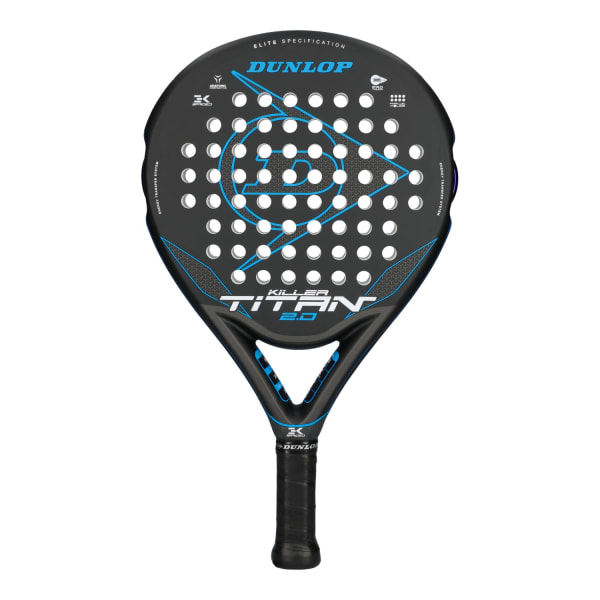
See similar rackets in stockA tube of high-density gel running through the frame — that's the starting point of the Dunlop Titan Killer 2.0 2024, a fibreglass padel racket weighing 360-375 g, with a 38 mm profile, a medium-hardness Mega Flex Core and head-heavy balance, built for the advanced player who closes points by hitting hard.
Power Bar and Energy Transfer System: weight that moves as you swing
The Power Bar is a tube housed in the frame, filled with high-density gel. The Energy Transfer System is what puts that gel to work: it slides toward the head or toward the throat depending on the type of swing, shifting mass toward power or toward control.
On court, here's what that means. When you accelerate through a long arc — a smash, a high vibora — mass travels upward and the balance loads even more into the head. On shorter, compact swings, the gel stays closer to the throat and the racket responds a bit more neutrally.
The dominant feel is still that of a head-heavy racket; the system doesn't turn it into something else. But it explains why the same frame behaves differently on a flat smash than on a blocked volley.
Why does the Dunlop Titan Killer 2.0 produce such fast ball exit?
Three construction choices all point the same way: the fibreglass face flexes more than a carbon weave, the medium-hardness EVA core returns that flex instead of absorbing it, and the 38 mm profile widens the rebound surface. The result is huge ball exit for minimal arm effort.
That's the defining trait of this padel racket. It doesn't demand pinpoint technique to send the ball flying: defensive lobs from the back reach the opposite wall without straining your shoulder, and wall-exit balls take off even when your timing is tight.
The trade-off shows up in the finer shots. With so much pop and a smooth surface, short dropshots and heavily sliced bandejas require you to consciously open the face and check your hand; play them on autopilot and they'll sail long.
Dunlop Titan Killer 2.0 2024 spec sheet
| Spec | Value |
|---|---|
| Level | Advanced |
| Playstyle | Power |
| Balance | Head-heavy |
| Weight | 360-375 g |
| Face | Fibreglass |
| Core | EVA Medium (Mega Flex Core) |
| Frame | 38 mm |
| Surface | Smooth |
| Technologies | Power Bar, Energy Transfer System, wavy frame, 100% carbon throat insert |
Shot by shot: where it wins and where it costs you
- **Remate por 3 and flat smash.** Its natural habitat. Top-of-range weight plus head-heavy balance punches through the ball without extra swing speed; the wide frame forgives slightly low contact on rushed smashes.
- **Vibora.** The wavy frame and the 100% carbon throat insert supply the torsional stiffness fibreglass alone wouldn't offer. Off-centre hits toward the tip twist the face less than you'd expect.
- **Bandeja.** The demanding stroke. The head-heavy inertia forces you to start the movement earlier; prepare late and the racket arrives under the ball.
- **Defence and wall exits.** Ball exit papers over technical gaps: you get deep lobs almost for free.
- **Volleys.** Blocks fast balls well through sheer mass, but on the second and third exchange at net the weight starts to tell.
Who is this Dunlop racket built for?
For the advanced player with a healthy shoulder and a long-arc swing who looks to close points up top, typically off the backhand. You need solid smash technique and, above all, anticipation — the extra weight punishes late reactions.
This isn't a step-up racket from intermediate level. Even though the huge ball exit makes contact forgiving, the limited maneuverability penalizes anyone still catching up on court positioning, and the medium-firm, elastic feel of the core doesn't give the feedback you'd get from a harder rubber.
As a pairing, it works best alongside a more controlling, manageable partner who covers the short game and the net approach, leaving the Titan Killer 2.0 to finish points.
Verdict: huge ball exit for minimal arm effort, in exchange for agility
What you're buying here is a launcher. Fibreglass, a medium-hardness core and a 38 mm profile combine to return energy generously, and the Power Bar adds a layer of dynamic mass distribution that you feel most on long-arc shots.
What you're paying for is maneuverability and bite. The smooth face limits spin on slices and topspin compared with a rough finish, and the 360-375 g with head-heavy balance shows no mercy if you're late to the bandeja.
If your game is about building points, changing rhythm and playing short balls, this isn't your racket. If your matches get decided by how many remates por 3 you close out, the Dunlop Titan Killer 2.0 2024 puts the weight exactly where you need it.
In the brand's lineup
Within Dunlop's lineup, the Titan Killer 2.0 positions itself as a distinctive alternative. At 76/100, it serves its purpose, though there are stronger alternatives on the market.
Frequently asked questions
Who is the Dunlop Titan Killer 2.0 2024 for?
The Dunlop Titan Killer 2.0 2024 targets advanced players. It needs consolidated technique and is not recommended for beginners.
How much does the Dunlop Titan Killer 2.0 2024 weigh?
The Dunlop Titan Killer 2.0 2024 weighs 360-375g according to the manufacturer's stated specs.
What's the Dunlop Titan Killer 2.0 2024's PadelTestLab score?
The Dunlop Titan Killer 2.0 2024 scores 76/100 in our review, based on power, hardness, control, maneuverability, ball exit, sweet spot and surface roughness.
Similar alternatives
Other rackets with a similar profile and price range: