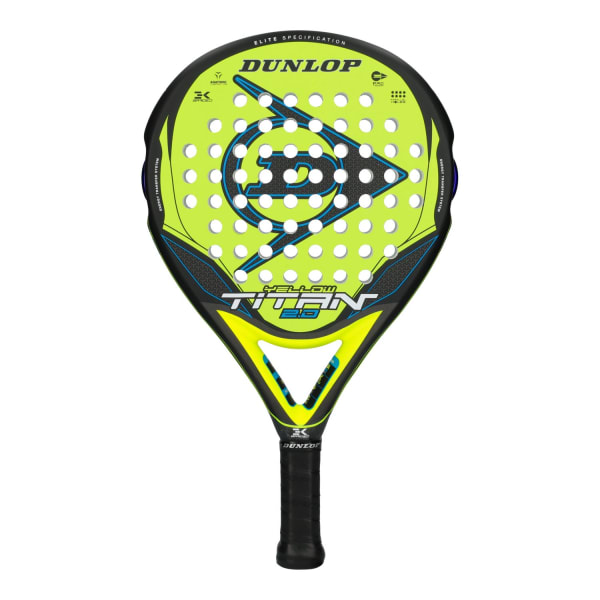
Dunlop Titan 2.0 Amarilla Azul
✓Cross-checked with official data from Dunlophow we score
PADELTESTLAB SCORE
0-100 scale
78/100
Description
Who this racket is for
Pros
- ✓The Power Bar redistributes the frame's weight depending on the shot: it drops toward the handle on wall exits and shifts up to the head when you load up for a smash from the back, something a fixed balance simply can't match The fibreglass face over a medium EVA core delivers exceptional ball exit: deep lobs and blocked volleys reach the back wall off half a swing, with no need to muscle the arm The Carbon Bridge stiffens the lower arc of the frame and filters out vibration, so hits low on the face still feel clean and controlled instead of jarring A wide sweet spot for a teardrop shape: a cross-court bandeja hit high and slightly off-centre still holds its height and depth without any wrist correction
Cons
- ✗At 360-375g this racket sits toward the heavy end of the market; by the third set it shows up in reaction volleys and defensive shots where you're just a touch late The smooth surface limits bite on heavily sliced viboras and topspin from the back against rough-textured rackets: the ball comes off fast, but with less spin The glossy finish scuffs easily on wall and floor contact — a cosmetic price, but one that shows up quickly The medium EVA core soaks up some of that dry, sharp pop: pure smashers chasing maximum kick will find more punch from a hard core with a head-heavy balance
PADELTESTLAB SCORE
0-100 scale
78/100
Out of stock right now
None of the shops we track has it in stock right now. We last saw it on October 14 at €69.95.
See similar rackets in stockThe Dunlop Titan 2.0 in yellow and blue moves mass around the perimeter of its 38mm frame: toward the handle when you drop down to defend, toward the head when you load your arm to attack. Built around that idea is a teardrop-shaped racket with a fibreglass face, a medium EVA Mega Flex Core, and a weight of 360-375g.
This isn't a pure power racket, nor is it a control-only board. The balance of its performance tips slightly toward control over pop, backed by outstanding ball exit and a wide sweet spot for a teardrop shape.
What actually changes in the Power Bar between a wall exit and a smash?
The perimeter channel houses a weight that shifts with the swing. When you drop the racket to defend, the weight falls toward the handle: the effective balance point lowers and the head gets under the ball sooner. When you load up for a smash, that weight climbs back toward the head, adding inertia to the impact. It's a mid-balance racket that behaves like two different rackets depending on the shot.
On court, that translates into something concrete: this padel racket doesn't punish rushed defensive digs off the glass the way a head-heavy frame would, and it still keeps its punch when the ball sits up for a smash from position 3.
The effect isn't dramatic point by point. It shows up over longer rallies, when you're stringing together two lobs and a flat smash with no time to reset your grip.
Fibreglass and Mega Flex Core: why the ball just comes off the face
A fibreglass face flexes more than a carbon weave under the same impact and returns that flex as extra pace. Paired with a medium EVA core, it produces the racket's standout trait: ball exit well above average.
On court that means: deep lobs come off without having to muscle the arm, blocked volleys reach the back of the court off half a swing, and cross-court bandejas hold their height without forcing the wrist. This is a racket that works in your favour once your arm has already had enough.
The Carbon Bridge supplies the other half of the equation. It stiffens the structure where it flexes most — the lower arc of the frame — and filters out a good chunk of the vibration from off-centre hits. The result is a clean feel even when you're catching the ball low on the face.
Dunlop Titan 2.0 yellow/blue: spec sheet
| Spec | Value |
|---|---|
| Shape | Teardrop |
| Weight | 360-375g |
| Balance | Medium |
| Face | Fibreglass |
| Core | Medium EVA (Mega Flex Core) |
| Frame | 38mm |
| Surface | Smooth |
| Technologies | Power Bar, Carbon Bridge |
| Recommended level | Advanced |
| Playstyle | All-round |
Shot by shot: where it delivers and where it falls short
- **Smash from position 3 and flat overheads:** the inertia the head picks up as you raise your arm gives you the punch you need, though the medium EVA core softens some of the dry, sharp pop a pure smasher is after.
- **Bandeja and vibora:** the wide sweet spot forgives high, off-centre contact; the vibora comes off fast, but with less bite than you'd get from a rough-textured face.
- **Wall exits:** its strongest suit. Mid-balance, agile handling and a lively rebound that turns tricky defensive situations into deep lobs.
- **Volleys:** a very lively response — maybe too lively on short, angled put-away volleys at the feet, so it's worth closing the face a touch more than usual.
- **Topspin from the back:** the smooth surface limits grip on heavily sliced or heavily topspun shots.
Who is this Dunlop teardrop racket really for?
The recommended level is advanced, and that checks out: at 360-375g this racket sits toward the heavy end of today's market, calling for a trained arm and solid technique so you're not nursing a sore shoulder by match's end.
Even so, the generous sweet spot and all-round character keep it accessible to an improving intermediate who already has solid positioning and is happy to let the racket generate some of the pace for them.
It suits players who switch between defending and coming to net especially well, since the Power Bar rewards exactly that transition. It's less suited to someone who lives purely for kick and maximum-power smashes — that player will get more out of a hard core with permanently head-heavy balance. As a doubles pairing, it works well alongside a clearly attack-minded partner who takes care of finishing the point.
Verdict: genuine all-round performance, with two trade-offs
The Dunlop Titan 2.0 delivers on its promise: a balance of power, control and structural durability, with ball exit strong enough to keep your game going once your legs start to tire. The Carbon Bridge shows up in the comfort department, and the 38mm frame never feels soft despite the medium core.
There are two trade-offs worth knowing before you buy. The weight, high even within its own bracket, demands you get set early on defence. And the glossy finish scuffs easily — it won't compromise the frame, but the racket stops looking new pretty fast.
If you're after a teardrop racket that gives you depth without burning your arm and forgives off-centre contact, this Dunlop has a strong case. If you're chasing bite and a dry, sharp hit, look toward rough-textured surfaces and harder cores instead.
In the brand's lineup
Within dunlop's lineup, the titan 2.0 positions itself as a distinctive alternative. At 78/100, it serves its purpose, though there are stronger alternatives on the market.
Frequently asked questions
Who is the Dunlop Titan 2.0 Amarilla Azul for?
The Dunlop Titan 2.0 Amarilla Azul targets advanced players. It needs consolidated technique and is not recommended for beginners.
How much does the Dunlop Titan 2.0 Amarilla Azul weigh?
The Dunlop Titan 2.0 Amarilla Azul weighs 360-375g according to the manufacturer's stated specs.
What's the Dunlop Titan 2.0 Amarilla Azul's PadelTestLab score?
The Dunlop Titan 2.0 Amarilla Azul scores 78/100 in our review, based on power, hardness, control, maneuverability, ball exit, sweet spot and surface roughness.
Similar alternatives
Other rackets with a similar profile and price range: