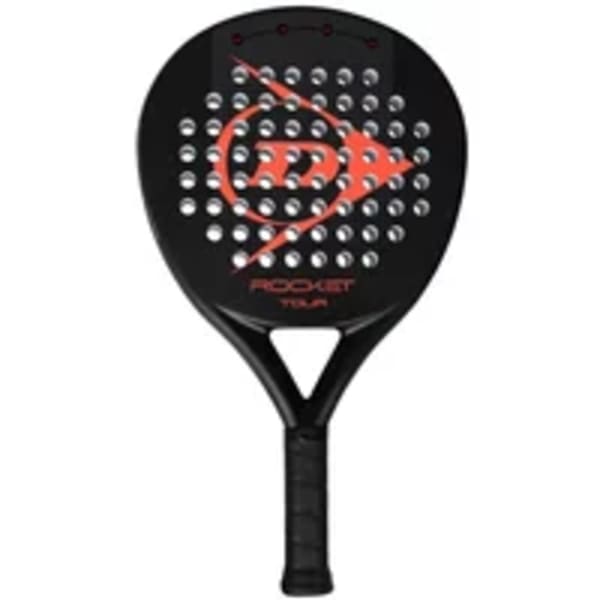
Dunlop Rocket Tour
✓Cross-checked with official data from Dunlophow we score
PADELTESTLAB SCORE
0-100 scale
82/100
Price range
Description
Who this racket is for
Pros
- ✓That massive sweet spot from the glass fibre face means a ball struck two fingers below centre still comes out with direction — a real asset when you're stretched on a volley The Pro EVA core makes wall exits a breeze: no need for a long follow-through, just present the face and the ball comes back with depth At 365 g and even balance the head doesn't drop on the bandeja, so you can prepare late and still connect above the shoulder The rough surface bites into the ball on defensive lifts and cut drop shots, adding a touch of spin without needing extra arm speed The 38 mm frame adds structural stiffness without piling weight into the head, which means less forearm fatigue over long matches
Cons
- ✗The glass fibre soaks up part of the impact energy: on the smash off the back wall and the flat smash the ball comes out with less penetration than off a carbon face The vibora loses bite because the face flexes before releasing the ball, so the shot comes out flatter than you're looking for when closing out a point The fixed 365 g weight leaves little room to manoeuvre: there's no lighter version for players who prefer a nimbler racket on quick volleys A player with settled technique will hit the ceiling fairly soon, especially on finishing shots that demand a crisper response than the racket gives
PADELTESTLAB SCORE
0-100 scale
82/100
Round-shaped, a fixed 365 g and a glass fibre face over a Pro EVA core: the Dunlop Rocket Tour doesn't hide who it's built for. A 38 mm frame, even balance and rough surface round out a control racket aimed at players who don't yet strike the ball consistently and need the equipment to cover for their mistakes.
Glass fibre and Pro EVA: the combo that makes this racket forgiving
Glass fibre is the most flexible material used in padel racket faces today. It flexes more than carbon on impact, filters out vibration and, crucially, keeps a similar feel across the whole hitting surface.
That's where the racket's real strength lies: a very wide sweet spot. Balls struck below centre or near the frame still come out with direction instead of dying in the net — exactly what a player who hasn't yet nailed a consistent contact point needs.
The Pro EVA core sits at a medium density. It's not the soft rubber that sinks in and gives little back, nor the hard EVA that needs arm speed to wake up. It compresses just enough for the ball to stay on the face a fraction longer, and that compression translates into a generous response that's especially welcome on block volleys.
The 38 mm profile rounds off the design. It's the maximum thickness allowed in competition and adds structural stiffness to the frame without loading up the head, which helps keep the balance sitting in the middle.
Who is the Dunlop Rocket Tour actually for?
Beginners and social players who prioritise keeping the ball in play over hitting hard. The flexible face and wide sweet spot forgive off-centre contact, and the 365 g weight with even balance lets you get to the volley in time without punishing your forearm over a two-hour match.
Tech specs
| Spec | Value |
|---|---|
| Shape | Round |
| Weight | 365 g |
| Balance | Even |
| Face | Glass fibre |
| Core | Medium EVA (Pro EVA) |
| Frame | 38 mm |
| Surface | Rough |
| Playstyle | Control |
| Level | Beginner |
Shot by shot: where the Rocket Tour delivers and where it falls short
Wall exits. This is where it shines brightest. The ball practically plays itself out: no need for a long follow-through or a full-body swing, just get the face on it and the rebound does the rest. For anyone still learning to read the glass, that's free points.
Defence and lobs. Control is high and depth is easy to dial in. The lob goes long without forcing it, and the rough surface adds a bit of lift on low balls.
Bandeja. Easy to handle. The head doesn't drop, so you can prepare late and still connect above the shoulder with the racket staying balanced. The ball comes out controlled rather than sharply cut, at mid-height.
Vibora. This is where the ceiling shows. The face flexes before releasing the energy back, so the shot comes out flatter than intended, with less lateral bite.
Smash. The weakest link. On the smash off the back wall and the flat smash, it lacks the spring-back of a stiffer face: the ball goes where you aim it, but arrives with less weight behind it. Finishing power depends almost entirely on your own technique, not the racket.
Can you finish points with such a flexible padel racket?
You can, but through placement. This Dunlop model rewards the cross-court ball at the feet, the drop shot and the deep lob — not attempts to end the point with a smash. Anyone trying to force power out of it ends up swinging with more arm than they should, and that's where unforced errors creep in.
Where it sits within the Rocket range
The Dunlop Rocket Tour shares its family with the Dunlop Rocket Ultra inside the brand's Performance line, a segment built around comfort and a wide sweet spot rather than raw power. Understanding that positioning saves you the frustration of asking it for something it was never meant to deliver.
Player profile and doubles pairing
- **Beginners** who need long rallies to build their technique.
- **Casual players** who play once a week and don't want to pay the physical toll of a stiff racket.
- **Baseline defenders** who lob, defend and wait for the opponent's mistake.
As a doubles pairing, it works well alongside someone with more firepower: you sustain the point from defence while your partner closes it out. If both players use soft rackets, you'll be missing a finishing shot.
Verdict: what you gain and what you give up
The Rocket Tour buys forgiveness at the cost of power. You gain a huge sweet spot, an easy ball exit and a weight that won't tire you out; you give up crisp response on the smash and bite on the vibora.
If you've been playing for over a year and already strike the ball consistently, you'll outgrow this racket within months. If you're in your first seasons and your main goal is cutting down errors, it delivers exactly what it promises.
In the brand's lineup
Within Dunlop's lineup, the Rocket Tour is one of the most accessible options starting at €48.71, perfect for getting started without a heavy outlay. Its overall score of 82/100 places it among the best control rackets we've reviewed.
Frequently asked questions
Who is the Dunlop Rocket Tour for?
The Dunlop Rocket Tour is built for beginner level: easy to handle and forgiving. Not the ideal pick if you already have consolidated technique.
How much does the Dunlop Rocket Tour weigh?
The Dunlop Rocket Tour weighs 365g according to the manufacturer's stated specs.
What's the Dunlop Rocket Tour's PadelTestLab score?
The Dunlop Rocket Tour scores 82/100 in our review, based on power, hardness, control, maneuverability, ball exit, sweet spot and surface roughness.
How much does the Dunlop Rocket Tour cost?
Current price of the Dunlop Rocket Tour is 48.71€, comparing 1 shop in our finder.
Similar alternatives
Other rackets with a similar profile and price range: