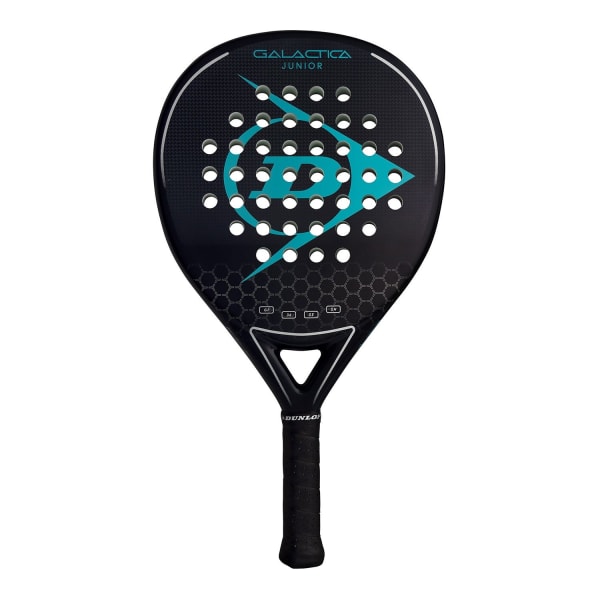
Dunlop Galactica Junior 2025
✓Cross-checked with official data from Dunlophow we score
PADELTESTLAB SCORE
0-100 scale
76/100
Price range
Description
Who this racket is for
Pros
- ✓The flexible fibreglass face over soft EVA rubber makes the ball come off the racket on its own during blocks and defensive volleys, exactly where a kid without a developed swing can't reach across the court The wide, centred sweet spot created by the teardrop shape with a 36mm frame forgives off-axis contact on wall exits, which is where most beginners misfire The soft core absorbs vibration from frame shots and off-centre hits, an important detail for wrists and elbows that are still growing At the low end of the range, 310g lets you lift the racket in time for bandejas and high volleys without dragging the arm up from below
Cons
- ✗The smooth surface and soft rubber limit bite: once a kid starts reaching for a cut bandeja or vibora, the spin falls short and the ball comes out flatter than intended The power ceiling arrives early; a player already driving a flat smash will find the racket cushioning the shot instead of accelerating it, leaving them short of depth 330g at the top of the range is still a lot of weight for a seven- or eight-year-old, so check the actual weight of the unit rather than just the range Low-density EVA compacts faster than a firmer core with daily use; in the hands of a junior training several times a week, it loses response within a season
PADELTESTLAB SCORE
0-100 scale
76/100
It is down 21% from its highest price: from €61.95 to €48.95. Tracked since July 17.
Prices collected on 39 days between July 17 and October 15
At 310-330 grams, with a fibreglass face and a 36mm frame, the Dunlop Galactica Junior 2025 lands in the kids' segment as the junior version of the Galactica line, aimed at 7-to-12-year-olds building their technique with a teardrop-shaped padel racket.
This isn't a toy with colourful graphics: the material choices answer a real problem in youth padel — the lack of arm speed needed to send the ball across the court.
Fibreglass and Junior Rubber: why the ball seems to leave the face on its own
Fibreglass flexes under impact far more than a carbon weave. That flex gives energy back to the ball, so the racket does part of the work instead of the player.
Underneath, the Junior Rubber — a soft-feel EVA — extends contact time. The ball sits on the face a fraction longer before leaving, and that split second is what lets a nine-year-old send a ball deep from their own back wall.
That same rubber does a second, less obvious job: filtering vibration. Frame shots and mishits reach the forearm heavily dampened, which matters when the joint is still developing.
The 36mm frame, narrower than what you'd find on an adult racket, helps keep the whole thing light and lets the chassis flex rather than kick back sharply.
What age and level is the Dunlop Galactica Junior 2025 built for?
This padel racket is designed for kids aged 7 to 12 in early stages or early technical development. Its light build, soft rubber and generous sweet spot are about getting the ball off the face with minimal effort, not about the player generating pace. An adult beginner will find the handle and balance too short.
Dunlop Galactica Junior 2025 specs
| Spec | Value |
|---|---|
| Shape | Teardrop |
| Weight | 310-330 g |
| Face | Fibreglass |
| Core | Soft EVA (Junior Rubber) |
| Frame | 36 mm |
| Surface | Smooth |
| Level | Beginner |
| Playstyle | All-round |
On court: blocks, wall exits and first volleys
This racket is best understood by what it takes off the player's plate rather than what it adds. On the block volley, with the ball arriving fast, the flexible face absorbs and returns it without the kid needing to grip hard — the ball clears the net instead of dying short.
On the wall exit, where most points are lost at lower levels, the teardrop's wide sweet spot earns its keep. Contact half a metre off-centre still comes out with direction, and that tolerance keeps the point alive instead of turning it into a dead ball.
On the defensive lob, the easy ball exit lets young players reach the back of the court from awkward positions, without needing the long swing that isn't yet automatic at that age.
The bandeja is where the seams start to show. The smooth surface and soft rubber don't do much to the ball: it comes out controlled and with height, but without the cut that makes it skid low off the glass. Fine for learning the motion, not for punishing with it.
Something similar happens on the flat smash. There's direction and there's height, but once the kid starts hitting with hip and shoulder, the core cushions exactly where it should transmit. The racket protects more than it punishes.
Where the Dunlop Galactica Junior 2025 falls short
The junior format comes at a cost. First is spin: with a smooth face, topspin and slice depend entirely on technique, and at this age the technique isn't there yet.
Second is a weight range that's easy to misread. 310-330g sounds light next to an adult racket, but 330g in a seven-year-old's hand is still 330g. It's worth checking the actual weight of the unit if the player is small or just starting out.
Third is core durability. Low-density rubber compacts under heavy training, and a club junior playing three days a week will feel it go soft and unresponsive before the grip even wears out.
When is it time to move on from the junior racket?
Three clear signs a player has outgrown this Dunlop option:
- They start smashing from position 3 looking to put the ball away, and the racket won't give them depth.
- They ask to cut the bandeja and the ball bounces up high and comfortable for the opponent.
- They're consistently hitting the sweet spot, so the extra forgiveness no longer adds anything.
Once all three show up, it's time to move up to an entry-level adult racket with a denser core, not keep stretching the junior format.
Verdict: a learning tool, not a competition racket
The Galactica Junior 2025 does the one thing a kids' beginner racket needs to do well: let a child sustain long rallies without getting hurt or frustrated. The mix of fibreglass, soft rubber and a light teardrop shape is calibrated for exactly that.
Anyone looking for a racket to carry them through their first competitions and handle already-developed power will find it lacking. But for the first step up from a borrowed club racket — with room for error and no punishment on the wrist — this is a solid, coherent choice.
In the brand's lineup
Within Dunlop's lineup, the Galactica Junior 2025 is one of the most accessible options starting at €48.95, perfect for getting started without a heavy outlay. At 76/100, it serves its purpose, though there are stronger alternatives on the market.
Frequently asked questions
Who is the Dunlop Galactica Junior 2025 for?
The Dunlop Galactica Junior 2025 is built for beginner level: easy to handle and forgiving. Not the ideal pick if you already have consolidated technique.
How much does the Dunlop Galactica Junior 2025 weigh?
The Dunlop Galactica Junior 2025 weighs 310-330g according to the manufacturer's stated specs.
What's the Dunlop Galactica Junior 2025's PadelTestLab score?
The Dunlop Galactica Junior 2025 scores 76/100 in our review, based on power, hardness, control, maneuverability, ball exit, sweet spot and surface roughness.
How much does the Dunlop Galactica Junior 2025 cost?
Current price of the Dunlop Galactica Junior 2025 is 48.95€, comparing 1 shop in our finder.
Similar alternatives
Other rackets with a similar profile and price range: