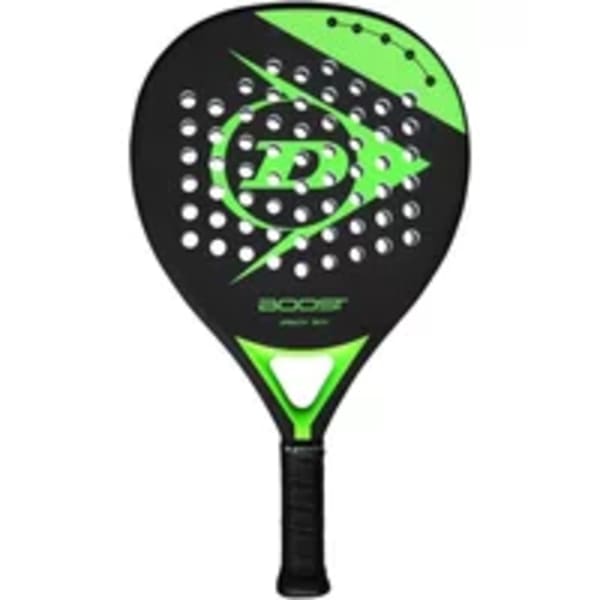
Dunlop Boost Attack 2.0
✓Cross-checked with official data from Dunlophow we score
PADELTESTLAB SCORE
0-100 scale
80/100
Price range
Description
Who this racket is for
Pros
- ✓The glassfibre face paired with medium-density Pro EVA gives the ball a real catapult effect: defensive lobs from the back of the court land deep without needing to muscle the shot. The rough Extra Grip finish genuinely bites into the ball, and it shows on the crosscourt vibora and the topspin smash to the back glass, which come off with real spin, not just raw pace. The sweet spot on this teardrop-shaped racket with a 38mm frame forgives off-centre contact on reflex volleys and rushed exits off the back wall, when you're not perfectly set. At 360-375g with an even balance, it moves fast at the net, letting you string together volleys and bandejas without arriving late to the ball or wrenching your wrist. The Power Frame concentrates flex right at the hitting zone, so the racket adds distance to your shots without demanding the polished ball-striking technique a hard core usually asks for.
Cons
- ✗Despite the "Attack" name, the flat smash off the back wall doesn't have the crisp, punchy response of a hard rubber: the ball comes off fast but lands lighter on the opponent's bounce. The glassfibre face filters out feel on contact, and short balls suffer for it: the dropshot and the sliced ball are trickier to dial in than with a carbon face. The even balance doesn't give advanced hitters the extra swing weight they want to really bury the smash; once you move up a level, it starts falling short.
PADELTESTLAB SCORE
0-100 scale
80/100
Since May 22 it has ranged between €83.00 and €154.00. Today it sits at €154.00.
Prices collected on 54 days between May 22 and October 15
Dunlop positions the Boost Attack 2.0 as a racket built to push players up a level: teardrop shape, glassfibre face, medium-density Pro EVA core, 38mm frame and 360-375g on the scale. The "Attack" name promises firepower, but on court it plays more balanced than the name lets on.
Where the power comes from: Power Frame meets glassfibre
The pop on this padel racket doesn't come from a hard core or a head-heavy balance — the weight distribution here is even — it comes from the flex of the whole package.
The Power Frame reinforces the perimeter of the 38mm frame so flex concentrates right at the hitting zone instead of spreading through the whole chassis. Less energy wasted in the frame, more returned to the ball.
Glassfibre does the rest. It compresses more than carbon on contact and releases that load with a catapult effect, so you don't need arm speed to send the ball deep. The medium-density Pro EVA backs up that compression without falling into the sluggish feel of softer cores.
On court, that translates into serious ball exit. The defensive lobe from the back of the court reaches deep without needing extra swing, and even a passive block volley comes out with depth.
Dunlop Boost Attack 2.0 spec sheet
| Spec | Value |
|---|---|
| Shape | Teardrop |
| Weight | 360-375g |
| Balance | Even |
| Face | Glassfibre |
| Core | EVA Medium (Pro EVA) |
| Frame | 38mm |
| Surface | Rough (Extra Grip) |
| Technologies | Power Frame, Extra Grip |
| Level | Intermediate |
| Playstyle | Power |
What level of player is the Dunlop Boost Attack 2.0 for?
It's built for the intermediate player who already places the ball well but hasn't yet built consistent power of their own. The glassfibre face and medium Pro EVA add extra distance to every shot without punishing the elbow or wrist, and the sweet spot of this teardrop shape forgives the off-centre contact that still crops up mid-match.
It's not the racket for the advanced power player chasing a crisp, heavy-hitting response: that calls for a harder core and a more head-heavy balance than this model offers.
Shot by shot: where it shines and where it falls short
- **Wall exit**: its best terrain. With a dead ball tight to the glass, the elastic face lifts the shot and clears the ball out of your own court without needing a full swing.
- **Bandeja**: comfortable and predictable. At 360-375g with even balance, you get to the contact point on time and finish the shot without the racket dragging on your arm.
- **Vibora and topspin smash**: this is where Extra Grip earns its keep. The rough surface bites into the ball and the topspin shot comes off with real bite toward the back glass.
- **Flat smash off the back wall**: it delivers, but without the crisp response of a hard rubber. It comes off fast but lands a touch lighter on the opponent's bounce.
- **Dropshot and sliced ball**: the weak point. The glassfibre face filters out feedback on contact, making short-distance shots harder to dial in.
- **Reflex volley**: quick to move and very forgiving on off-centre contact, useful when the ball arrives high with little reaction time.
Attack, Control and Lite: what the suffix changes across the Boost line
Dunlop builds all its Boost rackets on the same chassis and differentiates them by suffix. The Dunlop Boost Attack skews the build toward power; the Dunlop Boost Control leans into a more controlled touch; and the Dunlop Boost Lite trims weight for players after a lighter racket.
Choosing within the family means choosing a lean, not a different chassis: the base feel of the range stays constant, and what shifts is the balance between power and precision.
Three player profiles this racket suits
- The intermediate player who moves well to the net but comes up short on the defensive lob from the back of the court.
- Anyone coming from a soft round racket who wants more distance without jumping straight to a hard core.
- Anyone playing two or three times a week who needs a racket that won't punish the elbow.
As a doubles partner, it pairs well behind an aggressive net player: this Dunlop model handles the back-court defence and the deep lob with minimal effort and keeps the point alive until an attackable ball arrives.
Verdict: assisted power, not a pure power racket
The Boost Attack 2.0 delivers exactly what its build promises: strong ball exit, a generous sweet spot and comfortable handling within its 360-375g range. It adds distance for players who can't generate it on their own yet.
In exchange, it asks you to accept two trade-offs: less precision on short touch shots and less terminal weight on the flat smash. If your game leans on slicing, cutting and hunting your opponent's error with precision, the scales tip toward the Dunlop Boost Control instead. If distance is what you're missing, this is the right lean.
In the brand's lineup
Within dunlop's lineup, the boost attack 2.0 occupies the mid-range starting at €154, offering highly competitive value for its segment. With an overall score of 80/100, it's a solid choice within its price range.
Frequently asked questions
Who is the Dunlop Boost Attack 2.0 for?
The Dunlop Boost Attack 2.0 fits the intermediate level. Suited to players with a technical base who want to progress without jumping to a competition racket.
How much does the Dunlop Boost Attack 2.0 weigh?
The Dunlop Boost Attack 2.0 weighs 360-375g according to the manufacturer's stated specs.
What's the Dunlop Boost Attack 2.0's PadelTestLab score?
The Dunlop Boost Attack 2.0 scores 80/100 in our review, based on power, hardness, control, maneuverability, ball exit, sweet spot and surface roughness.
How much does the Dunlop Boost Attack 2.0 cost?
Current price of the Dunlop Boost Attack 2.0 is 154€, comparing 1 shop in our finder.
Similar alternatives
Other rackets with a similar profile and price range: