Babolat Viper 3.1 Juan Lebron 2027
✓Cross-checked with official data from Babolathow we score
PADELTESTLAB SCORE
0-100 scale
81/100
Price range
Description
Who this racket is for
Pros
- ✓The 3K carbon face and head-heavy balance give a crisp, punchy ball exit on x3 and x4 smashes, and the ball drives into the glass without you having to force the arm. The rough 3D Spin+ surface bites the ball on viboras and cut bandejas, so it comes off the glass with spin and is harder for your opponents to return with any advantage. The multilayer X-EVA core, with stiffer outer layers and softer inner ones, takes a little of the sting out of impact without losing the racket's firmness, which helps in long competitive matches. Dynamic Stability aims to steady the racket and channel power on full-commitment shots, helping keep the face stable on the wall rebound when you hit with intent.
Cons
- ✗With a head-heavy balance and 365-375 g, maneuverability is limited: on fast volleys at the net and in defence with little time to prepare, the racket arrives late and punishes you. The sweet spot is small and the 3K carbon face is hard: off-centre hits send vibration up the arm and the ball leaves without the direction you were after. Ball exit is controlled, so on blocks and passive defence the ball doesn't come off on its own; you have to accelerate the racket head, which is hard for anyone without a full swing.
PADELTESTLAB SCORE
0-100 scale
81/100
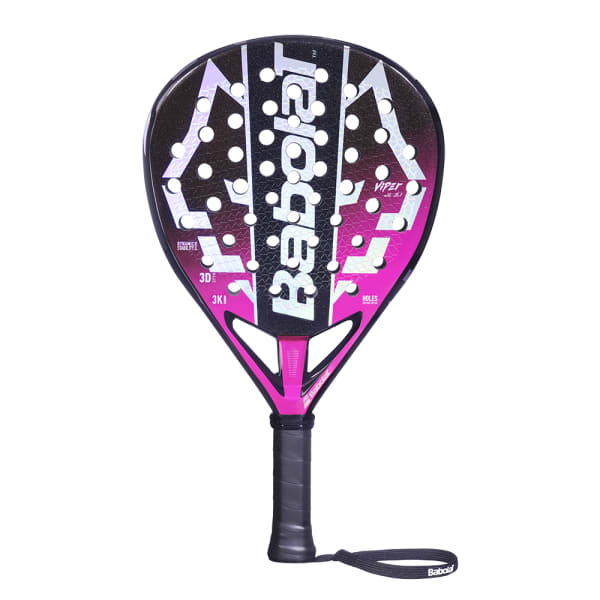
3K carbon, an X-EVA core, 365-375 g and a 38 mm frame: the Babolat Viper 3.1 Juan Lebron 2027 is built for the player who wants to close out points at the net, not for the one just trying to survive in defence. It carries Juan Lebron's signature and a rough 3D Spin+ surface you can feel on every sliced shot.
This is a competition-level padel racket with a diamond shape and a head-heavy balance. Everything about it pushes in the same direction: power on the smash and on the wall exit off a high ball.
Babolat Viper 3.1 Juan Lebron specs
| Spec | Value |
|---|---|
| Shape | Diamond |
| Balance | Head-heavy |
| Weight | 365-375 g |
| Face | 3K carbon |
| Core | X-EVA |
| Frame | 38 mm |
| Surface | Rough, 3D Spin+ |
| Level | Competition |
| Player | Juan Lebron |
| Year | 2027 |
Who is the Babolat Viper 3.1 Juan Lebron 2027 for?
It is aimed at advanced and competition players with solid technique and good fitness. It rewards the player who gets to the ball in time and swings with a loose arm: it returns plenty of energy on smashes and viboras, but it forgives little on mistimed shots and improvised defence.
If you're coming from a medium-balance racket, you'll notice the jump from the first few rallies. The head feels heavier, the shot comes off faster, and preparation errors are punished with balls that die in the net or sail long.
3K carbon and X-EVA core: where the dry, firm feel comes from
The 3K carbon face is stiff and passes on energy without damping it. In the hand that means a dry, firm feel: the ball leaves fast and the impact sounds clean, but more vibration reaches your arm than with a softer face.
The 3D Spin+ roughness makes up for some of that hardness with grip. On cut bandejas and viboras the ball bites and drops off the glass with spin, which lengthens the shot's path and makes life harder for your opponent's volley.
The X-EVA core works in layers: the stiffer outer layers give responsiveness on fast shots, while the softer inner ones take some of the harshness out of impact. Even so, the overall feel stays firm, with a controlled ball exit: the ball doesn't fly off by itself, so you have to accelerate the racket head.
The Holes Pattern System and the Smart Buttcap System round out the spec sheet. Dynamic Stability aims to steady the racket and channel power when you hit through the ball, which is welcome on the wall exit.
Smashes, viboras and bandejas: how this diamond plays on court
The smash is its home turf. With the head-heavy balance, the head follows the swing and the x3 smash comes off with pace, without needing an exaggerated whip. The x4 smash is possible, but it takes good footwork to get under the ball.
The vibora is where the stiff carbon and rough surface combine best: it comes off sliced, drops off the glass and dies short on the side wall. The bandeja works on the same logic, though it asks for more control over the ball's path so you don't hand your opponents easy balls.
Control is enough to build a point, but it isn't what this racket is about. Anyone who wants to place the ball with millimetre precision on every shot will find it a tougher tool to fine-tune.
Defence and volleys: where it takes its toll
In defence, the head weight and the small sweet spot penalise anyone who arrives late. A defensive lob from the back of the court needs you to push with your body rather than your wrist, because the racket won't give you any ball exit for free.
At the net, block volleys come off firm but slow to execute: switching quickly from forehand to backhand is harder than with a lower-balance racket. With time to prepare, the attacking volley is punchy; in point-blank exchanges, the racket arrives late.
What playing style and partner suit the Viper 3.1 Juan Lebron?
It suits attacking players who spend much of the match at the net and finish points with smashes or viboras. It works best with a partner who builds the point, keeps the ball low and leaves the final shot to whoever is holding this Viper.
- An advanced player with a good x3 smash and an aggressive vibora.
- Early preparation and quick feet, because the head-heavy balance doesn't forgive late arrivals.
- A healthy arm and shoulder: the hardness of the 3K carbon takes its toll if you already have niggles.
Verdict: a racket built to hit, with a comfort tax
The Babolat Viper 3.1 Juan Lebron 2027 delivers on what it promises: high power, a dry, firm feel and generous spin on sliced shots. In return, maneuverability is limited, the sweet spot is small and the hardness shows in the arm after long matches.
If your game is built on finishing at the net and you have the technique to control a racket with this profile, it's a coherent partner. If your matches are decided in defence or on the quick volley, this padel racket will ask more of you than it gives back.
In the brand's lineup
Within Babolat's lineup, the Viper 3.1 Juan Lebron sits at the premium tier starting at €389.95. It's a serious investment, but justified if you want top-tier materials and peak performance. Its overall score of 81/100 places it among the best power rackets we've reviewed.
Frequently asked questions
Who is the Babolat Viper 3.1 Juan Lebron 2027 for?
The Babolat Viper 3.1 Juan Lebron 2027 is a competition or pro-level racket. It demands refined technique and physical condition — not for getting started.
How much does the Babolat Viper 3.1 Juan Lebron 2027 weigh?
The Babolat Viper 3.1 Juan Lebron 2027 weighs 365-375g according to the manufacturer's stated specs.
What's the Babolat Viper 3.1 Juan Lebron 2027's PadelTestLab score?
The Babolat Viper 3.1 Juan Lebron 2027 scores 81/100 in our review, based on power, hardness, control, maneuverability, ball exit, sweet spot and surface roughness.
How much does the Babolat Viper 3.1 Juan Lebron 2027 cost?
Current price of the Babolat Viper 3.1 Juan Lebron 2027 is 389.95€ – 390€, comparing 2 shops in our finder.
Similar alternatives
Other rackets with a similar profile and price range: