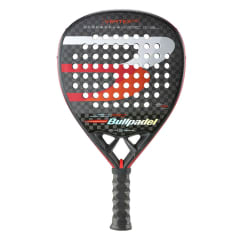
Babolat Technical Viper 2025
✓Cross-checked with official data from Babolathow we score

PADELTESTLAB SCORE
0-100 scale
82/100
Price range
Description
Who this racket is for
Pros
- ✓12K carbon face returns hit energy with barely any give: on first-line smashes and flat overheads the ball comes off with a speed and line that's tough for a defender to neutralise; 3D SPIN+ bites harder on cut bandejas and viboras, closing the spin down into a real weapon off any high ball from the back; VIBRABSORB SYSTEM2 damps frame vibration on off-centre hits, making this noticeably kinder on the arm than most 12K rackets through a smash-heavy, high-pressure match; and the SMART BUTTCAP lets you pull and refit the safety cord tool-free.
Cons
- ✗The head-heavy balance and stiff 12K face demand you're set before contact — get to the ball late from the back and you'll lose your line and load the elbow more than a glass-fibre face would; a high-balance diamond like this rewards early preparation, so anyone needing extra time to get the racket into position will drop more points than they would with a round or teardrop shape; and the 12K's stiffness magnifies off-centre mishits, so players with a history of tennis elbow or tendinitis should look at a softer-faced racket first.
PADELTESTLAB SCORE
0-100 scale
82/100
Since March 20 it has ranged between €89.95 and €179.95. Today it sits at €174.85.
Prices collected on 115 days between March 20 and October 15
Babolat Technical Viper 2025: 12K carbon for attackers who won't give an inch
When Babolat reworked the Viper line for 2025, the brief was simple: build a racket that turns every net position into a point and every bandeja into a genuine weapon. The Babolat Technical Viper 2025 delivers exactly that, no apologies — diamond shape, 12K carbon face, X-EVA core and a 38mm profile that doesn't pretend to be anything other than what it is.
12K carbon, X-EVA and VIBRABSORB SYSTEM2: the technical trio behind the feel
The 12K carbon face is this racket's headline argument. Twelve thousand filaments per carbon tow make for a stiffer face than the 3K used further down the Viper range, though it stops short of the outright extremes of an 18K or 24K tour racket. On court you feel it in how fast the racket gives the energy back: the ball comes off with real conviction, none of the give you get from glass-fibre or hybrid carbon-glass faces.
Babolat's X-EVA core is a multi-layer, cross-linked EVA at medium-high density. Hitting bandejas from mid-court, the feel is solid but never dead metal — there's enough feedback to adjust the racket face angle at the last split-second without the shot blowing up on you. This is EVA tuned to transfer energy with judgement, not just raw output.
VIBRABSORB SYSTEM2 works independently in the frame structure. 12K carbon tends to send more vibration up the arm than softer materials, and VIBRABSORB acts as a passive filter on every strike — especially the ones that miss dead centre. Over a long match packed with smashes, that difference adds up, and your arm will thank you for it.
3D SPIN+ and shot-defining bite
The 3D SPIN+ surface isn't a paint-deep gimmick — it's genuine geometric texturing on the face that boosts friction on ball contact. On the vibora, on spin smashes and on cut bandejas from mid-court, that extra grip on the face translates into tighter, harder-to-read spin from the back. Arrive at the ball with speed and this technology pays off in full; arrive slow or at a bad angle, and it won't save you.
How the Babolat Technical Viper 2025 performs shot by shot
Smash and bandeja: its natural habitat
The head-heavy diamond shape snaps the smash arc through quickly. From the net with time to set up, flat smashes come off clean and direct. Bandejas get the most out of 3D SPIN+ and the 12K's stiffness together — the ball grips the face and leaves with enough bite that the bounce off the back wall goes somewhere your opponent won't expect.
Defence and the back court: preparation is non-negotiable
The Technical Viper 2025 doesn't forgive being late. Defending from the back, the head-heavy balance punishes hesitation: if your arm isn't ahead of the ball at contact, the shot climbs higher than intended and the line goes with it. Players with solid defensive mechanics — a clean technical lob, a controlled globo — adapt fast. Anyone who relies on wrist to bail out a bad wall read will feel it from the first few points of the warm-up.
Net play and pressure volleys
On first-strike volleys, the X-EVA gives a predictable response that lets you calculate the exit without surprises. VIBRABSORB earns its keep when the ball comes in hot off the back wall and you need to take pace off it without giving up position. Short-timing volleys are this racket's real test: give it even a fraction of a beat to load and it responds well; ask it to absorb and redirect in one reactive motion and it will push back.
Who should buy the Babolat Technical Viper 2025?
Where it shines: - Advanced players running a predominantly attacking game from the net - Attackers chasing power and spin in the same shot without sacrificing recognisable touch - Anyone already used to carbon rackets looking for a step up in response without losing directional control - Pairs happy to concede a little defensively in exchange for a dominant net presence
Who should look elsewhere: - Players with a history of elbow or shoulder injuries: the 12K face and head-heavy balance place more joint demand across a long match than a glass-fibre carbon racket - Anyone who regularly builds the point from the back court; this racket wants you attacking, not defending - Intermediate players moving up from fibreglass: the jump in weight management is significant and will likely cost you points during the first few months of adjustment
Verdict on the Babolat Technical Viper 2025: attack or get punished
The Babolat Technical Viper 2025 is a 12K carbon racket built for established attackers who want power with genuine spin control. Its biggest strength is the 12K + 3D SPIN+ + X-EVA combination: instant response and real face grip on smashes and bandejas. Its biggest catch, shared by any head-heavy diamond, is that arriving late to the ball costs you both direction and joint load. If your points are won at the net, this racket works with you; if you build from the back court, the Babolat Counter Viper 2025 or the Veron family offer a more balanced profile.
What's the difference between 12K and 3K carbon in a padel racket?
The K number refers to filaments per carbon tow — more filaments, a stiffer tow. The 12K face on the Technical Viper 2025 returns energy faster than a 3K, with less flex on impact. In practice that means higher ball exit speed and less forgiveness on off-centre hits, where the stiffness amplifies every mishit.
Is the Babolat Technical Viper 2025 suitable for players with tennis elbow?
VIBRABSORB SYSTEM2 structurally filters out some vibration and reduces arm load compared with an undamped 12K racket, but the head-heavy balance and stiff face are still more demanding than glass-fibre or hybrid carbon-glass options. With a history of tennis elbow, a softer-faced, lower-balance racket would be the safer pick.
What weight should you buy the Babolat Technical Viper 2025 in?
The published range runs 355 to 375g. Players with a strong physical swing and good muscular endurance get more out of the top end of the range (370-375g), maximising energy transfer on the smash. Those who prioritise wrist speed and quick hands at the net will feel more at home at the lower end (355-360g), where the diamond shape loses a touch of swing weight but gains agility in fast exchanges.
In the brand's lineup
Within babolat's lineup, the technical viper occupies the mid-range starting at €174.85, offering highly competitive value for its segment. Its overall score of 82/100 places it among the best power rackets we've reviewed.
Frequently asked questions
Who is the Babolat Technical Viper 2025 for?
The Babolat Technical Viper 2025 targets advanced players. It needs consolidated technique and is not recommended for beginners.
How much does the Babolat Technical Viper 2025 weigh?
The Babolat Technical Viper 2025 weighs 355-375g according to the manufacturer's stated specs.
What's the Babolat Technical Viper 2025's PadelTestLab score?
The Babolat Technical Viper 2025 scores 82/100 in our review, based on power, hardness, control, maneuverability, ball exit, sweet spot and surface roughness.
How much does the Babolat Technical Viper 2025 cost?
Current price of the Babolat Technical Viper 2025 is 174.85€ – 179.95€, comparing 2 shops in our finder.
Similar alternatives
Other rackets with a similar profile and price range: