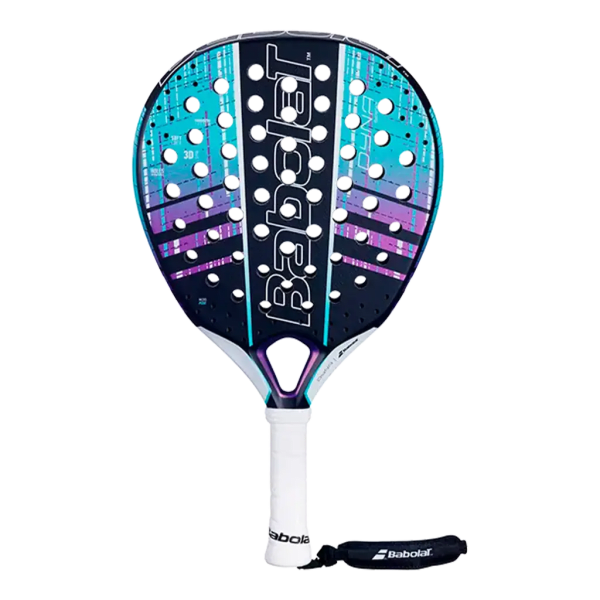
Babolat Dyna Spirit
✓Cross-checked with official data from Babolathow we score
PADELTESTLAB SCORE
0-100 scale
82/100
Price range
Description
Who this racket is for
Pros
- ✓The Soft EVA core paired with the 36mm Microperf frame practically returns the ball for you on defensive lobs and low wall exits, no arm acceleration needed That lightness (320-340g) translates into fast block volleys and re-volleys: you're first to the second ball at net when heavier rackets are still turning The 3D Spin texture on the fiberglass face bites into the ball on cut bandejas and viboras, generating enough kick to send the bounce toward the back glass SMAC filters vibration from the off-center sweet spot, and the wide sweet spot of the perforated frame forgives low-arc or late-reaction hits HPS adds precision on the serve return and wall exits: the ball goes where you aim it, not where the racket decides
Cons
- ✗The soft core hits a ceiling on the flat smash for 3: if you're looking to close out points with raw power, the ball comes off higher and with less penetration than you'd expect At 320-340g with a medium balance, wind and heavy-hitting opponents can win the battle on high volleys — there's just not enough mass to block without giving ground Fiberglass scuffs and wears faster than a carbon face if you're smashing hard against the mesh or brushing the back glass on defense An advanced player who already hits hard will hit the power ceiling quickly and miss a denser rubber
PADELTESTLAB SCORE
0-100 scale
82/100
It is at its lowest price since we started tracking it: €89.95, down from €144.82. We began recording on May 20.
Prices collected on 72 days between May 20 and October 15
Babolat Dyna Spirit Review: A Lightweight 36mm Teardrop Built for Net Play
The Babolat Dyna Spirit is a teardrop-shaped padel racket with a medium balance and just 320-340g of weight, built with a fiberglass face, Soft EVA core and a 36mm Microperf frame. Babolat developed it alongside the Babolat Dyna Energy as one of its lightest padel rackets, aimed at dynamic, fast-moving players who close out points at the net.
That combination — low weight, soft rubber, perforated profile — defines everything this racket does well, and everything it doesn't.
What Does the 36mm Microperf Actually Do?
The holes in the frame aren't just cosmetic. By shaving weight off the frame's perimeter and redistributing mass, the sweet spot grows and the racket tolerates off-center hits without the ball dying on contact.
On a teardrop shape with a medium balance, that effect pulls double duty: it keeps the naturally higher, center-weighted feel of the shape intact, while still forgiving mishits low on the face.
Then there's SMAC, the vibration-dampening system. On mishits — a ball skidding off the wall with weird spin, a mistimed volley — what reaches your arm is a dull thud rather than the sharp jolt you'd get from a stiffer frame.
Soft EVA: Why the Ball Practically Leaves the Racket on Its Own
The core is a low-density EVA, and that's where this Babolat gets its personality. The rubber compresses on impact and sends the ball back with a very generous ball exit — you don't need to accelerate your arm to send a lob deep.
That shows up in three specific situations:
- **Low wall exits**, with the ball skimming close to the ground: the racket lifts it without you having to force your wrist.
- **Defensive lobs from the back**, where a denser rubber demands a full swing but this one gets there with half the effort.
- **Chiquitas and drop shots**, because the soft rubber absorbs the incoming ball's speed instead of springing it back.
The trade-off is an honest one: the flat smash for 3 doesn't come off with the penetration you'd get from a denser rubber. The ball bounces high and comes back. If your way of finishing points is raw power, this isn't your racket.
3D Spin and Fiberglass: Spin Over Power
The face is fiberglass with a 3D Spin texture, a three-dimensional grip pattern that bites into the ball on contact.
On a cut bandeja, that translates into a flatter ball that dies against the back glass. On the vibora, the grip lets you open up the angle with confidence, since the sidespin comes from the texture rather than from swinging harder.
Fiberglass also flexes more than carbon. That extends the feel of the ball on the face — contact lasts a fraction longer — at the cost of a less crisp response when you're going for the kill shot.
HPS rounds out the package on the precision side: on the serve return and wall exits, direction stays reliable, something very soft rackets often lose.
Babolat Dyna Spirit Specs
| Spec | Value |
|---|---|
| Shape | Teardrop |
| Weight | 320-340g |
| Balance | Medium |
| Face | Fiberglass with 3D Spin texture |
| Core | Soft EVA (low-density EVA) |
| Frame | 36mm with Microperf |
| Level | Intermediate |
| Playstyle | All-court |
| Technologies | Microperf, 3D Spin, Smart Buttcap, SMAC, HPS |
Who Should Play With the Babolat Dyna Spirit?
The Babolat Dyna Spirit suits intermediate-level players with a net-based game, who win points through placement and hand speed rather than raw power. The 320-340g weight allows for quick second and third volleys where a heavier racket would already be lagging behind.
It's also a solid fit for players coming back from elbow or shoulder injuries: the combination of soft rubber, fiberglass and SMAC is one of the more forgiving setups on the joints.
It's not a fit for advanced-level big hitters. The power ceiling shows up quickly, and that low weight costs you on high volleys against heavy-hitting opponents, where there simply isn't enough mass to block without backing up.
Best Doubles Pairing
It works best alongside a partner running a more powerful racket, someone who can take on the smash for 3 and the flat overhead while the Dyna Spirit handles rhythm, bandejas and angled finishes.
Dyna Spirit vs. Dyna Energy: Same Family, Different Job
Babolat designed the Dyna Spirit alongside the Babolat Dyna Energy as part of a line built for fast, dynamic play finished off at the net. These are sibling models, not tiers of the same racket — worth demoing both if you're torn, since the choice comes down to rubber feel rather than which one ranks higher.
Verdict: Maneuverability and Forgiveness Over Raw Power
What this padel racket does well, it does very well: the ball exits on its own, off-center hits are forgiven, it turns fast at net and generates spin with minimal effort.
What it doesn't do is finish points with brute force or stand up to heavy-hitting opponents. The 36mm Microperf frame and Soft EVA core are tuned for tolerance, not punishment.
If your on-court problem is arriving late to the volley or an arm that's paying the price, the Babolat Dyna Spirit is the answer. If your problem is the ball not reaching the baseline, look elsewhere.
In the brand's lineup
Within babolat's lineup, the dyna spirit is one of the most accessible options starting at €89.95, perfect for getting started without a heavy outlay. Its overall score of 82/100 places it among the best all-round rackets we've reviewed.
Frequently asked questions
Who is the Babolat Dyna Spirit for?
The Babolat Dyna Spirit fits the intermediate level. Suited to players with a technical base who want to progress without jumping to a competition racket.
How much does the Babolat Dyna Spirit weigh?
The Babolat Dyna Spirit weighs 320-340g according to the manufacturer's stated specs.
What's the Babolat Dyna Spirit's PadelTestLab score?
The Babolat Dyna Spirit scores 82/100 in our review, based on power, hardness, control, maneuverability, ball exit, sweet spot and surface roughness.
How much does the Babolat Dyna Spirit cost?
Current price of the Babolat Dyna Spirit is 89.95€ – 129.95€, comparing 2 shops in our finder.
Similar alternatives
Other rackets with a similar profile and price range: