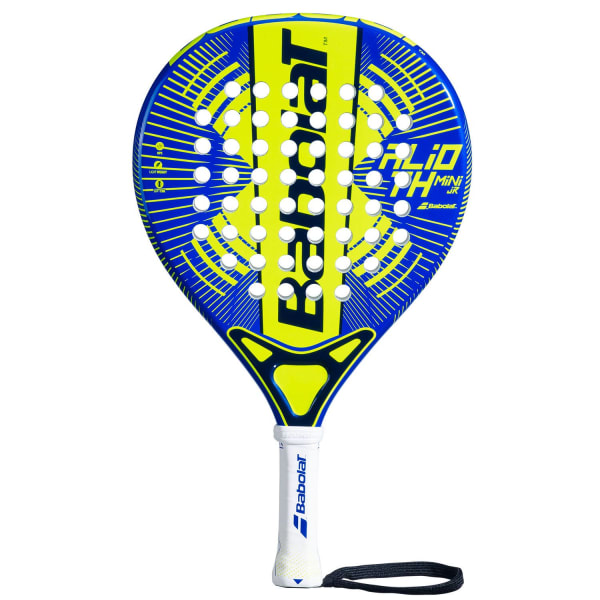
Babolat Alioth Mini Júnior Azul/Amarillo
✓Cross-checked with official data from Babolathow we score
PADELTESTLAB SCORE
0-100 scale
77/100
Price range
Description
Who this racket is for
Pros
- ✓The soft foam core sends the ball back without needing arm speed — kids can serve and clear a lob from the back of the court even with a swing that's still a work in progress At 290-300g with a low balance, the racket gets to rushed wall exits in time and lets a young player correct their grip mid-point without ever feeling stuck The glass fibre face widens the margin for error — off-centre hits near the frame still find direction instead of dying in the net Improver Grip on a reduced handle puts the hand in the right position from day one, heading off bad habits that later choke the bandeja The soft build and smooth finish cushion the impact, no small thing for wrists and elbows that are still developing
Cons
- ✗The power ceiling arrives early — as soon as a kid picks up arm speed, the foam eats the energy and smashes fall short The smooth surface barely bites the ball, so early attempts at a cut bandeja or vibora come out with no real spin Blocking fast volleys, the soft setup loses some directional precision next to a stiffer face The reduced grip and 290-300g weight fall short once a player outgrows 8 years old — this is a tool with a built-in shelf life
PADELTESTLAB SCORE
0-100 scale
77/100
It is at its lowest price since we started tracking it: €45.95, down from €89.15. We began recording on March 20.
Prices collected on 97 days between March 20 and October 15
Designing for a seven-year-old's arm flips every priority on its head, and the Babolat Alioth Mini Júnior commits to that from the moment it hits the scale: 290-300 grams, glass fibre face, foam core, low balance and the Improver Grip system on a reduced-size handle.
No carbon, no aggressive texture, no intention to hit hard. This is a padel racket built purely so the ball comes off easily and a kid can actually finish the swing.
Who is the Babolat Alioth Mini Júnior built for?
It's aimed at players under 8 who are just starting out in padel. The 290-300g weight, low balance and enlarged sweet spot let kids complete the swing without tiring out and still make contact even when the hit lands well off-centre. Think of it as a control and learning racket, not a performance one.
Glass fibre over foam: why this racket forgives the mishit
Glass fibre is the most flexible face material used in padel, and that flex is exactly what a player who isn't generating real racket-head speed needs. The face bends on contact and gives back a good chunk of that energy for free, which explains this racket's notably easy ball exit.
The foam core pulls in the same direction. It's a soft, low-rebound compound built for absorption — it takes the sting out of the impact before it ever reaches the wrist or elbow, which matters on joints that are still developing.
That same softness sets the ceiling. Foam swallows energy once the swing gets fast, so the power cap on this racket is real and it shows up sooner than most parents expect.
The smooth finish rounds out the profile. It adds predictability — the ball leaves where the face points — but it sacrifices the bite you need to genuinely cut a bandeja or lift a wall exit.
| Spec | Value |
|---|---|
| Weight | 290-300 g |
| Balance | Low |
| Face | Glass fibre |
| Core | Foam |
| Surface | Smooth |
| Level | Beginner |
| Playstyle | Control |
| Technology | Improver Grip |
On court: lobs, volleys and the first bandejas
Defence is where this racket makes the most sense. The low balance keeps the mass down in the handle, so the head doesn't drag — a kid can reach a rushed wall exit, adjust their grip at the last second, and still have time to push the lob back up.
The defensive lob carries deep without forcing anything, and that's the shot that keeps a point alive at beginner level. That mix of maneuverability and ball exit is really the whole selling point of this racket.
At net, blocking volleys works well — the flexible face sends the ball back without needing a firm wrist. Against a fast ball, though, the soft build gives up a bit of directional precision compared to a stiffer face.
The bandeja is where the learning happens. With so little weight in the head, the racket doesn't drag the arm down, letting kids finish the motion up and over the shoulder — which is really all that matters at this age. Real cut and slice will come with a different racket down the line: the smooth surface just doesn't grip the ball enough to bite it.
The flat smash is off the table entirely. This isn't a Babolat model built to put a ball away or hunt the exit through the back fence, and trying to force it just breeds frustration.
Improver Grip and the reduced handle: the detail that matters most long-term
The reduced-size grip isn't a cosmetic tweak. A child's hand on a standard handle can't close its fingers properly, and it ends up compensating with a frying-pan grip that blocks the continental grip entirely.
The Improver Grip system guides finger placement into that correct position from the very first session. It's the difference between a player who picks up the bandeja in two weeks at age twelve and one who spends a year unlearning a bad habit.
What this racket won't give you
- Power: the ceiling is low and shows up as soon as a kid's arm speeds up.
- Spin: with no texture on the face, slice and topspin are token at best.
- Longevity: the weight and handle size get outgrown past age 8.
- That crisp, solid feel: players who already hit hard will want something firmer.
Verdict: a tool with an expiry date, and that's exactly the point
The Alioth Mini Júnior does the one job it needs to do: remove the physical barriers so a kid can repeat the swing over and over without pain or fatigue. Glass fibre and foam buy forgiveness and easy ball exit at the cost of power and spin — a fair trade when the goal is technique, not results.
The common mistake is buying a lightweight adult racket thinking it'll last longer. At 290-300 grams with a reduced handle, this model fits the body using it today; once it stops fitting, it's time to move on — and that moment is proof it did its job.
In the brand's lineup
Within Babolat's lineup, the Alioth Mini Júnior is one of the most accessible options starting at €45.95, perfect for getting started without a heavy outlay. At 77/100, it serves its purpose, though there are stronger alternatives on the market.
Frequently asked questions
Who is the Babolat Alioth Mini Júnior Azul/Amarillo for?
The Babolat Alioth Mini Júnior Azul/Amarillo is built for beginner level: easy to handle and forgiving. Not the ideal pick if you already have consolidated technique.
How much does the Babolat Alioth Mini Júnior Azul/Amarillo weigh?
The Babolat Alioth Mini Júnior Azul/Amarillo weighs 290-300g according to the manufacturer's stated specs.
What's the Babolat Alioth Mini Júnior Azul/Amarillo's PadelTestLab score?
The Babolat Alioth Mini Júnior Azul/Amarillo scores 77/100 in our review, based on power, hardness, control, maneuverability, ball exit, sweet spot and surface roughness.
How much does the Babolat Alioth Mini Júnior Azul/Amarillo cost?
Current price of the Babolat Alioth Mini Júnior Azul/Amarillo is 45.95€ – 59.95€, comparing 2 shops in our finder.
Similar alternatives
Other rackets with a similar profile and price range: