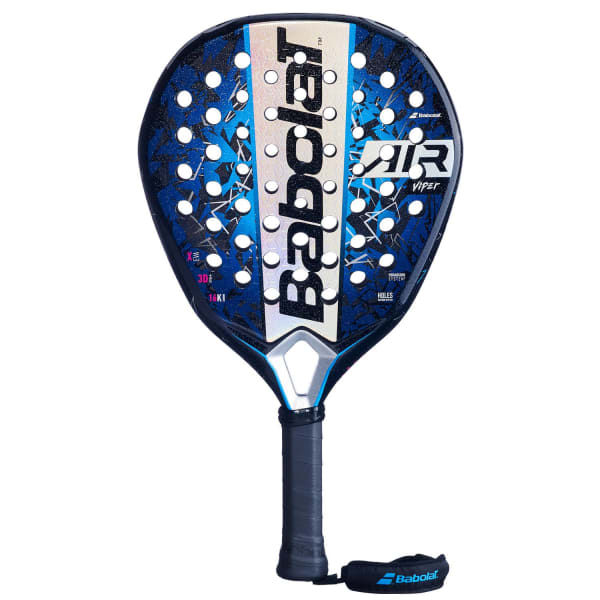
Babolat Air Viper 2025
✓Cross-checked with official data from Babolathow we score
PADELTESTLAB SCORE
0-100 scale
83/100
Description
Who this racket is for
Pros
- ✓The 16K carbon face responds with a crisp, direct snap on smashes off the third and flat bandejas, transferring the shot's energy without the deflection you get from lower-K constructions. The 3D Spin+ texture lets you generate real bite on cut bandejas and viboras even from awkward positions: the geometric surface grips the ball far more consistently than a smooth face would. The Vibrabsorb system filters out frame vibration on off-centre hits and wall exits, easing the load on your forearm through long matches without dulling the feedback on contact. The medium balance makes the Air Viper noticeably easier to handle at the net than other high-balance 16K carbon rackets, without giving up exit speed on the smash.
Cons
- ✗The reactive X-EVA core won't cushion the ball on defence: from very open positions or under pressure, the fast exit speed forces you to anticipate the contact point and punishes late timing. The 38mm profile and the stiffness of the 16K carbon make life hard on low, flat volleys with a short backswing — this racket wants a proper backswing that narrower control-profile rackets simply don't demand.
PADELTESTLAB SCORE
0-100 scale
83/100
Out of stock right now
None of the shops we track has it in stock right now. We last saw it on October 13 at €251.95.
See similar rackets in stockThe Air Viper 2025 Isn't Just a Technical With Less Carbon
The Babolat Air Viper 2025 weighs between 345 and 365 grams, runs 16K carbon on the face and an X-EVA core with a 38mm profile. It's Babolat's play for the advanced player who wants power without taking on the demanding timing window of an extreme-balance racket.
The Air prefix in the Viper line doesn't dial back the materials — it still keeps the 16K carbon face — it shifts the balance to a more neutral point that gives the player extra margin to set up the shot. The result is a power racket with a more forgiving tolerance for error than its higher-balance siblings.
16K Carbon + X-EVA: The Two Materials That Define Its Character
The 16K carbon on the face is a dense-weave construction: 16,000 filaments per tow. That translates into high structural stiffness, a crisp response on contact and direct energy transfer into the shot. The ball doesn't sink into the face — it comes off clean, especially on smashes from the third and flat bandejas where the arm is already loaded.
Beneath that face, the X-EVA is Babolat's medium-to-high density cross-linked EVA rubber. It doesn't sit passively — it gives the ball back with energy and rewards racket-head speed. Feed it a soft, unloaded shot and the core won't manufacture power out of nothing.
Together they define a clear character: a racket that rewards the attacking player, with a wider margin for timing error than a denser EVA core would allow.
How the Babolat Air Viper 2025 Performs on Court
Smash and Bandeja: Where the 16K Carbon Takes Over
On the flat overhead smash, the 16K face responds with real firmness. The ball comes off fast and direct, with minimal face deformation. Vibrabsorb widens the effective sweet spot by soaking up some of the frame's vibration on slightly off-centre hits — the sweet spot feels more generous than the raw materials would suggest.
On the bandeja, the 3D Spin+ earns its keep. The geometric texture grips the ball through the contact window and lets you generate spin without over-manipulating the wrist. It works on cut bandejas, defensive viboras and any shot where the angle isn't perpendicular to the ball's exit line.
Defence and Wall Exits: Where the X-EVA Core Gets Demanding
The reactive core is also the clearest limitation on defence. The ball isn't absorbed — it comes back with energy, which means you have to anticipate the contact point. Defending from very open positions, especially on a high kick off the side wall, the exit can run long if your timing is even slightly early.
Vibrabsorb eases the load on the forearm on off-centre hits, protecting the arm on forced defensive shots and improving the feel of control when contact isn't dead centre on the face. But the racket's character stays power-first: it won't turn a defensive shot under pressure into a soft, controlled touch.
At the Net and on Volleys
The medium balance and 345-365g weight range make the Air Viper 2025 more manageable at the net than its 16K face might suggest. High volleys arrive with plenty of time, and the smash-volley at the net holds up well.
Low, flat volleys with a short backswing are where the 38mm profile and carbon stiffness demand minimal preparation. Players who build their game around soft touch at the net will notice the racket asks for more of a backswing than narrower control-profile options require.
When the Air Viper 2025 Rewards You — and When It Doesn't
It performs best in the hands of advanced players with an offensive baseline game: attacking, hitting bandejas, smashing from position three and looking for depth on the shot. It particularly suits players who want to keep the power of a stiff carbon racket without losing defensive reaction time.
It's not the right pick for: - Players with active epicondylitis who need maximum vibration absorption: the X-EVA is reactive, not a comfort-first core. - Players who prioritise soft touch at the net over pace. - Players who don't load the arm on the smash: the Air Viper won't add power to a passive shot.
What Level Is the Babolat Air Viper 2025 Built For?
It's calibrated for advanced level: players with consolidated technical shots and the timing needed to get the most out of the 16K carbon and the X-EVA core. The learning curve is gentler than the higher-balance versions in the Viper line, but this isn't a racket for someone still building their technique — the timing demands on defence are real, and the reactive core won't help a passive shot.
Air Viper 2025: Power With an Honest Margin for Error
The Babolat Air Viper 2025 is a power racket with a more accessible profile than its construction would suggest. The 16K carbon gives a crisp, direct response; the X-EVA adds reactivity without going to the extreme of a high-density EVA core. Its biggest win is the medium balance in a stiff-face format: it lets you hit hard without giving up manoeuvrability on defence. The most honest caveat: feed it an unloaded ball and the core won't manufacture power for you. This is a racket for attackers, not for players who like to wait and counter.
What Does the Air Prefix Add to Babolat's Viper Line?
The Air prefix marks out the version of the Viper line with a more neutral balance. It doesn't mean lower-grade materials — the Air Viper 2025 still runs the 16K carbon face — it means a weight distribution built for players who want power with more tolerance for timing errors and better manoeuvrability on defence.
In the brand's lineup
Within Babolat's lineup, the Air Viper positions itself as a distinctive alternative. Its overall score of 83/100 places it among the best power rackets we've reviewed.
Frequently asked questions
Who is the Babolat Air Viper 2025 for?
The Babolat Air Viper 2025 targets advanced players. It needs consolidated technique and is not recommended for beginners.
How much does the Babolat Air Viper 2025 weigh?
The Babolat Air Viper 2025 weighs 345-365g according to the manufacturer's stated specs.
What's the Babolat Air Viper 2025's PadelTestLab score?
The Babolat Air Viper 2025 scores 83/100 in our review, based on power, hardness, control, maneuverability, ball exit, sweet spot and surface roughness.
Similar alternatives
Other rackets with a similar profile and price range: