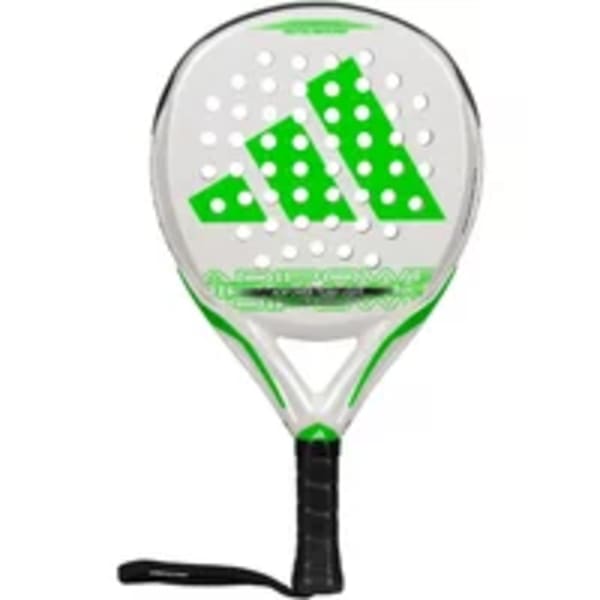
Adipower Team Light 3.3
✓Cross-checked with official data from Adidashow we score
PADELTESTLAB SCORE
0-100 scale
82/100
Description
Who this racket is for
Pros
- ✓The fiberglass face over Soft Performance EVA produces an exceptionally long ball exit on defense: lobs from the back of the court come out deep without needing to accelerate the arm. With a low balance and 45.5 cm length, it gets to blocked volleys with the head already set; in fast mid-court exchanges the hand speed doesn't beat you. The 460 cm² hitting surface concentrates a wide sweet spot: bitten balls off the back wall still come out with direction even when you make contact near the frame. The rough surface with Spin Blade grips the ball on the cut bandeja and on the vibora, letting you open angles with sidespin without relying on raw speed. The Dual Exoskeleton holds a soft setup together: despite the medium-density EVA and the flexible face, the 38mm frame never feels loose on the third-shot serve.
Cons
- ✗The power ceiling is low: on the smash for the point, all the pace has to come from you, because the face flexes and doesn't give back free depth. Against very tense balls the fiberglass absorbs part of the energy instead of rebounding it, so a flat smash needs clean technique to really hurt. The rough surface wears smooth with court hours, and the extra grip Spin Blade provides on spin shots fades sooner than on stiffer finishes. It's labeled for advanced level, but advanced players who build their game around finishing at the net will find little reward here: its territory is the long point.
PADELTESTLAB SCORE
0-100 scale
82/100
Out of stock right now
None of the shops we track has it in stock right now. We last saw it on August 1 at €118.98.
See similar rackets in stockWithin the Adipower 2024 generation, the adidas adipower team light 3.3 delivers one of the least aggressive combinations in the brand's lineup: round shape, low balance, 345-360g, 38mm frame and a rough fiberglass face with Spin Blade technology. Inside sits a medium-density Soft Performance EVA core.
That spec sheet already tells most of the story: this is a padel racket built to sustain the point, not to end it in one shot.
Fiberglass and Soft Performance EVA: why this racket forgives so much
Fiberglass flexes more than premium rigid faces. On impact, the face dips for a few extra milliseconds, the ball stays on the string bed longer, and it leaves with a long, clean trajectory.
That has a direct payoff: the padel racket returns depth almost on its own on defensive shots, and filters out a good chunk of the vibration that would otherwise reach your elbow.
The Soft Performance EVA reinforces the same idea. It's a medium-feel core, closer to plush than to crisp, that cushions the impact and extends the contact time instead of firing the ball back instantly.
The Dual Exoskeleton keeps that soft package from getting out of hand. It works as the structural skeleton of the 38mm frame, keeping the face locked in place even on off-center or max-speed hits.
The Power Embossed Ridge, textured onto the hitting surface, adds the bite that a flexible face naturally lacks: it grips the ball on contact and helps it not fall short.
Is the adipower team light 3.3 a power racket?
No. It's a control racket with a very generous ball exit. The fiberglass face and medium-density core trim the power ceiling compared to stiffer builds, and in exchange deliver a wide sweet spot, soft touch and deep return with minimal arm effort.
Shot-by-shot behaviour: 460 cm² working in your favor
Off the back wall. This is its real strength. With a 460 cm² hitting surface and an extended sweet spot, balls that bite off the wall don't die: they keep their direction even when contact isn't perfect.
Volley and block. The low balance keeps mass close to the grip. The racket turns faster than you'd expect and lets you correct the face angle at the last instant, which pays off on body shots.
Bandeja. The 45.5 cm length and round shape put the sweet spot exactly where the cut shot makes contact. It comes out comfortable, with height, without demanding pinpoint timing.
Vibora. The rough surface with Spin Blade is what carries this shot. The grip lets you close the angle with sidespin without needing extreme racket speed.
Smash. This is where the model hits its limit. With a low balance and a face that flexes, directional control is plentiful, but the pop off the glass won't match an attacking racket.
Tech specs
| Spec | Value |
|---|---|
| Shape | Round |
| Weight | 345-360g |
| Balance | Low |
| Level | Advanced |
| Play style | Control |
| Face | Fiberglass |
| Core | Soft Performance EVA (medium density) |
| Frame | 38mm |
| Surface | Rough |
| Hitting surface | 460 cm² |
| Length | 45.5 cm |
| Technologies | Dual Exoskeleton, Spin Blade, Power Embossed Ridge |
Who should actually be playing with this adidas racket?
It's marketed as advanced-level, but for a specific profile within that level: the player who wins points through construction rather than raw pace.
It's a particularly strong fit for:
- **Backhand-side players** who defend off the wall and need the ball to come out deep even when their wrist is compromised.
- **Anyone with a history of elbow or shoulder issues**, thanks to the combined cushioning of the fiberglass and soft core.
- **Quick hands at the net** who prioritize volleys, blocks and change of pace over the winning smash.
- **Players coming off a stiff, dry-feeling racket** looking to cut joint load without losing directional precision.
As a pairing, it works well alongside a high-balance partner who takes on the finishing shots: this racket covers the back of the court, holds up in the rally, and sets up the high ball.
What you won't get from this racket
The hitting ceiling is the tradeoff for everything else. Against very tense balls, the face absorbs energy rather than returning it, and a flat smash needs clean mechanics to do real damage.
The rough finish isn't forever either: as the surface polishes down, the extra grip on spin shots fades and the kick effect loses some of its bite.
Verdict: an honest round racket that knows exactly what it is
The adipower team light 3.3 does precisely what its build promises. It's forgiving on off-center hits, easy to handle at net, comfortable on the joints, and highly reliable in the defensive zone of the court.
If your game is built around finishing points at the net, this isn't your racket and you'll feel it in the first match. If it's built around not missing, moving your opponent around and waiting for the short ball, this model will win you more points than anything the other side is hitting harder with.
In the brand's lineup
Within adidas's lineup, the adipower team light 3.3 positions itself as a distinctive alternative. Its overall score of 82/100 places it among the best control rackets we've reviewed.
Frequently asked questions
Who is the Adipower Team Light 3.3 for?
The Adipower Team Light 3.3 targets advanced players. It needs consolidated technique and is not recommended for beginners.
How much does the Adipower Team Light 3.3 weigh?
The Adipower Team Light 3.3 weighs 345-360g according to the manufacturer's stated specs.
What's the Adipower Team Light 3.3's PadelTestLab score?
The Adipower Team Light 3.3 scores 82/100 in our review, based on power, hardness, control, maneuverability, ball exit, sweet spot and surface roughness.
Similar alternatives
Other rackets with a similar profile and price range: