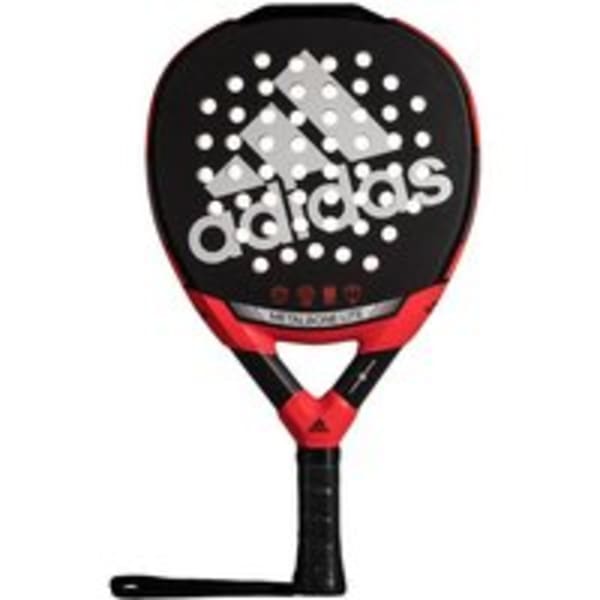
Adidas Metalbone Lite
✓Cross-checked with official data from Adidashow we score
PADELTESTLAB SCORE
0-100 scale
77/100
Description
Who this racket is for
Pros
- ✓The fibreglass-and-Soft-Performance-EVA combo gives you instant ball exit: on a blocked volley the ball comes off fast without you needing to add any arm speed of your own The Smart Holes Curve widens the sweet spot for a diamond shape, so smashes struck a couple of centimetres above centre still come out with usable direction The 38 mm frame with Octagonal Structure feels less rigid than the carbon-built Metalbone rackets, cutting down vibration on cut bandejas and off-centre contact The sandpaper-style rough surface bites into the ball on víbora and pinchada shots, giving extra grip that shows up whenever you want the bounce to die against the back glass At a 360 g minimum weight, a head-heavy diamond racket becomes manageable even if you've never played this shape before
Cons
- ✗That head-heavy balance still costs you in defence: on a low wall exit with your body closed off you need to prepare earlier, or the head arrives late and the lob falls short The soft EVA cushions part of the impact and takes bite off a flat smash; if you're a pure hitter chasing a dead ball, you'll feel the racket eating your pace Fine net play isn't its strong suit: on dejadas and mid-height volleys it's hard to dose the shot because the ball comes off with more energy than you're asking for At 375 g, the top end of the range, three-set matches will punish your shoulder if you don't have the physical conditioning behind you
PADELTESTLAB SCORE
0-100 scale
77/100
Out of stock right now
None of the shops we track has it in stock right now.
See similar rackets in stockadidas Metalbone Lite Review: The Forgiving 360-375 g Diamond Racket
The adidas Metalbone Lite (2022) is the friendlier read on the Metalbone family: same oversize diamond shape, same attacking intent, but built with a fibreglass face instead of the carbon layers found on its siblings. The result is a padel racket weighing 360-375 g, with a 38 mm frame and a Soft Performance EVA core that lowers the technical bar without giving up aggressive hitting.
That's the key to understanding this model: it's not less powerful by accident — it's deliberately less demanding.
Why Fibreglass Changes the Metalbone's Personality
Carbon responds dry: it gives back exactly what you put in and nothing more. Fibreglass does the opposite. It's a more elastic material, it flexes on impact and returns energy as the ball leaves the face.
On court that means the ball practically exits on its own. You don't need arm speed to send it deep — the face does the work for you. That's the difference between a racket that amplifies your swing and one that partially does it for you.
The Soft Performance EVA core pulls in the same direction. It's a soft compound that compresses easily, extends dwell time on the ball, and filters out much of the vibration a 38 mm diamond frame typically sends up to your elbow.
adidas Metalbone Lite: Specs
| Spec | Value |
|---|---|
| Shape | Diamond |
| Weight | 360-375 g |
| Balance | Head-heavy |
| Level | Advanced |
| Playstyle | Power |
| Face | Fibreglass |
| Core | Soft Performance EVA |
| Frame | 38 mm |
| Surface | Rough (sandpaper-style) |
| Tech | Octagonal Structure, Smart Holes Curve |
Smart Holes Curve: Solving the Diamond's Sweet Spot Problem
A diamond shape stacks mass up top and punishes mishits: catch the ball off-centre and it either dies or flies long. Smart Holes Curve tackles that by redistributing the face's usable zone to widen the sweet spot inside an oversize frame.
It doesn't turn a diamond into a round racket — that trick doesn't exist — but it does stretch the margin for error. On a smash by post 3, where contact usually lands above the racket's axis, the Metalbone Lite holds its line on shots that a stiffer diamond would send astray.
The Octagonal Structure works on top of the 38 mm frame, spreading structural stiffness more gently than a conventional profile. Off-centre contact feels cushioned rather than dead and bouncy.
Who Should Actually Buy This Racket?
Short answer: the advanced, attack-minded player who wants a diamond racket but doesn't have — or doesn't want to grind for — the technique and physicality a rigid carbon diamond demands. It's built for the player who crashes the net to close out points and needs the racket to back them up on off days.
More specifically, it suits three profiles:
- **The moderately aggressive player** stepping up from a teardrop or round shape who wants to try the diamond format without the jump in stiffness.
- **The hard hitter with elbow issues** who needs a soft core and a frame that filters vibration.
- **The attacking side of a pair** who smashes and blocks volleys at net, but doesn't live off a flat 200 km/h smash.
It's not the right fit if you're chasing surgical net control or if your game runs on dejadas and changes of pace: that lively ball exit works against you when what you actually want is to dose the shot.
Shot-by-Shot Breakdown
Smash and víbora. This is where it shines. The head-heavy balance drives the head through and the rough surface bites just enough for the víbora to kick and open up. The soft core takes some bite off the flat smash — don't expect a dead, sticking ball — but on the smash by post 3 and on kick serves the package delivers.
Bandeja. The widened sweet spot and the core's cushioning make the cut bandeja feel comfortable even on a slightly mistimed hit. This is where the Lite separates most from a rigid Metalbone.
Defence and wall exits. The weak link. The head-heavy balance forces early preparation; get caught out on a low wall exit and the head arrives late, sending the lob short. The 360 g low end of the weight range helps, but it can't erase the physics of the shape.
Volleys. Fast, deep blocked volleys come easily. The dejada volley is trickier: the ball comes off with more pace than you're asking for.
Verdict
The Metalbone Lite nails a specific brief: an attacking diamond racket that doesn't punish you for imperfect technique. It delivers some of the most generous ball exit you'll find in this shape, and the trade-off is finer control than you'd get from a balanced racket.
If your game is built around attacking and you need margin for error, it's a sound buy. If you want carbon's dry, precise response to finish points with the racket rather than the arm, this isn't the model in the family you're looking for.
In the brand's lineup
Within adidas's lineup, the metalbone lite positions itself as a distinctive alternative. At 77/100, it serves its purpose, though there are stronger alternatives on the market.
Frequently asked questions
Who is the Adidas Metalbone Lite for?
The Adidas Metalbone Lite targets advanced players. It needs consolidated technique and is not recommended for beginners.
How much does the Adidas Metalbone Lite weigh?
The Adidas Metalbone Lite weighs 360-375g according to the manufacturer's stated specs.
What's the Adidas Metalbone Lite's PadelTestLab score?
The Adidas Metalbone Lite scores 77/100 in our review, based on power, hardness, control, maneuverability, ball exit, sweet spot and surface roughness.
Similar alternatives
Other rackets with a similar profile and price range: