ADIDAS MATCH 3.4 White/Blue 2027
✓Cross-checked with official data from Adidashow we score
PADELTESTLAB SCORE
0-100 scale
79/100
Description
Who this racket is for
Pros
- ✓The fibreglass and Soft Performance EVA combo soaks up shock on off-centre contact, which you'll notice on rushed defensive volleys and blocks before your technique is fully grooved Ball exit is seriously generous: on defensive lobs from the back you barely need to accelerate your arm, the racket does most of the work getting the ball out of your court The wide sweet spot of the teardrop shape forgives high and low contact points, so block volleys keep their depth even when you're not catching it dead centre At 345-360g with a medium balance it moves quickly at net during fast exchanges: reaching a crosscourt backhand volley doesn't demand an early split-step or exaggerated prep Smart Holes Lineal and the structural reinforcement keep the 38mm frame stable on wall exits, where a softer racket would normally lose its shape
Cons
- ✗The soft EVA caps out early: push a flat smash for pace on a high bounce and the ball comes out heavier rather than faster, so you won't be finishing points on power alone Control is solid for this level, but it doesn't give the precise feedback a víbora cut to the middle demands; the face doesn't 'talk' much when you're hunting fine angles A player who already hits with real pace will find the fibreglass face falls short next to a carbon face in terms of response — the racket will start to feel soft within a few months The 345-360g range puts some units close to the upper limit; if you're coming from a lighter racket, check the exact weight before buying
PADELTESTLAB SCORE
0-100 scale
79/100
Out of stock right now
None of the shops we track has it in stock right now.
See similar rackets in stockAdidas Match 3.4 White/Blue 2027 Review: The Soft Teardrop Padel Racket Built for Your First Year
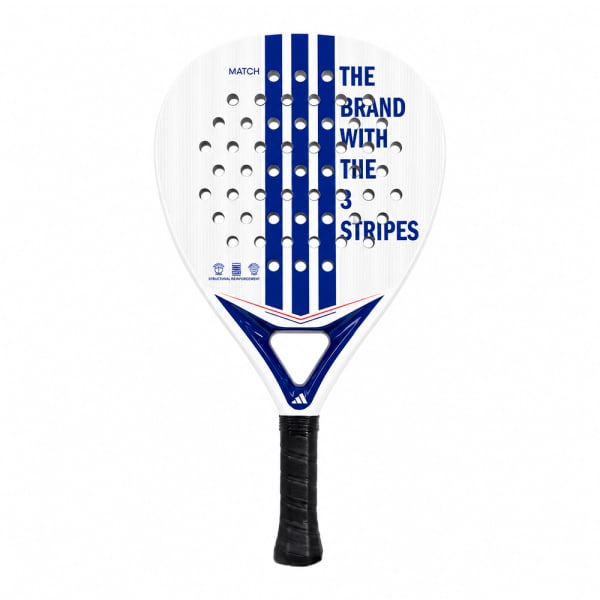
The Adidas Match 3.4 White/Blue 2027 is a beginner-friendly teardrop-shaped padel racket with a 38mm frame, fibreglass face and Soft Performance EVA core, in a 345-360g weight range with medium balance. Everything about this padel racket points the same direction: effortless ball exit that spares your arm the bill.
It's an honest proposition. No carbon face, no talk of raw power — just a hybrid build designed so a player still grooving their technique can play two hours without a sore elbow to show for it.
Adidas Match 3.4 White/Blue Specs
| Spec | Value |
|---|---|
| Shape | Teardrop |
| Weight | 345-360 g |
| Balance | Medium |
| Face | Fibreglass |
| Core | Soft Performance EVA |
| Frame | 38 mm |
| Technologies | Smart Holes Lineal, Structural Reinforcement |
| Level | Beginner |
| Year | 2027 |
Who Is This Adidas Racket Actually For?
Beginners, full stop, no hedging. The Match 3.4 White/Blue is built for players with anywhere from a few months to a couple of seasons on court, who aren't yet centring the ball consistently and need the racket to cover for those mishits rather than punish them.
The fibreglass-plus-soft-EVA pairing is the category standard for a mechanical reason: both materials flex more than carbon and firm EVA, and that flex bleeds off impact energy before it reaches the wrist and elbow. The trade-off is crisp feedback, but a beginner doesn't need that yet.
Fibreglass + Soft Performance EVA: What It Actually Feels Like
The fibreglass face has a recognisable signature: it gives slightly on contact and sends the ball back with a soft, almost cushioned touch. The Soft Performance EVA core amplifies that, stretching out dwell time on the strings — which is exactly what creates that sensation of the ball 'sitting' on the face half a second longer than expected.
That blend is behind this racket's biggest selling point: ball exit. On a defensive lob from the back of the court you don't need to accelerate your arm or complete a full swing — the racket lifts and clears the ball with a short, compact motion. Same story on service returns, where getting depth stops being a technical headache.
The 38mm frame and structural reinforcement counterbalance all that softness. A frame that thick with structural reinforcement stops the racket flexing too much on wall exits, which is exactly where an overly soft racket loses direction and sends the ball into the back glass. Smart Holes Lineal arrange the perforation pattern on the face to keep the hitting zone consistent.
Shot-by-Shot Breakdown
Volleys. The wide sweet spot earns its keep here more than anywhere else. A backhand block volley caught slightly off-centre still holds its depth; on a racket with a narrow sweet spot, that same contact falls short and hands over the net.
Bandeja. Easy to execute. The 345-360g weight with medium balance lets you carry the racket overhead without effort, and the cut motion comes out clean — though the ball comes off soft and low-bouncing compared to a stiffer face.
Smash. This is where the ceiling shows. The soft EVA caps out early, so a flat smash hunting pace won't finish the point: the ball comes out heavy, not fast. Closing out points with this racket depends more on placement than raw power.
Defence and wall exits. Favourable ground. The manoeuvrability lets you correct late, and the reinforced frame holds up when the ball comes off the glass with nothing on it.
Víbora. The shot this racket handles worst. A víbora cut to the middle needs precise feedback from the face to fine-tune the angle, and this face doesn't give much: you know you've made contact, just not exactly where.
When Will You Outgrow the Match 3.4?
When you actually start hitting with intent. The tell is feeling the racket 'sink' on smashes, with the pace of the rally outrunning the face's response. That usually happens once your ball-striking stabilises and you start chasing speed over safety.
Until then, jumping too early into a carbon racket with a hard core usually makes your game worse: smaller sweet spot, less ball exit, more strain on the joints.
Player Profile and Ideal Partner
- **Beginners still building their technique.** This is the core audience — the racket supplies what their stroke is still missing.
- **Players with a history of elbow or wrist issues.** The fibreglass-and-soft-EVA combo is one of the kinder options on the market for joint protection.
- **Baseline players who lob and wait for the error.** The teardrop shape with generous ball exit suits a patient, grinding game.
It's not a fit for a player who already smashes with intent, or anyone looking to close points on power. As a doubles partner, it pairs well alongside a stiffer racket that takes on the finishing role while this one holds the point from the back.
Verdict
The Adidas Match 3.4 White/Blue delivers exactly what its category promises: maximum ease of use, a wide sweet spot and joint protection, in exchange for power and fine control. The teardrop shape with medium balance gives it a bit more punch on the smash than a pure round racket, but the soft core sets the ceiling before that ever really matters.
It's a smart buy for your first or second year on court, with a shelf life that's limited by design: the day your game levels up, this racket will let you know.
In the brand's lineup
Within Adidas's lineup, the Match 3.4 White Blue positions itself as a distinctive alternative. With an overall score of 79/100, it's a solid choice within its price range.
Frequently asked questions
Who is the ADIDAS MATCH 3.4 White/Blue 2027 for?
The ADIDAS MATCH 3.4 White/Blue 2027 is built for beginner level: easy to handle and forgiving. Not the ideal pick if you already have consolidated technique.
How much does the ADIDAS MATCH 3.4 White/Blue 2027 weigh?
The ADIDAS MATCH 3.4 White/Blue 2027 weighs 345-360g according to the manufacturer's stated specs.
What's the ADIDAS MATCH 3.4 White/Blue 2027's PadelTestLab score?
The ADIDAS MATCH 3.4 White/Blue 2027 scores 79/100 in our review, based on power, hardness, control, maneuverability, ball exit, sweet spot and surface roughness.
Similar alternatives
Other rackets with a similar profile and price range: