Adidas Drive 3.3 Blue 2024
✓Cross-checked with official data from Adidashow we score
PADELTESTLAB SCORE
0-100 scale
82/100
Description
Who this racket is for
Pros
- ✓The low-density Soft Performance EVA core delivers near-automatic ball exit — on block volleys and lobs from the back of the court, you don't need to accelerate your arm to reach the opposite wall With a 519 cm² hitting surface and round shape, the sweet spot covers almost the entire usable face: off-centre two-handed backhands and mistimed wall exits still come out with direction The low balance and 45.5 cm length let the racket spin quickly in the wrist, which pays off on fast cross-court volleys and when you need to correct a bandeja dropping in on top of you The rough fibreglass surface bites into the ball just enough to add slice on the bandeja, without the extreme abrasiveness that chews through new balls in a couple of matches The Structural Reinforcement adds localised stiffness in the impact zone, killing that sinking feeling you get when you finally connect a clean smash
Cons
- ✗With controlled power and a soft rubber, the flat smash from the back of the court runs out of steam — if you're looking to smash for the line or close out points with a dry vibora, this isn't the racket for it The 38 mm profile with a soft core cushions so much that advanced players lose tactile feedback when blocking fast-paced balls; the ball leaves the face before you feel it At 360-375 g, the weight range isn't strictly light for a true beginner — if you're starting from zero with no physical conditioning, your arm will feel it by the second set The round shape with low balance shifts mass toward the grip and sacrifices swingweight — as your level goes up, you'll notice the racket runs out of punch on finishing shots
PADELTESTLAB SCORE
0-100 scale
82/100
Out of stock right now
None of the shops we track has it in stock right now. We last saw it on May 7 at €49.90.
See similar rackets in stockAdidas Drive 3.3 Blue 2024: 519 cm² of Forgiveness for Players Still Learning the Ropes
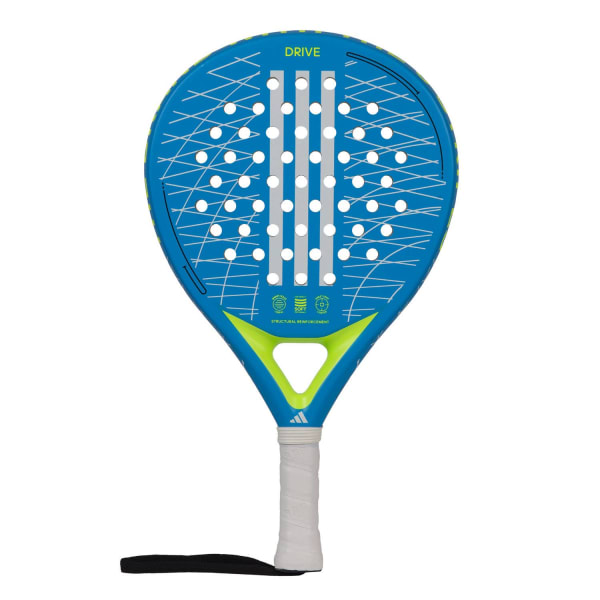
The Adidas Drive 3.3 Blue 2024 is a round-shaped padel racket with a fibreglass face, Soft Performance EVA core, 360-375 g weight range, 38 mm frame and a 519 cm² hitting surface. That last figure drives the whole spec sheet: it's a generous surface that turns off-centre contact — the single most common mishit for anyone with under two years on court — into a playable ball instead of a lost point.
This isn't a racket chasing highlight-reel smashes. It's built to keep the rally alive.
Who Should Actually Buy the Adidas Drive 3.3 Blue?
Beginners on the way up. The mix of a fibreglass face, low-density Soft Performance EVA rubber and a low balance produces a padel racket that asks very little technically and gives back plenty in tolerance: the sweet spot sits centred and wide, and ball exit stays strong even at low racket-head speed.
If you're already smashing for the line with intent or closing points with a vibora, this Adidas model will feel short on firepower. It's built for the stage before that.
Spec Sheet
| Spec | Value |
|---|---|
| Shape | Round |
| Weight | 360-375 g |
| Balance | Low |
| Face | Fibreglass |
| Core | Soft Performance EVA |
| Frame | 38 mm |
| Hitting surface | 519 cm² |
| Length | 45.5 cm |
| Surface texture | Rough |
| Level | Beginner |
| Playstyle | Control |
| Technologies | Structural Reinforcement, Smart Holes Linear, Octagonal Structure |
Fibreglass + Soft EVA: Why the Ball Practically Exits on Its Own
Fibreglass is more flexible than carbon and flexes more on contact. Paired with a low-density EVA core like Soft Performance, the combo behaves like a small trampoline: it absorbs the ball, flexes, and fires it back with its own added pace.
On court, that translates into something very tangible. On a block volley, when your opponent attacks hard and all you do is put the racket in front of the ball, it still reaches the back wall without you needing to add any swing. On a defensive lob from the corner, even with your body out of position, you keep finding depth.
The trade-off for that assistance is feel. The soft rubber filters out feedback: on very fast balls, you get less precise information about exactly where and how you made contact. A mid-to-high-level player will miss that read.
The Drive 3.3's Three Technologies, Explained
- **Structural Reinforcement** — added stiffness in the zone that absorbs the hardest impacts. Its job here is compensatory: it stops a 38 mm frame with a soft core from feeling spongy the moment you finally connect a shot with real pace.
- **Smart Holes Linear** — a linear hole pattern that boosts surface performance and extends the racket's lifespan. On a beginner-oriented model, where off-centre hits are constant, durability isn't a minor detail.
- **Octagonal Structure** — an octagonal frame structure that works alongside the same tension-distribution logic across the hitting surface.
Shot-by-Shot Breakdown
Wall exit. This is where it shines brightest. The low balance lets you make last-instant adjustments if the ball comes off wider than expected, and the wide hitting surface bails out hits toward the tip.
Bandeja. The rough surface bites just enough to impart slice and keep the ball low after the bounce. It's not aggressive sandpaper, but the friction is real, letting you work slice from day one.
Volley. Quick through the hands thanks to the 45.5 cm length with mass close to the grip. It swings well for cross-court angles and for correcting the trajectory mid-shot.
Smash. The weak link. Power is deliberately capped, and the flat smash ends up at the mercy of the opposing defence. This racket wants you to build the point, not end it in one shot.
Long defensive rallies. At 360-375 g, this sits in the mid-to-upper weight range for a beginner racket. Across three-set matches with plenty of defensive balls, the forearm ends up feeling it.
Verdict: A Learning Tool, Not a Finishing One
The Adidas Drive 3.3 Blue delivers exactly what it promises. It forgives off-centre contact, keeps the ball in play, and lets you start working on slice without punishing still-raw technique. That's a coherent, honest profile.
What it won't do is grow with you once your level climbs. The moment you start chasing finishing shots — smashing for the line, vibora, kick serve — you'll hit the power ceiling of the fibreglass face and soft EVA core, and feel the head lacking swingweight.
As part of a pair, it works better in the building-and-defending role than the finisher's spot. If your partner closes out points and your job is to avoid errors and place the lob, this racket does exactly that job.
In the brand's lineup
Within Adidas's lineup, the Drive 3.3 Blue positions itself as a distinctive alternative. Its overall score of 82/100 places it among the best control rackets we've reviewed.
Frequently asked questions
Who is the Adidas Drive 3.3 Blue 2024 for?
The Adidas Drive 3.3 Blue 2024 is built for beginner level: easy to handle and forgiving. Not the ideal pick if you already have consolidated technique.
How much does the Adidas Drive 3.3 Blue 2024 weigh?
The Adidas Drive 3.3 Blue 2024 weighs 360-375g according to the manufacturer's stated specs.
What's the Adidas Drive 3.3 Blue 2024's PadelTestLab score?
The Adidas Drive 3.3 Blue 2024 scores 82/100 in our review, based on power, hardness, control, maneuverability, ball exit, sweet spot and surface roughness.
Similar alternatives
Other rackets with a similar profile and price range: