
Choosing the right padel racket can seem complicated with so many options on the market. This guide will help you understand the key factors to find your ideal racket.
Note: Some links on this page are affiliate links. This does not affect the price or our opinion.
Index
1. Your skill level
The most important factor. A racket unsuitable for your level can hinder your progress or even cause injuries.
Beginner
If you're just starting, you need a control racket with a round shape and low balance. These rackets have a wide sweet spot that forgives errors and helps you develop your technique. Recommended budget: €60-120.
Intermediate
You already master basic techniques and are looking for more versatility. Teardrop shaped rackets with medium balance are ideal. They offer a good balance between control and power. Recommended budget: €120-200.
Advanced/Competition
You can choose based on your style: diamond shape for power, round for control, or teardrop for balance. Premium materials make the difference. Budget: €180-300+.
2. Racket shape
How shape affects your game:
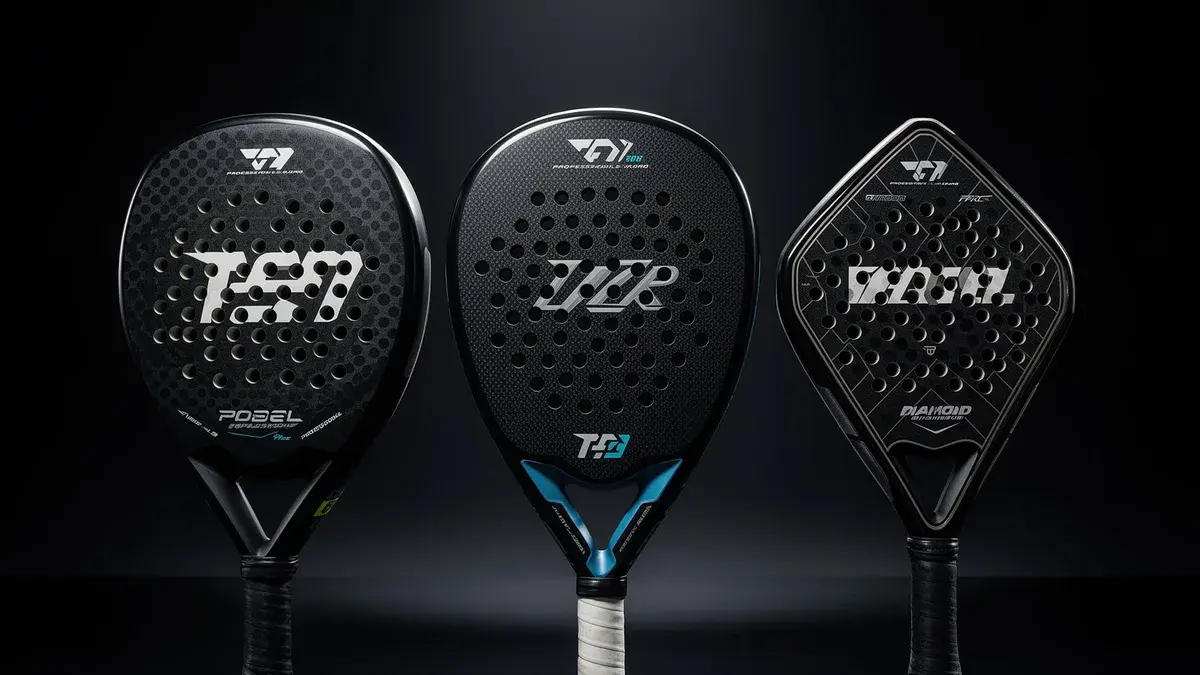
Round
Ideal for: Control and precision
Balance: Low
Sweet spot: Wide
Recommended for: Beginners and control players
Teardrop (Hybrid)
Ideal for: Control-power balance
Balance: Medium
Sweet spot: Medium
Recommended for: Intermediate and versatile advanced players
Diamond
Ideal for: Maximum power
Balance: High
Sweet spot: Small
Recommended for: Advanced players with good technique
3. Weight and balance
Weight
Standard weight ranges from 345g to 385g:
- 340-355g: More maneuverability, less power
- 355-370g: Ideal balance
- 370-385g: More stability and power, requires more strength
Balance
Indicates where the weight is concentrated:
- Low: More control and handling
- Medium: Versatile
- High: More power in smashes
4. Material hardness
How hardness affects your game:
Soft
Control: Maximum
Ball exit: Better
Comfort: Very comfortable for the arm
Ideal for: Elbow problems
Medium
Control: Balanced
Power: Balanced
Popularity: The most chosen option
Ideal for: Versatile players
Hard
Power: Maximum
Ball exit: Lower
Technique: Requires good level
Ideal for: Advanced players
5. Special considerations
If you have elbow problems
Choose soft rackets with a good anti-vibration system. Round rackets with low balance also help reduce arm strain.
If you come from tennis
You'll probably feel comfortable with control rackets at first, as your technique and sensitivity are already developed.
If you play frequently
Invest in a higher quality racket. In the long run, a good racket that takes care of your arm is an investment in your health.
Final tip
The best racket is the one that adapts to YOUR game, YOUR level and YOUR budget. Don't just be swayed by the racket your favorite player uses. If possible, try before you buy, or start with an affordable racket and level up as you improve.